Home Blog Page 18

CBSA Opens Nearly 200 Extortion Investigations in Greater Toronto, Deports 17 Foreign Nationals

0

CBSA Opens Nearly 200 Extortion Investigations in Greater Toronto, Deports 17 Foreign Nationals

The Canada Border Services Agency (CBSA) has opened 196 immigration investigations in the Greater Toronto Area linked to extortion crimes, the agency announced Thursday, with 33 removal orders issued and 17 people already deported.

National Scope of the Crackdown

Across Canada, the CBSA has launched a total of 484 immigration investigations as of June 18. Authorities have issued 139 removal orders currently being enforced, and 81 individuals have been removed from the country.

Regional breakdowns show the scale of the enforcement effort. In British Columbia and Yukon, 150 investigations have been opened, 69 removal orders issued, and 46 people removed. In the Prairies, 138 probes are underway, with 37 removal orders issued and 18 individuals deported.

Extortion Wave Targets South Asian Communities

The surge in extortion activity has been a growing concern for several years, particularly in Greater Toronto and British Columbia, where South Asian communities have been disproportionately targeted.

In the Peel Region alone, police have reported at least 37 shootings since last fall, with residents facing threats of violence and demands for large sums of money, often followed by shootings at properties or arsons.

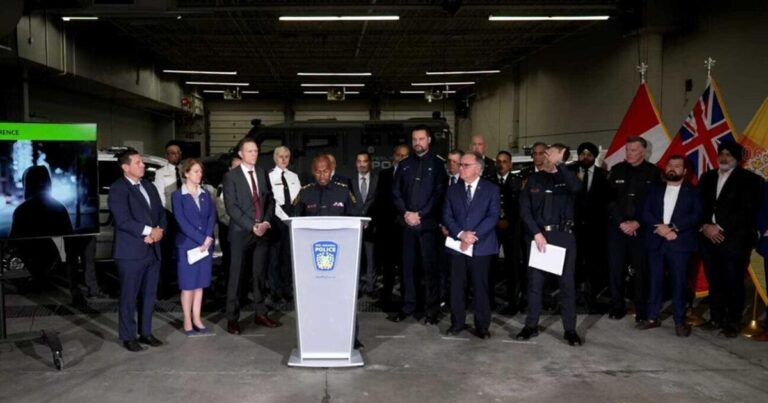
Last month, the Peel Regional Police Extortion Task Force arrested five men allegedly connected to a gang known as For Brothers, with ties to Surrey, B.C., and Edmonton.

Cross-Border Enforcement Partnerships

Since August 2024, the CBSA has intensified its immigration enforcement efforts by embedding with local police through joint task forces. Under this model, police flag individuals suspected of immigration violations and refer cases to the CBSA for investigation and potential removal.

Peel Regional Police have also partnered with law enforcement agencies across Canada and the FBI in the United States as part of a broader transnational investigation into extortion-related crimes.

Public Safety Minister Gary Anandasangaree, who oversees the CBSA, framed the crackdown in terms of public safety. “Canadians deserve to feel safe in their homes, workplaces and communities,” he said. “We continue to take strong action by strengthening enforcement, investing in our partners, and ensuring that those who exploit or endanger others are held accountable.”

How to Report Information

The CBSA is asking the public to help identify individuals who may be inadmissible to Canada. Tips can be submitted through the agency’s online tip line or by calling toll-free at 1-888-502-9060.
Saskatchewan Venezuelans Rally Support After Deadly Earthquakes Strike Home Country

0

Saskatchewan Venezuelans Rally Support After Deadly Earthquakes Strike Home Country

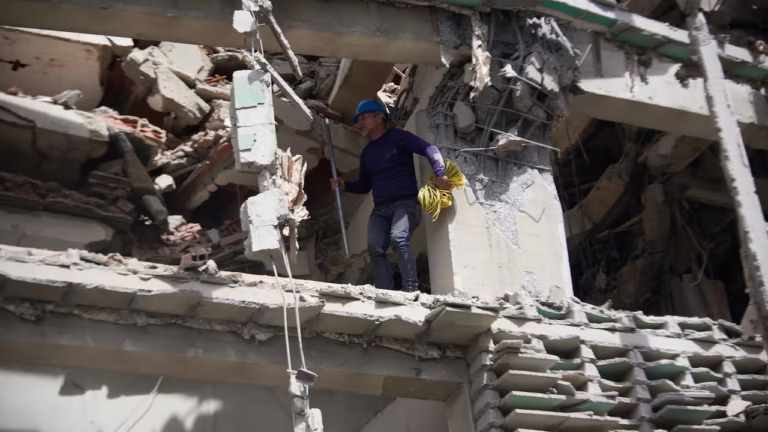
Venezuelans living in Saskatchewan are scrambling to locate missing loved ones and coordinate relief efforts after two powerful earthquakes — measuring 7.2 and 7.5 in magnitude — struck Venezuela on Wednesday, collapsing buildings in the capital Caracas and leaving thousands missing or homeless.

Diaspora Community Takes Action

Betzabeth Jaramillo, a humanitarian activist and political refugee who relocated to Saskatoon in 2023, has been working around the clock since the quakes hit. She is using social media to share missing persons information and help connect Saskatchewan’s Venezuelan community with relatives back home.

“We try to encourage the people to go outside and help the people inside the buildings,” Jaramillo said. “I try to connect to the rescue centres to find people because, you know, their communication is unstable and we need all the hands inside Venezuela and outside to try to help them to resolve the situation.”

The effort is complicated by unreliable telecommunications infrastructure in Venezuela, making it difficult to confirm the safety of friends and family members.

Canada Pledges Initial Aid

Canada’s foreign affairs minister announced the country will provide an initial $5 million in humanitarian aid to support lifesaving efforts on the ground. The funding is earmarked for emergency food, clean water, and health care.

The full scale of the disaster is still emerging, with rescue operations ongoing and the death toll expected to rise as crews work through collapsed structures across the country.

St. John’s Marks World Refugee Day with City Hall Ceremony Honouring Newcomers’ Resilience

0

St. John’s Marks World Refugee Day with City Hall Ceremony Honouring Newcomers’ Resilience

The City of St. John’s and the Association for New Canadians held a ceremony at City Hall on Tuesday to mark World Refugee Day, celebrating the contributions and resilience of refugees who have made Newfoundland and Labrador their home.

World Refugee Day, observed annually on June 20, honours the strength of people forced to flee their home countries. The event was designed to highlight refugee success stories and the ways newcomers enrich local communities.

Diversity as a Community Asset

Hussein Banisad, senior manager of the association’s Language Instruction for Newcomers to Canada program, emphasized the value refugees bring to the region.

“Diversity is very important when we see people are adding to our community in many different ways,” Banisad said at the ceremony.

Sharing Personal Stories

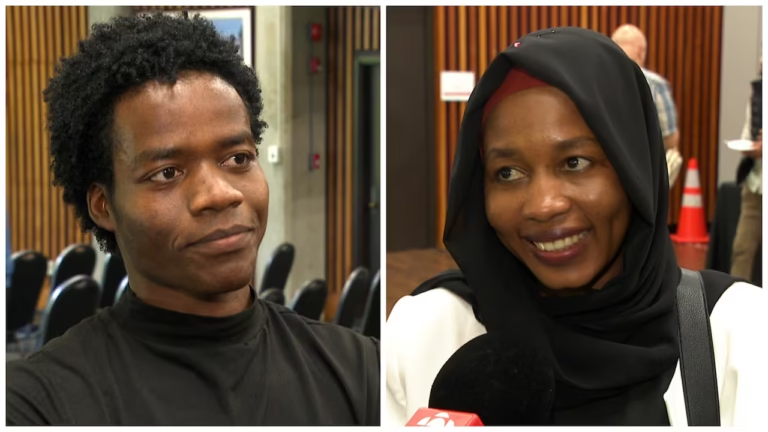
Alhafez Osman, originally from Sudan, arrived in Newfoundland and Labrador in 2022 after fleeing conflict in his home country. He told CBC News that giving refugees the space to share their experiences is essential.

Osman was among several newcomers who spoke at the event, reflecting on the journeys that brought them to Canada and the lives they are building in the province.

Russian Opposition Politician Sentenced to Seven Years in Prison for Anti-War Social Media Posts

0

Russian Opposition Politician Sentenced to Seven Years in Prison for Anti-War Social Media Posts

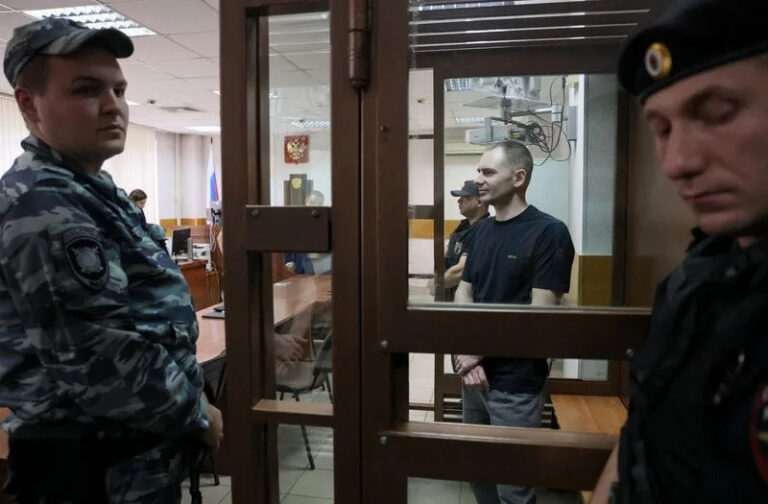
A Russian opposition politician was convicted Wednesday and sentenced to seven years in prison for two social media posts criticizing the war in Ukraine — a verdict the defendant called “a ban on dissent,” delivered just weeks before a national parliamentary election.

Who Is Maxim Kruglov?

Maxim Kruglov, 39, is the deputy leader of Yabloko, Russia’s main liberal opposition party and one of the few political forces openly opposing the war in Ukraine. He previously served as a lawmaker in Moscow’s city legislature.

Kruglov was arrested in October 2024 and charged under Russian laws criminalizing the spread of “false information” about the Russian military — laws enacted after Russia launched its full-scale invasion of Ukraine in 2022.

The Posts That Led to His Conviction

Prosecutors cited two posts Kruglov made on the messaging platform Telegram in 2022. One referenced United Nations data on casualties in the conflict; the other addressed events in Bucha, a town near Kyiv where Ukrainian authorities and Western governments say Russian forces killed civilians in March 2022. Moscow has denied responsibility, claiming the incident was staged.

Kruglov pleaded not guilty and rejected prosecutors’ claims that his posts were motivated by political hatred. “It turns out that political disagreement is tantamount to hatred,” he told the court.

A Verdict With Political Implications

The sentencing comes roughly two months before Russia’s State Duma elections, scheduled for September, in which Yabloko hopes to participate. The party, once a prominent force in post-Soviet Russian politics, currently holds no seats in the national parliament and only a handful in regional legislatures.

Yabloko leader Nikolai Rybakov condemned the verdict outside the courthouse. “If people think that such sentences are acceptable, that such sentences are normal, then they might as well not bother voting or support parties other than Yabloko,” he told reporters.

A recent survey by state pollster Vtsiom found that parties outside parliament, including Yabloko, collectively hold just 6.3% support, while more than two-thirds of respondents backed pro-Kremlin parties, including the ruling United Russia.

Kremlin Defends Censorship Laws

The Kremlin has justified sweeping censorship legislation as necessary to maintain national unity during what it describes as an existential confrontation with the West. Critics argue these laws are being used to silence legitimate political opposition.

Kruglov, speaking from the dock in a black T-shirt, said he remained opposed to the war and expressed hope for Russia’s future. “A country that its neighbours respect, rather than fear. A country where it is possible to disagree,” he said.

Como Submit Opening Bid for Chelsea Defender Trevoh Chalobah

0

Italian Club Makes Move for English Centre-Back

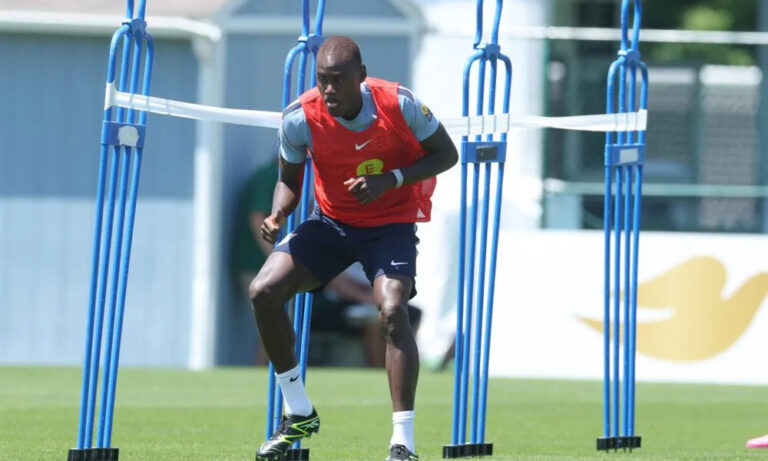
Serie A side Como have submitted an opening bid for Chelsea defender Trevoh Chalobah, according to transfer journalist Fabrizio Romano. Whether Chelsea will sanction the sale of the 26-year-old this summer remains uncertain, with Inter Milan also reported to be monitoring the situation.

Chalobah has two years remaining on his current contract at Stamford Bridge, with no new deal yet on the horizon — a circumstance that could prompt Chelsea to consider selling now in order to secure a transfer fee.

A Difficult Season at Stamford Bridge

Chalobah was among a number of Chelsea players who struggled for form during the 2025/26 Premier League season, failing to consistently reproduce the level he had shown toward the end of the previous campaign.

Chelsea’s defensive unit as a whole had a troubled year. Wesley Fofana was again hampered by injury, while Tosin Adarabioyo endured an inconsistent debut season at the club. Benoît Badiashile failed to build on his early promise, and new signing Mamadou Sarr is still unproven at the highest level.

Chelsea Weigh Value of Homegrown Asset

Despite his difficult season, Chalobah is considered by many observers to have outperformed several of his fellow centre-backs at the club. He is also a homegrown player — a designation that carries increasing regulatory weight under both Premier League and UEFA squad registration rules.

The interest from Como and Inter Milan underscores Chalobah’s standing in the market as a reliable, experienced defender. Notably, comparable transfer interest has not emerged for Fofana, Adarabioyo, Badiashile, or Sarr.

Chelsea’s leadership faces a decision about whether to cash in on one of their few centre-backs with demonstrable Premier League credentials and genuine resale value, or retain him as part of a defensive rebuild ahead of the coming season.

Montreal Shooting: How a Gunman Killed a Police Officer and a Civilian Before Being Shot Dead

0

Montreal Shooting: How a Gunman Killed a Police Officer and a Civilian Before Being Shot Dead

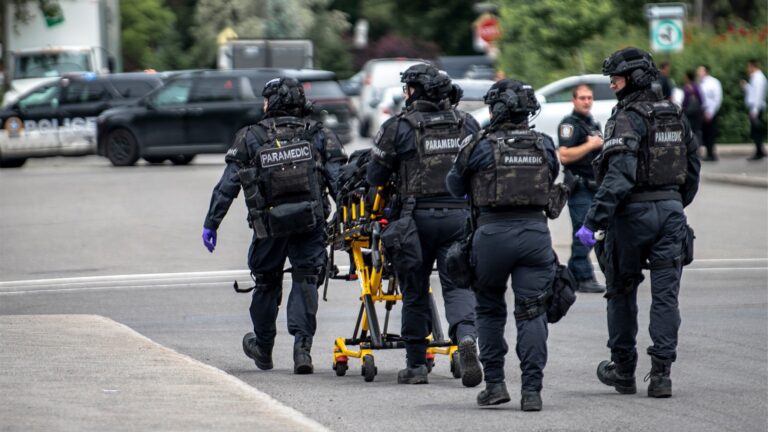
A police officer and a civilian were shot and killed in Montreal’s Côte-des-Neiges neighbourhood on Monday, June 22, 2026, after a gunman opened fire from a hotel window and then engaged officers in the street below. The suspected shooter was killed by responding officers. A second officer was critically wounded but has since stabilized.

How the Attack Unfolded

At approximately 11:35 a.m., someone called 911 to report a person pointing a gun from a window at the Hilton Garden Inn Montreal Midtown hotel. Officers arrived on scene and were immediately met with gunfire.

Cellphone videos verified by news outlets show a person dressed in fatigues-style clothing — an olive-coloured jacket and cargo pants — exchanging fire with police on the street. One officer is seen falling to the ground, crawling toward a parked car for cover, and eventually going fully prone.

Another officer takes cover behind a planter as gunfire continues. An unarmed civilian approaches the officer; a shot is heard and the person collapses. It remains unclear from the footage whether the officer or the gunman fired the fatal shot. Seconds later, the person in fatigues approaches the planter and appears to exchange fire with the officer before attempting to reload a rifle and collapsing amid continued gunfire.

The Victims

The officer killed was identified as Constable Mohamed Lamine Benredouane, 34, who joined the Service de police de la Ville de Montréal (SPVM) in 2021. The civilian killed was Michel (Michael) Moshe Mizrahi, described as a beloved member of Montreal’s Jewish community.

A second SPVM officer sustained critical injuries and was transported to hospital; her condition has since stabilized. A second civilian suffered minor injuries.

Who Was the Suspect?

Quebec’s coroner’s office identified the shooter as Seth Scott Hatfield, 25, from Lethbridge, Alberta. He was a philosophy student at the University of Lethbridge.

Investigators found a violent 104-page manifesto targeting women in his hotel room. Authorities have linked Hatfield to incel subculture — online communities associated with misogynistic ideology that have been connected to previous mass violence in Canada and elsewhere.

Quebec’s Minister of Domestic Security, Ian Lafrenière, confirmed the shooting was not classified as terrorism, a conclusion reached in consultation with multiple agencies including the Royal Canadian Mounted Police.

City on Alert

The attack triggered significant disruptions across central Montreal. Quebec’s Transport Department closed sections of the Décarie Expressway and surrounding highway network. Two metro lines were also partially shut down.

Residents near Côte-des-Neiges, Highway 40, and Queen Mary Road were ordered to shelter in place. That alert was lifted shortly after 3 p.m. — after the suspect had already been killed.

Eyewitness David Benchimol described the scene to Global News: “Right outside our window, we saw them going into the grocery store, guns drawn, hiding behind cars and SWAT team arrived shortly after. And since then, it’s been a ghost town out here.”

Political Response

Montreal Police Chief Fady Dagher noted it had been 24 years since a Montreal officer was killed in the line of duty. “It’s a very, very sad day. It’s a nightmare,” he told reporters.

Canadian Prime Minister Mark Carney issued a statement offering condolences to the victims and thanking officers for their response. Quebec Premier Christine Fréchette ordered the Quebec flag flown at half-mast. Montreal Mayor Soraya Martinez Ferrada issued the same order for City of Montreal flags.

Investigations Underway

Quebec’s police watchdog, the Bureau des enquêtes indépendantes (BEI), has opened an investigation into how officers responded to the shooting — a standard procedure whenever police use of force results in death or serious injury.

The Lethbridge Police Service confirmed it is assisting Quebec authorities with the broader investigation into the suspect’s background and motivations.

Winnipeg High School Students Bring Home International Culinary Gold from Paris

0

Gordon Bell team beats international competition after back-to-back Canadian titles

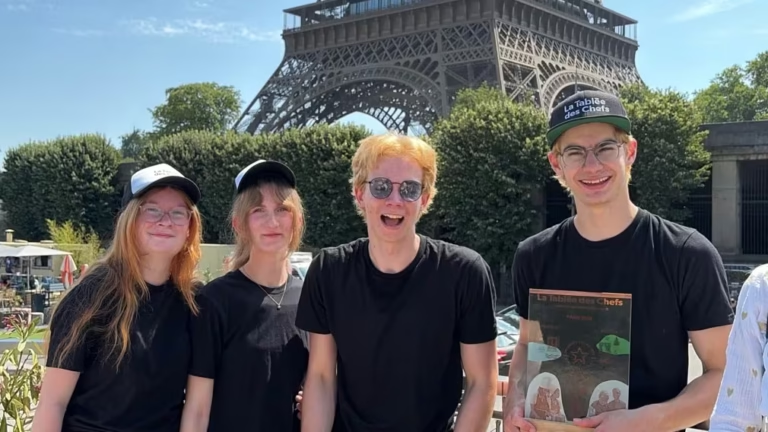
A team of four students from Gordon Bell High School in Winnipeg has won an international culinary competition in Paris, capping a remarkable run that included a second consecutive national title earlier this month.

Students Avery Van Solkema, Cailyn Olshevski, Yevhen Zinchenko and Matea Thiessen-Unger, 16, represented Canada on the world stage — and came home with top honours.

“It was kind of unreal,” said Thiessen-Unger.

From After-School Program to World Stage

The four students got their start through Kitchen Brigades, an after-school culinary education program run by La Tablée des Chefs for students aged 12 to 17.

The program consists of 25 cooking workshops designed to build practical skills and food literacy. “The goal is to teach kids how to cook responsibly,” said Van Solkema.

After completing the workshops, top students are assembled into a team and begin training together before entering the competition stream.

Back-to-Back National Titles

The Gordon Bell team secured their spot at the international competition earlier this month at the Institut de tourisme et d’hôtellerie du Québec culinary school in Montreal. They were the only Manitoba team in the finals, and took first place for the second year in a row against four other finalist teams.

Mystery Ingredients, Five Minutes to Plan

In Paris, the pressure was immediate. Competing teams were presented with a set of mystery ingredients and given just five minutes to plan before a one-hour cooking window began.

The rules required each team to incorporate one Canadian ingredient and one French ingredient. The Gordon Bell students prepared maple pan-seared vegetables and a pesto sauce made with olives and parmesan, with each team member taking responsibility for a specific part of the process.

“[The judging process] is intense. Really intense,” said Zinchenko.

Judges evaluated the dishes on taste and presentation, but also assessed teamwork, organization and cleanliness. After tasting the meals privately, they deliberated for approximately 30 minutes before announcing their decision.

What Comes Next

For some team members, the experience has opened doors to a potential culinary career. “Culinary is definitely an option for me,” said Van Solkema.

Thiessen-Unger said she does not plan to pursue cooking professionally, but values what the program gave her. “Kitchen Brigades has taught me things, like, the knowledge of what goes into a dish, and appreciating making food,” she said.

Zinchenko is already thinking about the program’s future. “Next year, we hope there are other kids who are as passionate about cooking as us, doing better than us,” he said.

Brazil Touch Down in Fort Lauderdale Ahead of Must-Watch World Cup Clash with Scotland

0

Brazil Arrive in Florida for Group Stage Decider Against Scotland

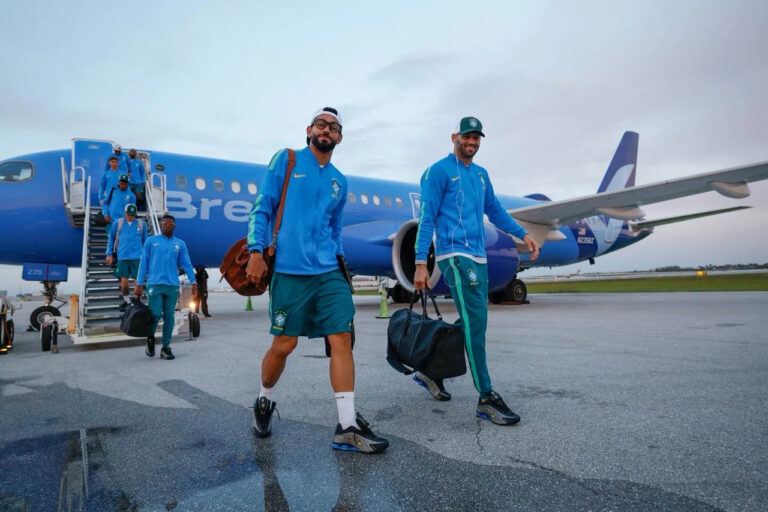
The Brazilian national football team arrived in Fort Lauderdale late Tuesday night ahead of their third and final World Cup group stage match against Scotland, with kickoff scheduled for 7 p.m. Brasília time at Hard Rock Stadium in Miami.

The team’s plane touched down at Fort Lauderdale’s international airport, north of Miami, at approximately 9 p.m. Brasília time — later than planned after bad weather caused departure delays from Newark International Airport in New Jersey.

Delayed Departure, Warm Welcome

Brazil had held their final pre-match training session at the Columbia Park training centre earlier that morning before travelling directly to Newark for the flight south.

Despite the late arrival, a contingent of Brazilian supporters gathered at the hotel to greet the squad, seeking photos and autographs from the players.

What’s at Stake

The match against Scotland represents Brazil’s last group stage fixture. The result could determine the team’s standing heading into the knockout rounds of the tournament.

Federal Government Eyes Kingston Stop in Revised High-Speed Rail Route

0

Federal Government Eyes Kingston Stop in Revised High-Speed Rail Route

The Liberal government is considering a major route change to Canada’s proposed Alto high-speed rail line that would add a stop in Kingston, Ont., shifting part of the corridor southward toward the shore of Lake Ontario following a public consultation process.

What’s Being Proposed

Transport Minister Steven MacKinnon announced Monday in Kingston that the federal government has directed Alto to evaluate an additional stop in the city — a potential significant departure from the original plan. MacKinnon said he was “acting on what we heard” during three months of public consultations held in roughly two dozen communities this year.

The original Quebec City–Toronto route, announced late last year, included planned stops in Trois-Rivières, Laval, Montreal, Ottawa and Peterborough. So far, the federal government has mandated seven stops: Toronto, Peterborough, Ottawa, Laval, Montreal, Trois-Rivières and Quebec City.

Alto has put forward two route options. The first is a near-straight line between Peterborough and Ottawa. The second is a southern track that brings the line to within a half-hour’s drive of downtown Kingston. MacKinnon said his office would take “a very, very, long, strong and positive look” at the southern option, while stressing no final decision has been made.

The Case for Kingston

According to Alto, adding a Kingston stop would cut travel times between the city and Toronto roughly in half, to approximately 90 minutes. The southern route would also allow the vast majority of residents between Peterborough and Ottawa to reach a station within a 30-minute drive.

MacKinnon said the review was informed not only by public feedback but also by consultations with Indigenous communities conducted between October 2025 and June 2026 along the Toronto–Quebec City corridor.

Kingston city council had previously passed a motion calling on the transport minister to add a Kingston-area stop to Alto’s mandate, and had expressed opposition to the project if no such stop were included. Ontario Premier Doug Ford has also previously backed a southern route along the 401 corridor with a Kingston stop.

A Massive and Contentious Infrastructure Project

The Alto project envisions a roughly 1,000-kilometre all-electric rail line with trains reaching speeds of 300 km/h, at an estimated cost of between $60 billion and $90 billion. Prime Minister Mark Carney has said he wants construction to begin within four years.

Construction of the first phase — linking Montreal and Ottawa — is scheduled to begin in 2029 or 2030, serving as an initial test case for the broader corridor.

The project has faced sustained opposition since its announcement. A grassroots coalition of farmers and small-town residents, particularly in rural eastern Ontario and in Mirabel, Que., has raised concerns about land expropriations and the line’s impact on agricultural properties and communities.

The Budget 2025 Implementation Act included amendments to the Expropriation Act and related legislation to accelerate the federal government’s ability to acquire land for the railway — changes that have deepened opposition among affected landowners.

MacKinnon, who described himself as coming from a farming family, acknowledged the emotional weight of expropriation. “We will not cut corners when it comes to respect; we will not cut corners when it comes to sensitivity,” he said, adding that his preference would be to secure a federal right-of-way rather than full expropriation wherever possible.

Critics Question the Process

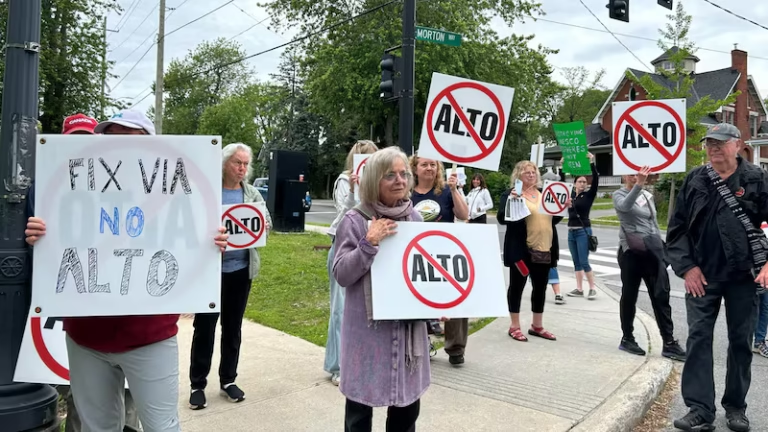
The prospect of an eighth stop drew immediate backlash. Protesters demonstrated outside the Isabel Bader Centre in Kingston where MacKinnon made his announcement, and blocked the exit before police were called to disperse the crowd.

Christian Hébert, president of Quebec’s Union des producteurs agricoles, questioned the project’s planning rigour. “This Alto project is improvisation,” he wrote in a social media post, arguing that Kingston should have been included from the outset if the project rested on a sound business case.

Federal Conservative Leader Pierre Poilievre, speaking in Vancouver, dismissed the project’s viability. “If this project ever gets built it will be 15 years from now and it will cost every family $8,000 in higher taxes,” he said, arguing the funds would be better spent cutting taxes, including the GST on used vehicles purchased through dealerships.

The Parti Québécois has also opposed the project, joining federal Conservatives and rural advocacy groups in criticizing the rail corridor as costly to taxpayers and disruptive to the communities it would pass through.

MacKinnon defended the evolving route, saying the proposed change reflects a clear community preference that emerged through consultation. “This is a strong indication of preference for one route over another,” he told reporters — while reiterating that the final decision has yet to be made.

Colombia swings hard right as criminal lawyer and political outsider wins presidency by razor-thin margin

0

Colombia swings hard right as criminal lawyer and political outsider wins presidency by razor-thin margin

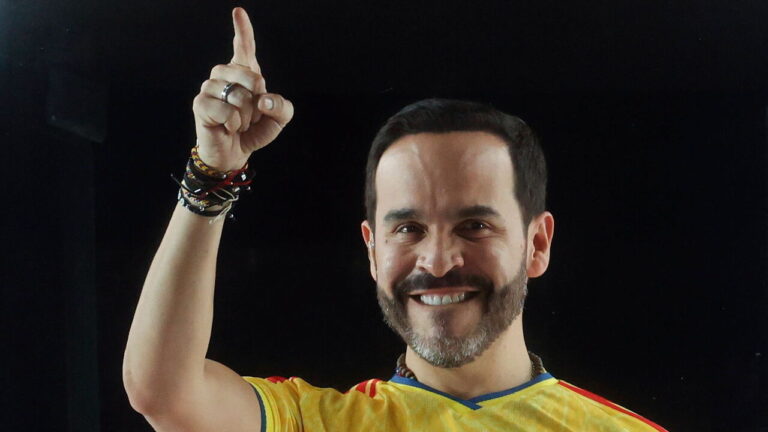
Abelardo de la Espriella, a far-right criminal defence lawyer who has never held public office, won Colombia’s presidential runoff on June 21, 2026, defeating leftist senator Iván Cepeda by fewer than 250,000 votes — one of the closest presidential races in the country’s history and a dramatic ideological reversal just four years after Colombia elected its first-ever left-wing president.

A historic but narrow victory

De la Espriella secured approximately 12.91 million votes, or 49.65% of ballots cast, against Cepeda’s 12.67 million — a margin of roughly 248,000 votes, or under one percentage point. The election recorded Colombia’s highest voter turnout since the presidential runoff system was established in 1994.

The result ends four years under Gustavo Petro, the country’s first and only left-wing president, who was constitutionally barred from seeking re-election. De la Espriella will take office on August 7.

Who is de la Espriella?

Known as “the Tiger,” de la Espriella built his public profile as a high-profile criminal defence lawyer representing some of Colombia’s most controversial figures. His clients have included David Murcia Guzmán, convicted for orchestrating the largest Ponzi scheme in Colombian history, and Alex Saab, a financier and close ally of former Venezuelan leader Nicolás Maduro.

He holds U.S. citizenship, has worked extensively in Miami, and lived in Italy before launching his presidential campaign. He received an endorsement from U.S. President Donald Trump earlier this month.

An iron-fist platform

De la Espriella campaigned on a hardline security agenda, pledging to confront Colombia’s resurging violence with full-scale military force. His key promises include:

Analysts remain skeptical that military confrontation will succeed where similar approaches failed across decades of conflict. For more than 60 years, Colombia has been a battleground for leftist rebels, drug cartels, and criminal gangs founded by former right-wing paramilitaries.

A divided country, a difficult mandate

De la Espriella’s vice-president will be economist José Manuel Restrepo, who served as finance minister under Petro’s conservative predecessor, Iván Duque. But the new president-elect faces a minority in Congress and a deeply polarized electorate.

Armed groups are expected to push back against his promised military offensive. Opposition parties hold significant tools to block his legislative agenda. Election night saw clashes between protesters and police in the city of Cali, a sign of the tensions already running high.

Cepeda and outgoing President Petro alleged irregularities in the preliminary vote count, though neither presented supporting evidence. Petro claimed the National Civil Registry was “uploading forms without the signatures of election jurors.” Historically, the difference between preliminary counts and official scrutiny in Colombian elections has been less than one percent.

Part of a regional wave

De la Espriella’s victory is the latest in a series of rightward swings across Latin America, where outsider and strongman political figures have gained ground in recent years. The result underscores a sharp public reaction against the Petro government’s record, particularly on security, where extortion and drug trafficking have risen in several regions.

Yet the margin of victory also lays bare the depth of Colombia’s divisions: more than half the country did not vote for de la Espriella, and the contest was decided by a fraction of a percentage point. How he governs — and whether his confrontational approach can hold — will be closely watched both within Colombia and across the hemisphere.