
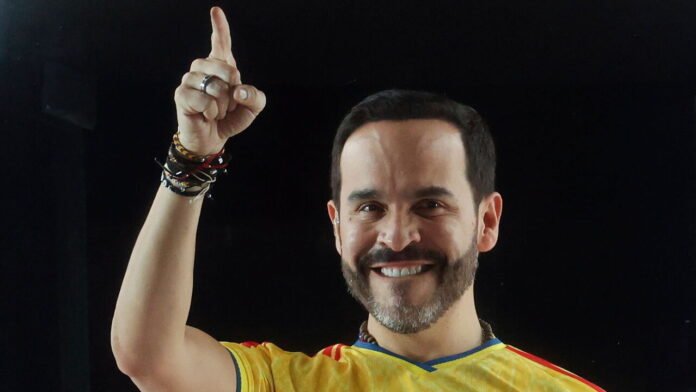
Colombia swings hard right as criminal lawyer and political outsider wins presidency by razor-thin margin
Abelardo de la Espriella, a far-right criminal defence lawyer who has never held public office, won Colombia’s presidential runoff on June 21, 2026, defeating leftist senator Iván Cepeda by fewer than 250,000 votes — one of the closest presidential races in the country’s history and a dramatic ideological reversal just four years after Colombia elected its first-ever left-wing president.
A historic but narrow victory
De la Espriella secured approximately 12.91 million votes, or 49.65% of ballots cast, against Cepeda’s 12.67 million — a margin of roughly 248,000 votes, or under one percentage point. The election recorded Colombia’s highest voter turnout since the presidential runoff system was established in 1994.
The result ends four years under Gustavo Petro, the country’s first and only left-wing president, who was constitutionally barred from seeking re-election. De la Espriella will take office on August 7.
Who is de la Espriella?
Known as “the Tiger,” de la Espriella built his public profile as a high-profile criminal defence lawyer representing some of Colombia’s most controversial figures. His clients have included David Murcia Guzmán, convicted for orchestrating the largest Ponzi scheme in Colombian history, and Alex Saab, a financier and close ally of former Venezuelan leader Nicolás Maduro.
He holds U.S. citizenship, has worked extensively in Miami, and lived in Italy before launching his presidential campaign. He received an endorsement from U.S. President Donald Trump earlier this month.
An iron-fist platform
De la Espriella campaigned on a hardline security agenda, pledging to confront Colombia’s resurging violence with full-scale military force. His key promises include:
Analysts remain skeptical that military confrontation will succeed where similar approaches failed across decades of conflict. For more than 60 years, Colombia has been a battleground for leftist rebels, drug cartels, and criminal gangs founded by former right-wing paramilitaries.
A divided country, a difficult mandate
De la Espriella’s vice-president will be economist José Manuel Restrepo, who served as finance minister under Petro’s conservative predecessor, Iván Duque. But the new president-elect faces a minority in Congress and a deeply polarized electorate.
Armed groups are expected to push back against his promised military offensive. Opposition parties hold significant tools to block his legislative agenda. Election night saw clashes between protesters and police in the city of Cali, a sign of the tensions already running high.
Cepeda and outgoing President Petro alleged irregularities in the preliminary vote count, though neither presented supporting evidence. Petro claimed the National Civil Registry was “uploading forms without the signatures of election jurors.” Historically, the difference between preliminary counts and official scrutiny in Colombian elections has been less than one percent.
Part of a regional wave
De la Espriella’s victory is the latest in a series of rightward swings across Latin America, where outsider and strongman political figures have gained ground in recent years. The result underscores a sharp public reaction against the Petro government’s record, particularly on security, where extortion and drug trafficking have risen in several regions.
Yet the margin of victory also lays bare the depth of Colombia’s divisions: more than half the country did not vote for de la Espriella, and the contest was decided by a fraction of a percentage point. How he governs — and whether his confrontational approach can hold — will be closely watched both within Colombia and across the hemisphere.

