
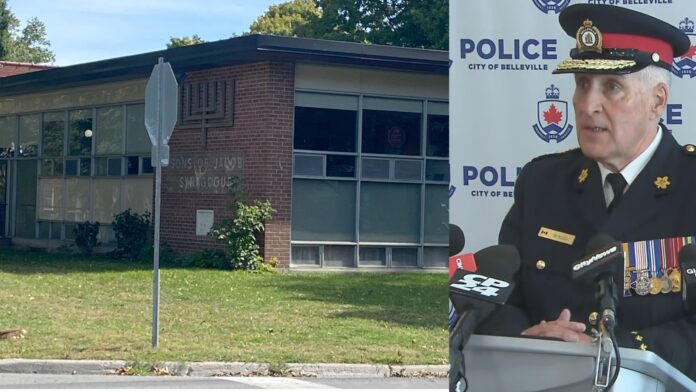
A Targeted Attack on Yom Kippur
The shooting outside Belleville’s Sons of Jacob synagogue on September 20 was not a random act of violence. It was, as Belleville Police Chief Murray Rodd confirmed at a press conference Thursday, a premeditated and targeted hate crime — a deliberate assault on the Jewish community during one of the most sacred observances on the Jewish calendar. The evidence gathered so far points to a calculated attempt at mass murder, and the only reason congregants walked out of that synagogue alive was the extraordinary courage of two police officers who stood between the attacker and his victims.
The central thesis is difficult to avoid: Canada’s Jewish communities are facing an escalating and violent threat, and the institutional response — from policing to legislation to government funding — has not kept pace with the danger.
What Happened Outside the Synagogue
The suspect, identified as 29-year-old Sean Ward, a former Canadian Forces soldier released from the military in 2022, arrived at the synagogue armed with a shotgun and carrying gasoline in his truck. Police say he also had additional weapons and, in Chief Rodd’s words, “the means to carry on a gun battle for a long time.” Ward had previously conducted reconnaissance of the site while Constable Jeff Smith was present — a detail that underscores the deliberate, methodical nature of the attack.
When Ward opened fire, Smith was inside his cruiser. Despite sustaining life-threatening gunshot wounds to his head and body, Smith exited his vehicle and engaged the attacker. Video played at the press conference captured Ward asking Smith, “You are going to die for the Jews?” — words that remove any ambiguity about motive. Nearly three minutes into the exchange, Constable Mike McCurdy arrived and joined the fight. Together, the two officers stopped Ward before a single worshipper was killed.
Ward suffered life-threatening injuries and later died in hospital. Smith is expected to undergo multiple surgeries for serious head trauma, fractures, and shrapnel wounds. His recovery will be long.
The Broader Pattern of Antisemitic Violence
Chief Rodd was careful to note that Smith’s presence outside the synagogue that Sunday night was not a reaction to a separate incident in Durham Region days earlier, where a person had threatened to shoot a synagogue. It was, rather, the product of an established relationship between Belleville police and the local Jewish community — a relationship that, on this occasion, proved to be the difference between a tragedy and a catastrophe.
That distinction matters enormously, because it reveals how much depends on local circumstances and informal arrangements rather than systematic protection. Jewish advocacy organization B’nai Brith has been sounding alarms for months, releasing what it describes as multiple unprecedented reports documenting a rapid acceleration of violent antisemitic incidents since May. The organization’s post-Belleville statement is blunt: most Jewish institutions in Canada do not have armed, trained officers at their doors. The Sons of Jacob congregation was, in a very real sense, fortunate.
Jewish Federations of Canada CEO Steven Shulman put it plainly after the press conference: “Without that, we would’ve had a massacre, likely. That can’t be in Canada.”
Institutional Gaps and the Question of Government Responsibility
The RCMP’s Integrated National Enforcement Team is assisting Belleville police and reviewing whether the attack falls within the national security mandate. Inspector Christine Belair declined to say whether Ward had been radicalized during his time in the Canadian Forces — a question that remains open and significant. Evidence discovered at Ward’s residence, which police say will “corroborate the intent in more detail,” has not yet been disclosed publicly.
Ontario Solicitor General Michael Kerzner condemned the attack, declaring that “a line of decency” had been crossed and calling on Canadians to reject hate. Premier Doug Ford expressed support for Smith and his family. Toronto, York Region, and Durham police all issued statements pledging vigilance and increased patrols around synagogues and places of worship. These are appropriate responses. They are also, on their own, insufficient.
B’nai Brith’s call for legislative changes — specifically, to allow synagogues to hire armed, qualified security guards — and for dedicated government funding to ensure police presence at Jewish institutions across Canada raises a legitimate constitutional and civic question. The burden of physical security for a religious minority facing documented and escalating threats should not rest on the communities themselves. Protecting citizens from targeted violence is among the most fundamental obligations of the state.
The Belleville attack is not an isolated incident to be managed and moved past. It is a data point in a worsening trend, and it demands a proportionate institutional response: clearer legislation, sustained funding, coordinated national strategy, and honest public acknowledgment that antisemitic violence in Canada is not merely a social problem but a security one. The courage of Constables Smith and McCurdy bought time. Policy has to do the rest.

