Home Blog Page 9

WestJet Strike Ends After One Day as CUPE Reaches Tentative Agreement with Airline

0

It lasted less than a day. Early Monday morning, at 4:15 a.m. Mountain time, WestJet and the Canadian Union of Public Employees reached a tentative agreement that ended a strike by the airline’s 4,400 flight attendants — a work stoppage that had rippled through the summer travel season, stranding passengers and cancelling hundreds of flights across the country.

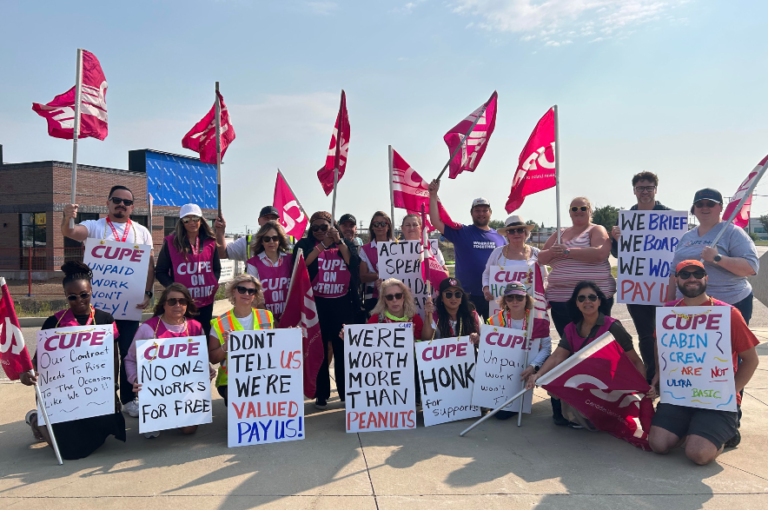
The dispute had been building for some time. CUPE Local 8125, which represents cabin crew at the Calgary-based carrier, had pushed for a fundamental change to how flight attendants are compensated — specifically, that they be paid from the moment they check in to the moment they clock out, rather than primarily for the time their aircraft is in motion. That gap between clock-in and wheels-up, familiar to anyone who has ever watched a flight crew prepare a cabin, represents real labour that had long gone unrecognized in the existing credit system.

The tentative agreement will now go to membership for a ratification vote, which must take place within 30 days. Details remain under wraps. CUPE 8125 president Alia Hussain said at a Calgary news conference Monday that her team intends to present the agreement to union members before releasing specifics to the public — a standard and sensible sequencing that respects workers’ right to hear the terms first.

“This tentative agreement represents meaningful progress on the issues we brought to the table,” Hussain said. She added that WestJet’s longstanding flight credit system will be expanded to recognize more of the work cabin crew are required to perform, and that compensation for that work will increase. She was careful to frame it not as a victory lap, but as a step in an ongoing process.

Before the strike began, WestJet had tabled a proposal that included a 13% wage increase in October, annual increases of 2.5% each January for the following three years, retroactive pay to last January, additional compensation for all hours worked, and improvements to other benefits. Whether the tentative deal tracks closely to that offer, or reflects meaningful movement on both sides, will only become clear once members are briefed.

WestJet CEO Alexis von Hoensbroech expressed regret for the disruption. “We know this disruption has been frustrating for our guests and WestJetters and we’re sorry for that,” he said in a statement, adding that the airline’s teams are working to restore service and return passengers to their destinations as quickly as possible. The airline confirmed it has entered a “recovery phase” and is rebuilding its flight schedule, though full restoration will take time.

Minister of Jobs and Families Patty Hajdu welcomed the news, noting that the federal government was pleased the parties had reached a deal at the bargaining table — without government intervention. That matters. Collective bargaining works best when workers and employers resolve their differences themselves, and this outcome, however imperfect its details may prove, suggests that process held.

The strike touched something real. Flight attendants are among the most visible workers in Canadian aviation, yet their compensation structures have often failed to account for the full scope of their duties — the safety briefings, the boarding management, the hours of preparation that happen before a single passenger fastens a seatbelt. The core demand here was not extravagant. It was a claim for recognition of work already being done.

The agreement still needs ratification. Members may embrace it, or they may push back. Either outcome is legitimate. For now, though, the flights are returning, the passengers are moving, and a workforce that walked off the job on a Sunday morning in the middle of summer has returned to work knowing that what they do — all of it — is at least somewhat more visible than it was before.


Two Storms in One Week Leave St. Catharines Flooded, Grieving, and Without Provincial or Federal Aid

0

St. Catharines is in shock. Within the span of ten days, three extraordinary rainstorms have battered this Niagara-region city, overwhelming its infrastructure, gutting basements, and leaving residents to drag the waterlogged remnants of their lives to the curb — with no disaster relief from either Queen’s Park or Ottawa in sight.

The sequence of events has been relentless. The first storm struck on July 21. A second, more punishing system moved through from July 27 to 28, triggering widespread flooding across St. Catharines and neighbouring Niagara-on-the-Lake. Then, before residents had finished cleaning up, a third storm hit on Sunday, prompting Mayor Mat Siscoe to declare a state of emergency. The nearby Town of Lincoln, also battered by the back-to-back storms, issued its own declaration under Mayor Sandra Easton. Together, the events dumped a combined 250 millimetres of rain on parts of the region — roughly a quarter of the area’s typical annual precipitation, compressed into just three days.

The human toll is written in soggy drywall and destroyed keepsakes. Billy Hammond took a day off from his job at Canada Post to haul bags of ruined photo albums and family mementos to the curb after sewage backed up into his basement for the second time in less than a week. “We need this garbage out of here because it’s traumatizing to look at,” he said. “It’s like you’re reliving the grief over and over again.” For Hammond and many others, the cruelty of the situation is compounded by its repetition: just as one cleanup neared completion, the second storm arrived to undo it entirely.

Mitch St. Hilaire’s mother and stepfather, who live in the Port Weller area, saw their home flood on July 28 and again on Sunday. Firefighters, meanwhile, have been responding not only to flooded properties but to people trapped in their vehicles by rising water. The city’s emergency operations centre has been running continuously since last Tuesday morning, co-ordinating response efforts, clearing catch basins clogged with debris, and removing obstructions from waterways. Crews are also bracing for additional rainfall forecast later this week.

Mayor Siscoe has been direct about what the city needs and what it has not received. On Sunday night, he posted a video of his own flooded basement to Facebook, describing “a hurricane’s worth” of rain falling in a single evening. By Tuesday, he was standing before reporters with a sharper message: “There has been no disaster relief assistance offered by either the provincial or the federal government. The city has been left to fend for itself.” He is calling on both levels of government to provide immediate assistance and to help municipalities fund the kind of critical stormwater infrastructure upgrades that events like these make unmistakably necessary.

That call touches on a structural tension familiar to many Canadian cities: the gap between the scale of climate-related infrastructure challenges and the fiscal capacity of municipalities to address them alone. Stormwater systems, roads, and sewer networks are largely a local responsibility, yet the storms reshaping Canada’s weather patterns respect no jurisdictional boundary. In St. Catharines, roads, sewer systems, and stormwater infrastructure were all overwhelmed, with significant damage extending to homes, businesses, city facilities, and shoreline areas on both private and public land. The declaration Siscoe issued Monday acknowledged that “Sunday’s storm extended those impacts to even more neighbourhoods across St. Catharines” — meaning the crisis is still widening even as the cleanup begins.

What St. Catharines is living through is not simply a local emergency. It is a signal — arriving with unusual force and unusual frequency — that the infrastructure Canadians depend on was not designed for the weather now bearing down on their communities. The grief Billy Hammond described, the shock spreading across neighbourhoods hit twice in a week, the mayor’s unanswered calls for help: these are not abstract policy problems. They are the lived reality of a city that found itself, in the span of ten days, entirely on its own.

From Sacramento State to Georgia Southern: CFN’s Bottom 38 College Football Preseason Rankings for 2026

0

College Football Network has released the bottom tier of its 2026 preseason rankings, covering teams 101 through 138, and this stretch of the list carries more intrigue than usual heading into the fall season. Sacramento State makes its FBS debut in the MAC, Northern Illinois begins a new chapter in the Mountain West, and a cluster of Sun Belt programs enter the year with genuine conference title ambitions. Taken together, these 38 teams represent a wide range of circumstances — rebuilds, fresh starts, and programs quietly positioning themselves for a breakthrough.

At the very bottom of the rankings sits Sacramento State (No. 138), the newest FBS program, projected to finish 3-9 in its inaugural season. The Hornets bring a loyal fanbase and a home-field advantage that could turn heads, but thin offensive and defensive lines remain a serious concern. Joining them near the floor is UMass (No. 137), coming off a winless 2025 campaign and projected for just two wins, though a pair of FCS matchups on the schedule offer a narrow path to modest improvement. Charlotte (No. 132) finds itself in a similar predicament, projected for just one win after a disastrous 1-11 finish last season, with the 49ers needing to find any formula that produces consistent competitiveness before results can follow.

Several programs in this tier are navigating significant transitions. Northern Illinois (No. 123) moves to the Mountain West under an interim head coach, with a roster in the early stages of a rebuild and a travel schedule that will stretch across four time zones — a genuine logistical and competitive challenge for a program still finding its footing. UTEP (No. 129) also joins the Mountain West, entering with more optimism: a lively offence and a favourable mid-season home stretch give the Miners a realistic shot at outperforming their projected 2-10 record. Louisiana Tech (No. 103) completes its own move, departing Conference USA for the Sun Belt, where its offence is expected to rank among the division’s best.

The Sun Belt West emerges as one of the more competitive sub-stories in this portion of the rankings. Arkansas State (No. 102), Louisiana (No. 105), and Louisiana Tech (No. 103) are each projected for six or seven wins, with road-game performance in the back half of their schedules likely to determine which program claims the division title. Georgia Southern (No. 101), the highest-ranked team in this group, enters at 7-5 projected, leaning on a reliable passing game while hoping its defence takes a meaningful step forward. The Sun Belt East is projected to be equally demanding, with Old Dominion (No. 108) and App State (No. 120) both facing pressure to return to relevance after disappointing recent campaigns.

A few teams in the middle of this range stand out as potential overachievers. Kennesaw State (No. 111) enters as the defending Conference USA champion and is projected for an 8-4 record, with a controlled, disciplined style of play that makes the Owls a consistent threat. WKU (No. 107) is similarly well-regarded, projected at 8-4 despite a punishing early schedule that includes trips to Georgia and Indiana. Central Michigan (No. 119) is identified as one of the MAC’s genuine wildcard teams, with a strong offensive backfield and coaching staff capable of competing for a conference title. CFN also flags Jacksonville State (No. 112) with a note of self-correction, acknowledging it significantly underestimated the Gamecocks in 2025, when the program went 9-5 — a caution worth keeping in mind as the season approaches.

At the MAC level, Bowling Green (No. 122) under Eddie George is projected to struggle early before the schedule softens, while Eastern Michigan (No. 127) is seen as a bounce-back candidate after slipping to 4-8 last year, buoyed by an improved passing attack and a more reliable offensive line. Kent State (No. 125) draws praise for head coach Mark Carney, described as a rising star in the profession, even as the Golden Flashes are projected to fall short of a winning record due to ongoing roster limitations. Further down, Ball State (No. 124) faces the structural difficulty of five road games in its first seven weeks, making any late-season bowl push an uphill climb from the opening whistle.

Rounding out the rankings, FIU (No. 109) is positioned as a potential Conference USA breakthrough team under Willie Simmons, with a capable passing game and defensive secondary that could push for a title. Temple (No. 110) draws an enthusiastic note about head coach KC Keeler, whose track record suggests the Owls could punch above their weight in the American Athletic Conference. Across the board, this tier of college football reflects the sport’s structural realities — limited recruiting budgets, brutal scheduling, and the constant churn of the transfer portal — but also the genuine unpredictability that makes the bottom half of the rankings worth watching every fall Saturday.

CentreBC Wants to Redraw the Province’s Political Map — but the System May Not Let It

0

British Columbia’s political centre is restless. Former premier Christy Clark has declared that the province’s voters face a grim binary: what she calls “the worst government in B.C. history” on one side, and a Conservative opposition led by someone she dismisses as unelectable on the other. Into that perceived vacuum steps CentreBC, a fledgling party now led by former B.C. Liberal MLA and Dawson Creek mayor Mike Bernier, which positions itself as a “socially progressive, fiscally responsible” alternative to both the governing NDP and the increasingly ideological B.C. Conservatives. The thesis CentreBC is betting on is straightforward: that Kerry-Lynne Findlay’s rightward shift has cracked the traditional not-the-NDP coalition wide open, and that a credible centre-right party can fill the gap. Whether the province’s political architecture will allow that is a different question entirely.

The case for a centrist opening is not without foundation. Findlay defeated her more moderate rival Caroline Elliott by a razor-thin margin — 51 per cent to 49 per cent after four rounds of voting — and her leadership has already triggered a series of departures from the Conservative caucus. Federal Conservative leader Pierre Poilievre, speaking at the Calgary Stampede, framed Findlay’s victory as a defeat for “liberal lobbyists from out east,” a characterization that underscored just how deliberately ideological her brand of conservatism is meant to be. Findlay has spoken of a government guided by “faith, family, and freedom,” and Bernier himself warns of what he describes as “Trump-style politics” taking hold in the Conservative Party. Meanwhile, MLA Amelia Boultbee crossed the floor last month to join the NDP caucus, a move that signals genuine instability in the opposition benches. These are not the hallmarks of a unified, broadly appealing party of the centre-right.

Bernier’s pitch draws on real economic grievances, particularly in northern and rural British Columbia. He has pointed to the recently announced closure of Northwood Pulp in Prince George as emblematic of the pressures facing resource-dependent communities across the province, arguing that successive governments have failed the forestry sector while it remains foundational to the provincial economy. “The forestry sector is what built British Columbia,” he said. His framing — supporting resource industries while maintaining environmental standards, rejecting ideological “purity tests,” building a “broad coalition of builders and doers” — is calibrated to appeal to pragmatic voters in regions where the NDP’s environmental commitments can feel distant from lived economic realities, and where Findlay’s social conservatism may prove equally alienating. Bernier also claims he is already receiving calls from former Conservative and NDP MLAs intrigued by the new party, though he has declined to name anyone.

The structural obstacles, however, are formidable and should not be minimized. UBC political scientist Stewart Prest acknowledges that some of Findlay’s caucus appointments could alienate moderate voters and generate appetite for a centrist option — but he is equally clear that the first-past-the-post electoral system makes life exceptionally hard for small parties without existing legislative representation. Building a party from scratch is difficult anywhere; doing so without a single seat in the legislature makes it nearly impossible to generate the media attention, donor confidence, and organizational momentum that competitive politics demands. British Columbia has a well-documented tendency toward binary political choices, a culture shaped in part by the very electoral system that rewards consolidation and punishes fragmentation. The B.C. Conservatives themselves only overcame this hurdle when John Rustad, sitting as an independent, joined the party in 2023 and Bruce Banman’s defection from BC United gave it official status — a sequence of events that required existing elected officials, not a ground-up organizing effort.

CentreBC was founded roughly fifteen months ago by former West Vancouver-Capilano MLA Karin Kirkpatrick, who has since handed the leadership to Bernier. Kirkpatrick has acknowledged the difficulty of the organizational work involved, but the party now has an elected executive, an approved constitution, riding associations, and has held its first annual general meeting — modest but real institutional foundations. Whether those foundations are sufficient to sustain a genuine electoral challenge remains to be seen. The conditions that Bernier and his supporters are counting on — a Conservative Party too ideologically extreme for a significant portion of right-leaning voters, and an NDP government that has lost credibility on the economy, health care, and affordability — are real enough. The harder question is whether discontent with both established options translates into votes for a third party under a system that structurally discourages exactly that kind of fragmentation. CentreBC’s central wager is that the political centre is not just restless, but ready to act — and that this time, the conditions are different enough to matter.

WestJet Strike Ends With Tentative Deal, But Vancouver Passengers Still Face Cancellations

0

The strike is over — on paper, at least — but for many travellers passing through Vancouver International Airport on Monday, the disruption was far from finished. WestJet and the Canadian Union of Public Employees (CUPE) announced a tentative agreement in the early hours of Monday morning, ending a job action that had already forced the cancellation of several hundred flights across the country. The relief, however, arrived unevenly.

YVR moved quickly to caution passengers that a deal at the bargaining table does not translate instantly into a functioning airline schedule. Of the WestJet flights slated to operate out of Vancouver on Monday, only 21 were expected to proceed as planned, while 49 others remained cancelled — a stark reminder of how long it takes an airline to rebuild its operations after even a brief work stoppage. WestJet Encore flights were unaffected by the dispute.

The strike itself had been rooted in a straightforward but consequential grievance. WestJet flight attendants walked off the job on Sunday, pressing the company to compensate them for the hours they spend working without being airborne — time spent assisting passengers at the gate, managing delays, or simply waiting for a late departure that is very much part of the job, even if it happens before the wheels leave the ground. It is the kind of labour that is invisible until it disappears.

For travellers already caught in the disruption, the timing of the announcement offered cold comfort. Tran Thai, an Edmonton resident whose flight out of Vancouver was cancelled, found himself navigating a particularly punishing itinerary: a flight to Victoria Monday evening, followed by a sixteen-hour layover before he could board a connection home. “I have to wait here all day — all day today — to get a flight,” he said, with the weary resignation of someone who had already done the math on his options and found none of them good.

His situation illustrates something worth keeping in mind when a labour dispute ends: the headline resolution and the lived experience of passengers rarely coincide. The network effects of mass cancellations ripple outward for days, displacing crews, aircraft, and schedules in ways that no single announcement can undo overnight.

WestJet has not disclosed the terms of the tentative agreement, and the deal is not yet final. CUPE members must still ratify the contract before it takes effect — a vote that will determine whether the settlement holds or whether further negotiations lie ahead. Until that ratification is complete, the tentative deal remains exactly what its name suggests: provisional, and subject to the judgment of the workers it is meant to represent.

What comes next depends on that vote, and on how quickly WestJet can restore normal operations across its network. For now, anyone booked with the airline is well advised to check their flight status before heading to the airport — because the strike may be suspended, but its consequences are still very much in the air.

Blue Jays Reload at Trade Deadline, but Questions Linger Over a Disappointing Season

0

Jeff Hoffman threw one pitch in the ninth inning of Game 7. The Blue Jays were an out away from a World Series championship. Then Miguel Rojas connected, the ball cleared the wall, and everything that followed — the extra innings, the Dodgers celebrating on the Rogers Centre turf — set the tone for a franchise that has spent the months since trying to make sense of what went wrong.

Now it is August, Toronto sits four and a half games back of the final American League wild-card spot, and general manager Ross Atkins has spent the last 48 hours trying to thread an unusually difficult needle: acknowledging a disappointing 2026 campaign while insisting the club still has something to play for.

The deadline, by any measure, was busy. Atkins completed five trades in total, a flurry of moves that reshaped the roster in ways both immediate and forward-looking. The most prominent departure was Kevin Gausman, the veteran starter shipped to the Chicago Cubs on Sunday night in exchange for outfield prospect Brett Bateman and infielder Ty Southisene. The Cubs, in a separate earlier transaction, also sent starter Jameson Taillon to Toronto for cash considerations — a quieter addition that nonetheless fills a rotation need.

The headline acquisition, at least in terms of long-term value, is Jose Soriano. The 27-year-old right-hander arrives from the Los Angeles Angels in exchange for infielder Arjun Nimmala, outfielder Eddie Micheletti Jr., and pitcher Angel Rivero. Soriano carries club control through 2028, which gives the Blue Jays something they have been short on: cost-controlled pitching with a runway. Spencer Arrighetti, 26, came over from the Houston Astros as part of the deal that sent outfielder Daulton Varsho south to Texas. Arrighetti is currently sidelined with right foot nerve irritation, a complication that tempers the immediate return, though the organization clearly values his upside.

Varsho, for his part, was already in the Houston lineup Monday evening when the Astros opened a series at Rogers Centre — a detail that carries its own particular awkwardness.

The outgoing moves did not stop there. Canadian reliever Adam Macko was traded to the Texas Rangers for utility player Josh Smith and right-handed pitcher Josh Stephan. Jeff Hoffman, the reliever whose name became synonymous with that Game 7 moment, was dealt to the Minnesota Twins for prospects Dasan Hill, John Klein, and Dameury Pena, along with $250,000 in international bonus pool space.

Manager John Schneider pushed back, firmly, on the idea that Hoffman should be defined by a single pitch. “I think it’s very unfair for Jeff Hoffman to be remembered by one pitch last year in Game 7,” Schneider said. “Unfortunately, that comes with Game 7 when you’re pitching the ninth inning. But what he’s done for us and the innings that he’s pitched for us, last year and this year, I’ll always be thankful for.” It was a generous and probably correct assessment. It was also, inevitably, a farewell.

Atkins took responsibility for the team’s underperformance, a notable acknowledgment from a GM whose club reached a World Series just twelve months ago. He chose not to move veterans George Springer, Max Scherzer, or Shane Bieber, all of whom are playing out expiring contracts. The reasoning was straightforward: the team still believes it can win games, and those three players carry value in the clubhouse that does not show up in a trade return. “There was a benefit to us continuing to compete, a benefit to individuals like Max and George and Shane being here to impact others individually, and impact us winning baseball games,” Atkins said.

Whether that calculus proves correct will depend on what Toronto does with the next two months. The math is tight. The margin for error is thin.

“I think we’re close,” Atkins said, “but obviously, I would rather we were just adding at this point.” He acknowledged the team was not in that position — not quite a buyer, not quite a seller, something more complicated and harder to explain. The moves, he argued, serve both 2026 and 2027. Whether the players acquired can deliver on that promise is a question that only the standings, eventually, will answer.

For a franchise that came within one pitch of a championship, that is a strange and sobering place to be standing in August.

‘Everything Was Orange’: B.C. Wildfire Forces Evacuations in North Okanagan as Structures Lost

0

A Fast-Moving Threat

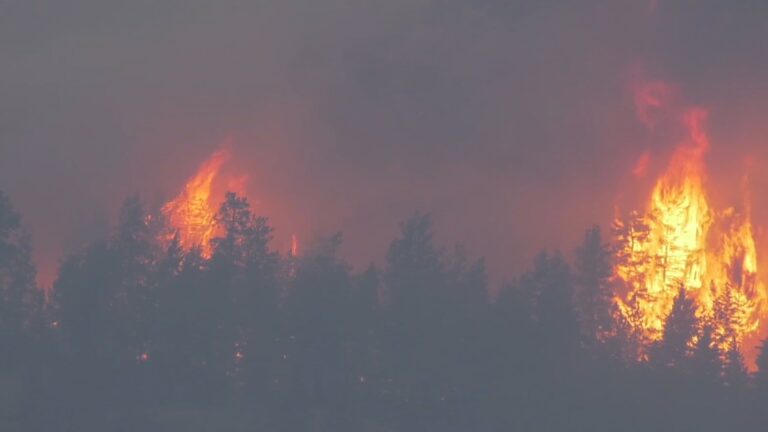
The Bradley Creek wildfire tore through B.C.’s north Okanagan this weekend with terrifying speed. Driven by winds reaching 115 km/h at elevation, the blaze has grown to over 26 square kilometres — and it has already destroyed structures.

Provincial officials confirmed the losses at a news conference, though they warned a full damage assessment remains impossible until conditions improve. The B.C. Wildfire Service was blunt in its online update: “These winds caused significant challenges and the firefighters, helicopters, airtankers and skimmers were unable to hold the fire.”

Voices From the Evacuation Zone

For those who lived through it, the speed of the fire was what struck hardest. Kate Erickson owns a 160-acre property now sitting inside the evacuation zone. When the winds surged, her family scrambled to load animals into vehicles — horses, dogs, a cat — and whatever else they could grab. “They’ve got the cat, the dogs, and the horses and a change of underwear, maybe,” she said. “It breaks my heart.”

At the reception centre in Vernon, another evacuee described the hours before the order came down as relentless and frightening. “It was very scary. It was the whole day of seeing the fire,” she said. “Everything was orange.” She and her husband had watched the blaze all day, never quite believing the order would come — and then it did. “It was just running, running, running because you’re never totally prepared, you think you have everything but you don’t.”

A Broader Wildfire Surge

The Bradley Creek fire did not ignite in isolation. The same volatile weather system — fierce, erratic winds and over 2,200 recorded lightning strikes hitting tinder-dry terrain — sparked dozens of new fires across the province within a single 24-hour window. The BCWS described it plainly as a “dynamic weather event.” That is the language of fire management. For the families now displaced across the north Okanagan, it means something far more immediate.

Conditions across the region remain dangerous. Residents in affected areas should monitor Emergency Info BC and follow all evacuation orders and alerts from local authorities.

Helen Konek, the Woman Behind Nunavut’s Most Shared Photograph, Dies at 95

She was seventeen years old, walking into her igloo near what is now Arviat, Nunavut, when a freelance photographer named Richard Harrington raised his camera and captured a moment that would outlast almost everyone who witnessed it. That February morning in 1949 produced one of the most quietly arresting images in the photographic record of the Canadian Arctic — a young woman, Helen Agaaqtuq, framed by ice and winter light, staring directly into the lens with a composure that time has never managed to diminish. Helen Konek, as she would become known, died on July 25, 2025, at the age of 95.

The photograph has circulated on social media dozens of times over the past decade, drawing thousands of responses each time it resurfaces. Her grandson Jordan Konek first shared it in 2019, and it spread far beyond anything the family had anticipated. He would return to it on special occasions — her birthday, milestones, moments worth marking — and each time the image found new audiences, new comments, new people encountering Inuit life in the mid-twentieth century for the first time.

“It was no intention to go international,” Jordan said. “But I think a lot of people were interested in learning about Inuit culture.”

What the photograph shows is deceptively simple: a teenager descending the carved ice steps of an igloo entrance, the Arctic sun cutting through the opening behind her, her gaze steady and unhurried. What it cannot show, and what Helen herself understood, is the texture of the life surrounding that moment. Richard Harrington had followed her persistently through those weeks of fieldwork. “He followed me everywhere I went,” she recalled in Inuktitut. “Everywhere I went he was right there. We would wander around and just take many photos all the time.” Harrington’s 1949 Arctic journey was not a portrait of picturesque northern living — his broader documentation recorded famine and acute hardship among Inuit communities, survival conditions that the now-famous image alone does not convey.

Helen was born on May 11, 1931, in a tupiq on the eastern shore of Henik Lake, Nunavut. Her birth name was Helen Agaaqtuq. Her father was Piqqanaaq Agaaqtuq and her mother was Paalak Agaaqtuq. She grew up with three brothers — Nanauq, Pukiluk, and Kinaalik — in a world that bore little resemblance to the romanticized northern imagery that would later circulate around her teenage likeness.

Jordan remembers his grandmother not as a viral photograph but as a presence: cooking together during visits to Arviat, setting up her tent out on the land, the ordinary intimacies of family life that exist entirely outside any camera frame. That gap between public image and private person is worth sitting with. The photograph gave many people their first encounter with Inuit life in the late 1940s — but as Jordan has noted, it is not the whole picture, not even close to it.

The image endures because it is genuinely striking, but Helen Konek’s life endured for ninety-five years because of everything the photograph could not capture: the knowledge she carried, the family she raised, the land she knew in ways that no lens can fully render. She was, as her grandson might put it, not what you see on television — or on a screen, or in a viral post. She was far more than that, and the people of Arviat know it.

WestJet Strike Grounds Hundreds of Flights, Leaving 250,000 Passengers Stranded at the Height of Summer

0

A Strike That Stopped Summer Travel in Its Tracks

Roughly 4,400 WestJet flight attendants walked off the job at 12:01 a.m. Mountain Time on August 2, 2026, after overnight contract negotiations collapsed without a deal. Represented by CUPE Local 8125, the workers launched a strike that immediately paralyzed one of Canada’s busiest airlines during the August long weekend — one of the peak travel periods of the year. Within hours, the airline had cancelled 309 flights and began scrambling to rebook an estimated 250,000 affected passengers. The disruption struck at the heart of the summer travel season, when Canadians from every region of the country depend on domestic air connections.

WestJet operates more than 600 flights per day and regularly carries upward of 70,000 passengers, making the stoppage one of the most consequential labour disruptions in Canadian aviation in recent memory. The airline moved quickly to issue refunds and arrange alternative travel options, extending its flexible change and cancel policy through August 6. Notably, the disruptions did not affect WestJet Encore or code-share flights operated by partner carriers, though the vast majority of the airline’s mainline network — including Boeing 737 and 787 routes — was grounded. Industry analysts suggest a full shutdown of this scale could cost the airline millions of dollars daily.

The Core Dispute: What “Credit Hours” Actually Mean for Workers

At the centre of this conflict is a compensation structure that has long drawn criticism from aviation labour advocates: WestJet’s credit hour system. Under this model, flight time, ground duties, boarding, delays, and other forms of work are all folded into a single blended rate of pay, currently ranging from $28.88 to $53.61 per credit hour. At full-time hours, that translates to an annual salary of between roughly $27,700 and $51,500 — figures that the union argues fail to reflect the full scope of work flight attendants perform before a plane ever leaves the ground.

CUPE Local 8125 has pushed specifically for separate, dedicated pay for boarding and ground delays — work that occurs while the aircraft remains stationary and that the union argues goes effectively uncompensated under the current blended model. WestJet countered with what it described as a transformational offer, including a 13 per cent wage increase, but the union held firm on the structural question of ground pay. The strike mandate that authorized this action was overwhelming: CUPE members voted 99.4 per cent in favour, a figure that signals deep and broadly shared frustration with the existing terms.

Federal Involvement and the Path to a Breakdown

The federal government has been watching this dispute closely since spring. Federal conciliators assigned by the Minister of Labour have been involved in the talks since May 12, 2026, a timeline that underscores how long the two sides have struggled to find common ground. Minister of Jobs Patty Hajdu expressed public disappointment as the overnight talks collapsed, and Ottawa has left open the possibility of further intervention, though no concrete action had been announced at the time of the strike’s launch.

WestJet had anticipated the breakdown, taking proactive steps in the days before the strike to ground planes and cancel flights rather than risk stranding passengers and crew mid-journey. On the same day the union issued its strike notice, the airline responded with a 72-hour lockout notice — a parallel escalation that reflects the depth of the impasse. Despite the acrimony, both parties indicated they remained willing to return to the bargaining table, leaving open the possibility of a negotiated resolution before the dispute extends further into the summer season.

A Precedent Set at Air Canada

This dispute does not exist in a vacuum. In 2025, approximately 10,000 Air Canada flight attendants successfully fought for and won ground pay — a compensation model that formally recognizes work performed while an aircraft is on the ground, separate from in-flight duties. That outcome established a clear precedent within the Canadian airline industry and has since become a benchmark that unions representing workers at other carriers are determined to match. For WestJet flight attendants, the Air Canada settlement transformed ground pay from an abstract demand into a concrete and achievable standard.

The pattern speaks to a broader shift in how aviation labour is understood and valued in Canada. Flight attendants have long argued that their responsibilities extend well beyond the moment of takeoff — encompassing safety checks, passenger boarding, ground delays, and a range of duties that consume significant time and professional energy. The Air Canada agreement gave legal and contractual weight to that argument, and CUPE Local 8125 is now pressing WestJet to follow suit. Whether management ultimately accepts that framing will likely determine how quickly this dispute is resolved.

Regional and Passenger Impacts

The timing of this strike amplifies its reach considerably. The August long weekend is among the highest-volume travel periods in the Canadian calendar, drawing families, tourists, and workers across every province and territory. WestJet’s network serves communities from Victoria to St. John’s, and its routes connect smaller regional centres to major hubs in ways that Air Canada’s network does not always replicate. For passengers in cities like Kelowna, Abbotsford, or Charlottetown — where WestJet sometimes operates as the primary or sole carrier — a sudden cancellation is not merely an inconvenience but a genuine logistical crisis.

The 250,000 passengers affected by the initial wave of cancellations represent a cross-section of the travelling public: families heading to reunions, workers on tight schedules, and tourists whose itineraries depend on connections that no longer exist. The airline’s decision to extend its flexible rebooking policy through August 6 offers some relief, but the capacity to absorb displaced travellers across competing carriers during peak season is inherently limited. Passengers who cannot rebook face the prospect of significant delays, added costs, and disrupted plans with little immediate recourse.

What Comes Next

Both WestJet and CUPE Local 8125 have signalled openness to resuming negotiations, and federal conciliators remain available to facilitate further talks. The question is whether the airline is prepared to move on the structural issue of ground pay — the one demand the union has consistently refused to trade away. A 13 per cent wage increase, while meaningful, does not address the underlying architecture of the credit hour system that the union views as fundamentally inequitable.

The broader stakes extend beyond this particular contract. Canadian airlines are navigating a period of sustained labour pressure, with rising wage demands and the expanding recognition of ground work reshaping cost structures across the industry. How WestJet resolves this dispute will influence not only its own labour relations going forward but also the expectations of aviation workers at other carriers watching closely. For travellers, workers, and the communities that depend on reliable domestic air service, a swift and fair resolution is the outcome that matters most.

Ukraine Asks Trump to Unlock Starlink for Strikes Inside Russia as Patriot Commitments Waver

0

Ukrainian President Volodymyr Zelenskyy has formally asked President Donald Trump to intervene with SpaceX chief Elon Musk and secure expanded access to the Starlink satellite communications network — specifically to guide Ukrainian strikes on targets inside Russian territory. The request, made during an Oval Office meeting this week, represents one of the most sensitive diplomatic asks Zelenskyy has brought to Washington since the full-scale Russian invasion began in February 2022, and it arrives at a moment when Ukraine’s other major defence priorities are running into headwinds from an increasingly distracted American administration.

Musk has permitted Ukraine to use Starlink within its own territory, including in areas currently under Russian occupation, but has maintained a firm restriction on extending the system’s reach across the Russian border. Zelenskyy has been pressing U.S. officials on this question for at least several weeks, and during his Washington visit this week — ostensibly to attend Senator Lindsey Graham’s memorial service — he repeated the request directly to Trump in the Oval Office and again to a group of senators on Capitol Hill the same evening. Two people familiar with the private discussions confirmed the substance of those conversations on condition of anonymity. Trump did not commit to the request. The White House, the Ukrainian Embassy in Washington, and SpaceX did not respond to requests for comment.

The strategic logic behind the Starlink request is straightforward, even if the politics surrounding it are anything but. Senator Mike Rounds, a Republican from South Dakota and member of the Senate Armed Services Committee who was present during Zelenskyy’s Capitol Hill session, explained that Ukraine needs reliable satellite connectivity to make its longer-range and intermediate-range weapons systems meaningfully more accurate. “They prefer to be exactly on target, as opposed to in the general area,” Rounds said, adding that Zelenskyy had made that point with considerable clarity. The Ukrainian president had raised the same issue at the NATO summit in Ankara two weeks earlier, and senators noted the consistency between the two conversations — a consistency that itself signals how central this capability has become to Ukraine’s military planning.

Expanding Starlink’s operational zone into Russia would not be without risk for Musk and his company. Reporting by The Associated Press in December revealed that two NATO-member intelligence services believe Russia is developing an anti-satellite weapon designed to target the Starlink constellation by releasing destructive clouds of shrapnel in low orbit — though the AP was not able to independently verify those conclusions, and the intelligence services involved asked not to be identified. Russia has long regarded Starlink as a grave threat, and the thousands of low-orbiting satellites have been widely credited with giving Ukraine a decisive communications edge throughout the conflict. Granting Ukraine the ability to use that edge offensively, inside Russia itself, would almost certainly intensify whatever pressure Moscow is already applying to the system.

Patriot Commitments Under Review as Interceptor Supplies Tighten

The Starlink request does not exist in isolation — it is partly a response to a growing shortage of the Patriot air defence interceptors that Ukraine relies on to blunt the relentless barrage of Russian missiles and drones targeting Ukrainian cities and infrastructure. Those interceptors are in shorter supply in part because the ongoing U.S. and Israeli military campaign against Iran has drawn heavily on the same stockpiles. Zelenskyy reiterated to senators this week that Ukraine urgently needs more Patriot batteries and, critically, a licensing agreement that would allow Ukraine to begin manufacturing the system domestically — a proposal Trump had appeared to endorse at the NATO summit in Turkey, where he declared that the United States would give Ukraine “the right to make Patriots.”

By Friday, however, Trump appeared to be retreating from that commitment. Speaking to reporters at Camp David, where his Cabinet had gathered, the president described the licensing question as still under discussion and said no decision had been made. “We’re talking about it. But it’s a hard thing to give away that kind of technology,” Trump said — a formulation that contrasted noticeably with the declarative confidence he had projected in Ankara. The shift leaves Ukraine in a familiar position: reliant on American goodwill that can shift quickly, and searching for alternative levers to maintain its defensive capacity.

Zelenskyy has worked to frame Ukraine’s situation not merely as a bilateral issue between Kyiv and Washington, but as one directly connected to American strategic interests in the Middle East. U.S. intelligence has confirmed that Iran supplied Russia with drones used against Ukrainian targets, and more recently, U.S. and European officials have indicated that Russia is preparing to ship upgraded versions of those same drones back to Iran. Zelenskyy told American officials ahead of his visit that he had evidence Russia is assisting Iran in targeting U.S. military bases in the Middle East through satellite surveillance — a claim designed to make Ukraine’s war effort legible in terms that resonate with the Trump administration’s current preoccupations. Senator Richard Blumenthal, a Democrat from Connecticut who also sits on the Armed Services Committee, said Zelenskyy was emphatic about Ukraine’s readiness to contribute more directly to countering Iranian drone capabilities, drawing on battlefield experience that Ukrainian forces have developed over years of confronting the very technology Iran is now deploying more broadly. “He was very emphatic on that point,” Blumenthal said.

The Senate, for its part, advanced a sweeping new Russia sanctions package toward a final vote expected next week, with Zelenskyy having spoken to lawmakers the evening before that procedural vote. Whether the legislative momentum translates into the specific military and technological commitments Kyiv is seeking — Starlink access, Patriot production rights, sustained weapons supply — remains an open question, one whose answer will depend in no small part on how the Trump administration weighs Ukraine’s requests against a set of competing priorities that stretches from the Gulf to the Pacific.