
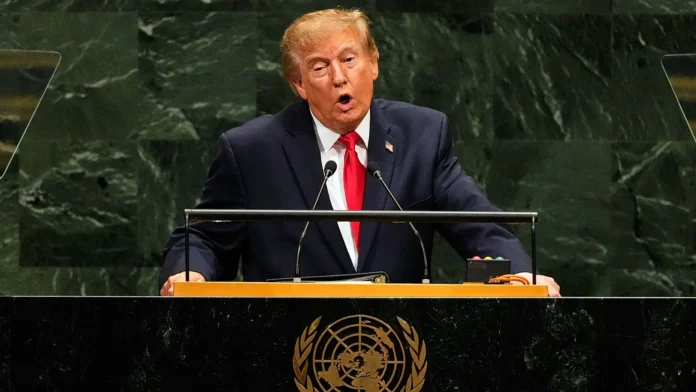
There was a moment of quiet relief among the Canadian delegation gathered in New York last week, when U.S. President Donald Trump stepped to the podium at the United Nations General Assembly and delivered his address without once turning his sights on Canada. It was, by any measure, a low bar — but in the current climate of Washington’s erratic diplomacy, the absence of a slight had come to feel like a reprieve.
That relief, however, proved short-lived. Within days, Trump took to social media to announce that his administration was exploring a pivot away from Canadian potash, one of Canada’s most significant agricultural exports to the United States, in favour of a supply deal with Belarus. The price, Trump suggested, would be more favourable. The signal it sent to Ottawa was anything but.
Belarus, it bears remembering, is not a neutral trading partner. The Lukashenko government has been a willing enabler of Vladimir Putin’s war in Ukraine, providing Russian forces with a staging ground for the initial invasion in 2022 and continuing to offer logistical and political cover for a conflict that has killed tens of thousands and displaced millions more. That the United States would look to Minsk for agricultural imports — bypassing a democratic neighbour and longstanding ally — speaks to something more than a trade calculation.
Washington correspondents Katie Simpson, Willy Lowry and Paul Hunter have been tracking this shift closely, and the question they are now asking is one that would have seemed almost unthinkable a decade ago: Who are Trump’s allies anymore? And, perhaps more pointedly, does the president view alliance itself as a concept worth preserving?
What is emerging from this White House is a brand of diplomacy that treats traditional partnerships as liabilities to be renegotiated rather than assets to be maintained. The America First framework, which drove Trump’s first term, has returned with sharper edges — and a greater willingness to court authoritarian governments when they offer a transactional advantage, however marginal.
For Canada, the implications are immediate and deeply uncomfortable. The potash episode is not an isolated provocation; it fits a pattern in which Trump has repeatedly used Canada as a rhetorical target at public events, deploying the relationship as a prop for domestic political theatre. That this week’s UN speech omitted such a jab was notable precisely because the jabs have become so routine.
The broader picture, though, extends well beyond the Canada-U.S. relationship. Across Europe, in the Indo-Pacific, and throughout the multilateral institutions that the postwar American-led order helped construct, governments are recalibrating their assumptions about Washington’s reliability. The United Nations General Assembly, long a venue where American presidents reaffirmed their country’s commitment to collective security and the rules-based international system, has become something of a barometer for how far that commitment has eroded.
What makes the current moment particularly consequential is the speed of the erosion. Alliances built over decades — through treaty obligations, shared intelligence, integrated military command structures, and dense webs of trade — are being stress-tested by a presidency that measures loyalty in immediate returns and views interdependence with suspicion. The potash pivot to Belarus may ultimately go nowhere. But the fact that it was floated publicly, casually, as a social media post, tells its own story about how this administration understands partnership.
For Canadians watching from across the border, the stakes are not abstract. Potash feeds crops. Trade feeds communities. And the question of whether the country sitting to Canada’s south regards the relationship as something worth protecting — or simply as another deal to be remade on more advantageous terms — is one that will shape Canadian economic and foreign policy for years to come.

