
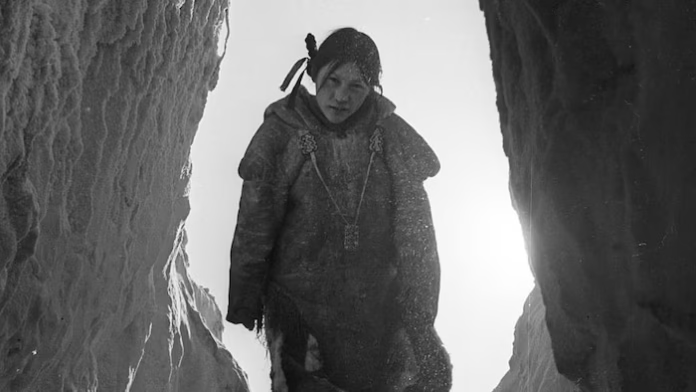
She was seventeen years old, walking into her igloo near what is now Arviat, Nunavut, when a freelance photographer named Richard Harrington raised his camera and captured a moment that would outlast almost everyone who witnessed it. That February morning in 1949 produced one of the most quietly arresting images in the photographic record of the Canadian Arctic — a young woman, Helen Agaaqtuq, framed by ice and winter light, staring directly into the lens with a composure that time has never managed to diminish. Helen Konek, as she would become known, died on July 25, 2025, at the age of 95.
The photograph has circulated on social media dozens of times over the past decade, drawing thousands of responses each time it resurfaces. Her grandson Jordan Konek first shared it in 2019, and it spread far beyond anything the family had anticipated. He would return to it on special occasions — her birthday, milestones, moments worth marking — and each time the image found new audiences, new comments, new people encountering Inuit life in the mid-twentieth century for the first time.
“It was no intention to go international,” Jordan said. “But I think a lot of people were interested in learning about Inuit culture.”
What the photograph shows is deceptively simple: a teenager descending the carved ice steps of an igloo entrance, the Arctic sun cutting through the opening behind her, her gaze steady and unhurried. What it cannot show, and what Helen herself understood, is the texture of the life surrounding that moment. Richard Harrington had followed her persistently through those weeks of fieldwork. “He followed me everywhere I went,” she recalled in Inuktitut. “Everywhere I went he was right there. We would wander around and just take many photos all the time.” Harrington’s 1949 Arctic journey was not a portrait of picturesque northern living — his broader documentation recorded famine and acute hardship among Inuit communities, survival conditions that the now-famous image alone does not convey.
Helen was born on May 11, 1931, in a tupiq on the eastern shore of Henik Lake, Nunavut. Her birth name was Helen Agaaqtuq. Her father was Piqqanaaq Agaaqtuq and her mother was Paalak Agaaqtuq. She grew up with three brothers — Nanauq, Pukiluk, and Kinaalik — in a world that bore little resemblance to the romanticized northern imagery that would later circulate around her teenage likeness.
Jordan remembers his grandmother not as a viral photograph but as a presence: cooking together during visits to Arviat, setting up her tent out on the land, the ordinary intimacies of family life that exist entirely outside any camera frame. That gap between public image and private person is worth sitting with. The photograph gave many people their first encounter with Inuit life in the late 1940s — but as Jordan has noted, it is not the whole picture, not even close to it.
The image endures because it is genuinely striking, but Helen Konek’s life endured for ninety-five years because of everything the photograph could not capture: the knowledge she carried, the family she raised, the land she knew in ways that no lens can fully render. She was, as her grandson might put it, not what you see on television — or on a screen, or in a viral post. She was far more than that, and the people of Arviat know it.

