
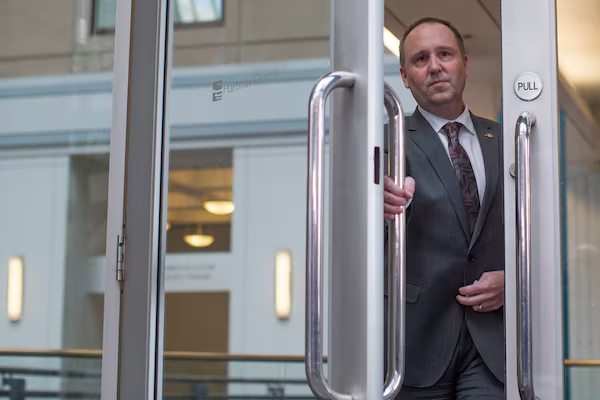
British Columbia’s political centre is restless. Former premier Christy Clark has declared that the province’s voters face a grim binary: what she calls “the worst government in B.C. history” on one side, and a Conservative opposition led by someone she dismisses as unelectable on the other. Into that perceived vacuum steps CentreBC, a fledgling party now led by former B.C. Liberal MLA and Dawson Creek mayor Mike Bernier, which positions itself as a “socially progressive, fiscally responsible” alternative to both the governing NDP and the increasingly ideological B.C. Conservatives. The thesis CentreBC is betting on is straightforward: that Kerry-Lynne Findlay’s rightward shift has cracked the traditional not-the-NDP coalition wide open, and that a credible centre-right party can fill the gap. Whether the province’s political architecture will allow that is a different question entirely.
The case for a centrist opening is not without foundation. Findlay defeated her more moderate rival Caroline Elliott by a razor-thin margin — 51 per cent to 49 per cent after four rounds of voting — and her leadership has already triggered a series of departures from the Conservative caucus. Federal Conservative leader Pierre Poilievre, speaking at the Calgary Stampede, framed Findlay’s victory as a defeat for “liberal lobbyists from out east,” a characterization that underscored just how deliberately ideological her brand of conservatism is meant to be. Findlay has spoken of a government guided by “faith, family, and freedom,” and Bernier himself warns of what he describes as “Trump-style politics” taking hold in the Conservative Party. Meanwhile, MLA Amelia Boultbee crossed the floor last month to join the NDP caucus, a move that signals genuine instability in the opposition benches. These are not the hallmarks of a unified, broadly appealing party of the centre-right.
Bernier’s pitch draws on real economic grievances, particularly in northern and rural British Columbia. He has pointed to the recently announced closure of Northwood Pulp in Prince George as emblematic of the pressures facing resource-dependent communities across the province, arguing that successive governments have failed the forestry sector while it remains foundational to the provincial economy. “The forestry sector is what built British Columbia,” he said. His framing — supporting resource industries while maintaining environmental standards, rejecting ideological “purity tests,” building a “broad coalition of builders and doers” — is calibrated to appeal to pragmatic voters in regions where the NDP’s environmental commitments can feel distant from lived economic realities, and where Findlay’s social conservatism may prove equally alienating. Bernier also claims he is already receiving calls from former Conservative and NDP MLAs intrigued by the new party, though he has declined to name anyone.
The structural obstacles, however, are formidable and should not be minimized. UBC political scientist Stewart Prest acknowledges that some of Findlay’s caucus appointments could alienate moderate voters and generate appetite for a centrist option — but he is equally clear that the first-past-the-post electoral system makes life exceptionally hard for small parties without existing legislative representation. Building a party from scratch is difficult anywhere; doing so without a single seat in the legislature makes it nearly impossible to generate the media attention, donor confidence, and organizational momentum that competitive politics demands. British Columbia has a well-documented tendency toward binary political choices, a culture shaped in part by the very electoral system that rewards consolidation and punishes fragmentation. The B.C. Conservatives themselves only overcame this hurdle when John Rustad, sitting as an independent, joined the party in 2023 and Bruce Banman’s defection from BC United gave it official status — a sequence of events that required existing elected officials, not a ground-up organizing effort.
CentreBC was founded roughly fifteen months ago by former West Vancouver-Capilano MLA Karin Kirkpatrick, who has since handed the leadership to Bernier. Kirkpatrick has acknowledged the difficulty of the organizational work involved, but the party now has an elected executive, an approved constitution, riding associations, and has held its first annual general meeting — modest but real institutional foundations. Whether those foundations are sufficient to sustain a genuine electoral challenge remains to be seen. The conditions that Bernier and his supporters are counting on — a Conservative Party too ideologically extreme for a significant portion of right-leaning voters, and an NDP government that has lost credibility on the economy, health care, and affordability — are real enough. The harder question is whether discontent with both established options translates into votes for a third party under a system that structurally discourages exactly that kind of fragmentation. CentreBC’s central wager is that the political centre is not just restless, but ready to act — and that this time, the conditions are different enough to matter.

