
Thursday, March 5, 2026
Home Blog Page 2

Truro snowplow crash ruled an accident after fatal collision

0

Police say last week’s deadly snowplow collision in Truro was accidental. Officers, firefighters, and paramedics responded to a Queen Street parking lot around 6:30 a.m. on Feb. 2. The pedestrian, 54-year-old Tina Clyke, was taken by EHS—Emergency Health Services—to Colchester East Hants Health Centre, where she died of her injuries. At the time, police said a three-quarter-ton truck—light-duty pickup class—operated by a private contractor was plowing a car-dealership lot when the incident occurred. Clyke was walking across the lot on her way to work at Sobeys.

What police determined

Chief Dave MacNeil said conditions were snowy and windy, and visibility was an issue. Investigators later met with the family. In an update Friday, Truro Police Service stated the case “has been ruled a tragic accident” and that no charges are pending. The service also confirmed an active file remains for administrative close-out and liaison with other authorities.

Weather and visibility factors

Early-morning plowing coincided with low light and blowing snow. Such conditions reduce contrast and hinder depth perception, especially around large vehicles with moving blades. According to police, these factors contributed to the tragedy. However, they found no evidence of criminality.

Truro snowplow accident and workplace review

The incident has been referred to the Nova Scotia Department of Labour for review from a workplace-safety perspective. That process typically examines training, supervision, equipment condition, and site controls. Any recommendations or orders would follow that assessment.

Community response and support

A community fundraiser on GoFundMe has raised more than $50,000 for Clyke’s family. “We appreciate all the support from everybody… We couldn’t make it through this without the support and love that they’ve given Tina,” her brother, Gordie Clyke, told CTV Atlantic. Friends and colleagues have also shared tributes, highlighting her kindness and dedication.

The investigation’s outcome confirms no criminal charges will follow, while a provincial review proceeds. Meanwhile, local support continues for the family as Truro residents process a loss felt across workplaces and neighbourhoods.

Suspect’s father addresses the Tumbler Ridge tragedy

0

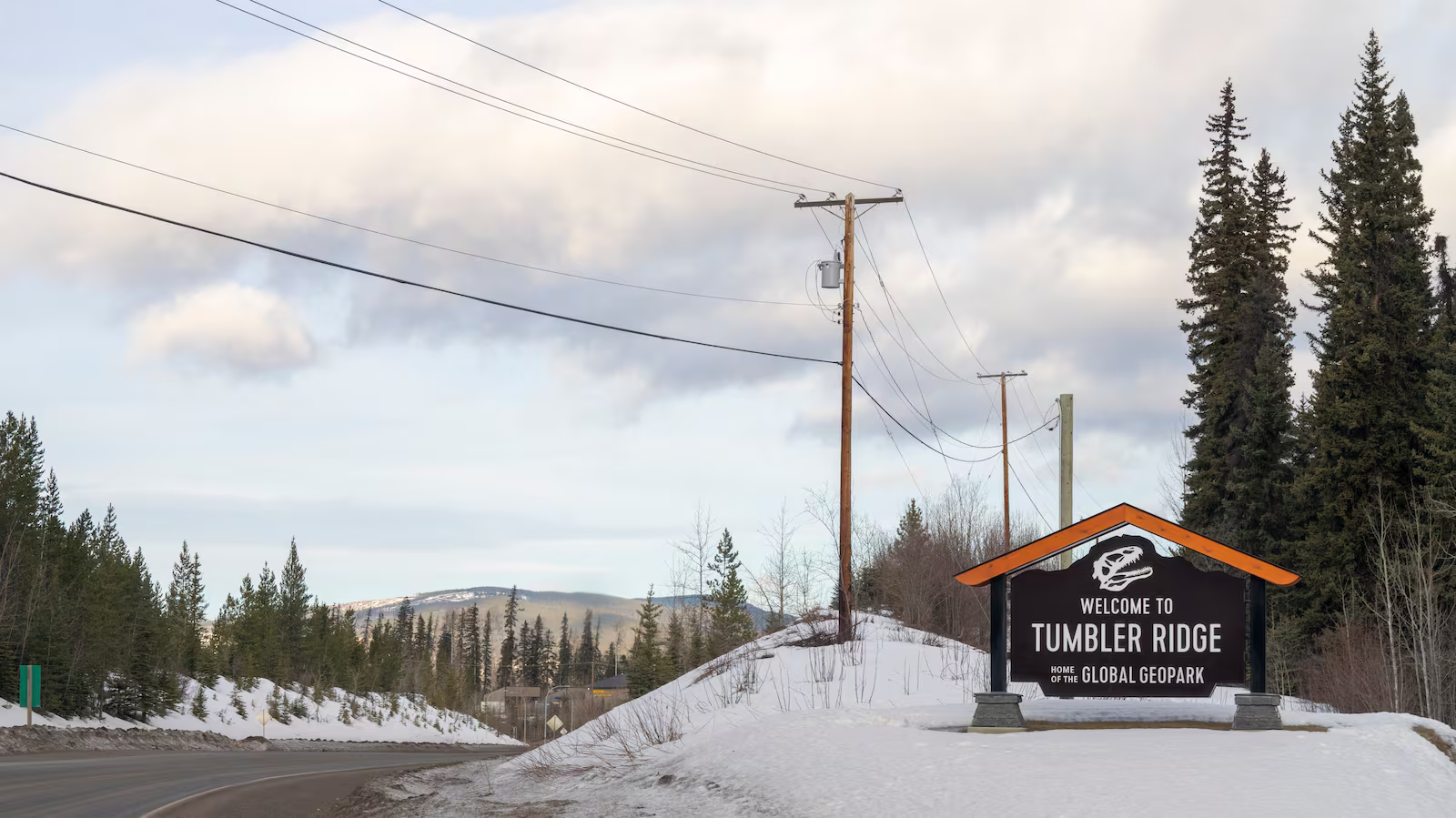
The father of the alleged gunman in the recent mass shooting in Tumbler Ridge has released a written statement to local media. Justin VanRootselaar expressed condolences to victims’ families, emphasized his estrangement from the suspect, and asked for privacy as the community grieves. The message, shared on Thursday with a request to publish it in full, seeks to acknowledge collective loss while clarifying family ties.

Tumbler Ridge shooting: what the father said

VanRootselaar wrote that the town feels “an ache… that will not soon fade,” underscoring how violence in a small community strikes close to home. He offered “heartfelt condolences” to the families and all those affected, stating they remain in his thoughts and prayers. He identified himself as the biological father of the suspect, Jesse Strang, while noting he had been estranged and “was not part of his life.” According to the statement, Strang did not use the VanRootselaar surname. The father stressed that distance does not lessen his sorrow for the harm caused and concluded by asking the public and media to respect the family’s grief and that there would be no further comment.

What we know and what remains unclear

Authorities continue to investigate the episode. Law enforcement has not released further operational details. The statement does not address the circumstances of the attack, potential motives, or charging decisions. Those elements typically come from police or court records as cases proceed. Meanwhile, the community focus remains on supporting victims’ families and restoring a measure of safety and calm.

Community impact and responsible coverage

Mass shootings are events in which multiple victims are shot in a single incident. They create shock, disrupt daily life, and place heavy demands on local services and crisis responders. In close-knit towns such as Tumbler Ridge, residents often share workplaces, schools, and community spaces, which intensifies the emotional toll. Public statements from family members can help convey empathy, but they do not substitute for official updates. Accurate, measured information helps communities grieve without spreading unverified claims.

Family context and privacy

VanRootselaar’s message centers on compassion and boundaries. He clarifies the estrangement from Jesse Strang, affirms solidarity with victims, and asks that media limit intrusion. Such requests are common after high-profile crimes, particularly when relatives were not in contact with the accused. Respecting privacy can reduce secondary harm to families and bystanders who are also processing trauma.

In the days ahead, residents of Tumbler Ridge will look to official channels for verified updates while community organizations coordinate support. VanRootselaar’s statement underscores a shared focus: care for the grieving, space for due process, and a commitment to healing together.

West London U-15 team dissolved after locker-room video reports

0

The president of the Minor Hockey Alliance of Ontario has confirmed the disbandment of a U-15 team within the West London Minor Hockey Association. The move follows reports that cell phone videos of naked players were recorded in dressing room showers and posted on Snapchat. Two players received suspensions. Three coaches were issued indefinite suspensions pending a disciplinary hearing. The team could not continue without coaches, so eligible players were offered spots on other West London teams.

What happened and how the league responded

Larry Moreland said the association acted after the Ontario Hockey Federation alerted Alliance Hockey more than two weeks ago. The league then reviewed staffing and safety requirements. According to Moreland, the club needed coaches to continue games and practices. That was not possible while the suspensions remained in place. As a result, the roster was dissolved. Players not linked to the allegations were reassigned to keep their seasons on track.

ITP process explained and next steps for players

The two suspended players will enter Hockey Canada’s Independent Third Party (ITP) process. The ITP is an arm’s-length intake and case-management system created in 2022 to handle maltreatment complaints. It does not rule on cases itself. Instead, it ensures confidential, neutral, and fair handling. The ITP can retain external mediators, investigators, and adjudicators. It can also recommend interim measures when needed under Hockey Canada’s Maltreatment Complaint Management Policy.

Safety rules: “rule of two” and no phones in rooms

Hockey Canada’s “rule of two” requires two screened adults to monitor the dressing room or remain immediately outside with the door propped open. The policy also bans cell phones and cameras in dressing rooms. These measures aim to reduce risk and protect minors in private spaces. The reported use of phones in showers runs against those rules.

Police and disciplinary investigations continue

London police said they are aware of a social media post about a local boys’ team and noted an active investigation. The service stated that no further information is appropriate at this time. Meanwhile, the three coaches remain suspended pending a disciplinary hearing. The ITP process will manage the player-related complaints. Timelines were not disclosed.

Why the dissolution matters for West London Minor Hockey

Disbanding the roster allows the association to maintain league play while the case proceeds. It also aligns with safeguarding policies that prioritize player welfare. Reassigning unaffected athletes limits disruption. However, the step underscores the consequences of policy breaches, especially where privacy and minors are involved.

Alliance Hockey and regional context

Alliance Hockey represents 23 minor associations across southwestern Ontario, from Niagara to Sarnia. The body oversees competition standards, eligibility, and discipline. U-15 refers to players under 15 years of age, a key development tier in minor hockey. In this case, Alliance Hockey coordinated with the Ontario Hockey Federation and Hockey Canada to apply policy and process.

In sum, the U-15 team’s dissolution reflects a safety-first approach under Hockey Canada rules. The ITP process and police inquiry will determine any further action. Until then, West London players have been placed on other teams, and league operations continue under enhanced oversight.

Crew-12 heads to the ISS after NASA’s first medical evac

0

A new four-person crew blasted off from Florida on Friday to re-staff the International Space Station. The mission follows NASA’s first medical evacuation of a crew in 65 years of human spaceflight. SpaceX launched the replacements at NASA’s request, sending Americans Jessica Meir and Jack Hathaway, France’s Sophie Adenot, and Russia’s Andrei Fedyaev on an expected eight- to nine-month stay. They are due to arrive Saturday, bringing the station back to full strength after a month of reduced operations. “It turns out Friday the 13th is a very lucky day,” Mission Control told the crew after orbital insertion. “That was quite a ride,” commander Jessica Meir replied.

What changed on orbit

NASA paused spacewalks and deferred some maintenance while waiting for reinforcements. Only three astronauts—one American and two Russians—kept the orbital lab running in recent weeks. The evacuated crew splashed down in the Pacific near San Diego and went directly to hospital care. NASA has not identified the affected astronaut or disclosed the condition. An ultrasound machine already aboard for research supported on-orbit checks on January 7, allowing teams to manage the situation until a safe return. Ultrasound is a medical imaging method that uses high-frequency sound waves to view tissues and blood flow.

Launch details and the ride uphill

Liftoff came from Cape Canaveral Space Force Station. The rocket was a Falcon 9, a two-stage launcher that returns its first stage for reuse. The capsule was Crew Dragon, SpaceX’s human-rated spacecraft designed for orbital missions and ISS dockings. Ascent, staging, and orbital insertion proceeded as planned. The crew then began a standard series of maneuvers to phase with the station for docking on Saturday.

Who is on Crew-12

Meir returns for a second station mission; in 2019 she took part in the first all-female spacewalk. Hathaway is a spaceflight rookie. Adenot becomes only the second French woman to fly to space, three decades after Claudie Haigneré’s 1996 mission. Fedyaev makes his second trip to the ISS. Together, they restore the laboratory’s normal tempo of science and upkeep.

Crew-12 launch and why it matters

The rapid turnaround underscores how human spaceflight must manage medical risk. Long missions stretch systems and crews. Some equipment cannot be miniaturized or operated safely in microgravity, so timely return remains a key safety tool. A full crew also allows NASA and partners to resume spacewalks, conduct maintenance, and clear science backlogs. The station’s role as a testbed for future exploration depends on that steady cadence.

Science tasks with an exploration focus

The crew will test a filter that can turn drinking water into emergency IV fluid. They will try an ultrasound system that uses artificial intelligence and augmented reality to guide scans without real-time experts on the ground. They will also perform jugular-vein ultrasound scans for a study on blood clot risks in microgravity. These experiments target medical autonomy for trips to the Moon and Mars, where communication delays and limited supplies raise the stakes.

Training linked to Artemis

On orbit, the astronauts will run a simulated lunar landing guidance exercise. The drill draws added attention with Artemis II preparing to send four astronauts around the Moon for the first time in more than 50 years. Meir noted before launch that she did not expect to see a lunar return so soon in her career, and said overlapping missions make this a striking moment for crews on both paths.

Industry and agency context

SpaceX flew Crew-12 while also preparing its nearby Kennedy Space Center pad for Starship operations. NASA plans to use the larger vehicle as part of future lunar landings. After Friday’s launch, NASA Administrator Jared Isaacman said fueling tests continue at the Artemis pad. A recent hydrogen leak prompted seal replacements and an additional test. He emphasized that no launch date will be set until the team completes further tanking runs, with the earliest target for Artemis II now cited as March 3.

In short, Crew-12 restores full staffing on the ISS and resets the pace of science, maintenance, and training. The mission supports near-term lunar objectives while advancing the medical tools needed for longer, more distant voyages.

Canada adds two silvers on Day 6 at Milan-Cortina Olympics

0

Canada picked up its fifth and sixth medals of the Milan-Cortina Winter Olympics on Day 6, landing two silvers in Livigno. Both came in tight finishes that left Canadians just short of the top step of the podium.

Eliot Grondin back on the podium in snowboard cross

Snowboarder Eliot Grondin won silver in the men’s snowboard cross, finishing behind Austria’s Alessandro Haemmerle.

It is Grondin’s third Olympic medal. The 24-year-old from Ste-Marie, Que., also won silver in the same event at Beijing 2022, where he again finished second to Haemmerle.

“A lot of emotion, for sure,” Grondin said after the race. He called Haemmerle one of his biggest rivals and said he was proud of how he rode, even if Canada arrived chasing gold.

Mikael Kingsbury loses gold on a tiebreak in moguls

Earlier in the day, freestyle skiing star Mikael Kingsbury claimed silver in men’s moguls after an unusually close finish.

Kingsbury, 33, from Deux-Montagnes, Que., matched Australia’s Cooper Woods with an identical score of 83.71 in the final. Woods won the gold on the tiebreak because he earned higher marks for turns.

“I feel amazing. I’m very happy with my skiing,” Kingsbury said. He added that the tiebreak went against him, but he was proud of the work that led to the medal.

The silver is Kingsbury’s fourth Olympic medal. His previous results include gold at Pyeongchang 2018 and bronzes at Beijing 2022 and Sochi 2014.

Mackie places eighth as Sweden goes one-two

In Tesero, Edmonton’s Alison Mackie finished eighth in the women’s 10-kilometre interval start. She was 1:17.9 back of Sweden’s Frida Karlsson.

Karlsson led a Swedish one-two finish ahead of Ebba Andersson. American Jessie Diggins took bronze.

Women’s hockey responds with a shutout win

Canada’s women’s hockey team rebounded with a 5-0 victory over Finland, playing without captain Marie-Philip Poulin due to injury.

Emily Clark scored twice. Jennifer Gardiner, Daryl Watts and Kristin O’Neill also found the net.

Canada will face Germany in the quarterfinals on Saturday.

Men’s hockey set for an opening test with NHL stars back

Canada’s men’s hockey team opens against Czechia in Milan, with NHL players competing at the Olympics for the first time since 2014.

Sidney Crosby is chasing a third Olympic gold medal. Connor McDavid is set to make his Olympic debut.

More medals possible on the ice in Milan

Canada could add to its total again in short-track speed skating. After winning silver in the mixed team relay, the team is set to chase medals in the women’s 500-metre and men’s 1,000 finals in Milan.

Two silvers in Livigno kept Canada’s momentum going on Day 6. The margins were thin, but the podium visits added up fast as the schedule moved toward hockey knockouts and more speed skating finals

Nancy Guthrie disappearance: investigators urge public to share surveillance footage

0

Investigators searching for Nancy Guthrie, the mother of “Today” show host Savannah Guthrie, are urging residents in southern Arizona to share home surveillance footage from specific dates in January and early February.

The 84-year-old has been missing since Feb. 1. Authorities say they believe she was taken against her will, and they warn her health could be at risk because she relies on several medications.

Why detectives are asking for video from multiple dates

Law enforcement has asked neighbours to review cameras for Jan. 31 and the morning of Feb. 1, when Guthrie vanished. Investigators have also requested footage from earlier in January, including a window on Jan. 11 between 9 p.m. and midnight that was circulated through a community alert tied to doorbell cameras.

Those requests suggest police are working to build a wider timeline, looking for suspicious movement or repeat activity near Guthrie’s home.

New images show a masked person at the front door

The FBI has released black-and-white images and video showing a masked individual on Guthrie’s porch. Investigators said the person appears to tamper with the front-door camera around the time of her disappearance.

The footage does not show what happened to Guthrie, but authorities say they hope someone will recognize the person based on clothing and movements.

FBI Director Kash Patel said investigators spent days trying to recover footage that was lost, corrupted, or otherwise inaccessible.

Search teams spread across Tucson-area neighbourhoods

Agents and deputies have carried out searches in and around the Catalina Foothills area, including desert terrain near Guthrie’s home. Investigators have also knocked on doors, asked residents about their cameras, and sought permission to look around properties.

At a nearby home belonging to Guthrie’s daughter Annie, investigators were seen leaving with bags and items collected from the property, along with mail taken from a roadside mailbox.

A detained man was released after questioning

Authorities confirmed they stopped a man near the U.S.-Mexico border after the FBI footage was released. He was later released after questioning. Police have not said what prompted the detention or whether he remains connected to the case.

Investigators also searched a location in Rio Rico, south of Tucson, where the man lives.

Thousands of tips, but no public suspect yet

The Pima County Sheriff’s Department says thousands of calls have poured into the tip line, with the volume surging after the FBI released images. Several hundred detectives and agents are now assigned to the case as the search expands.

Police have also said DNA testing confirmed blood found on Guthrie’s porch belonged to her.

Family appeals for help as questions remain

Savannah Guthrie and her siblings have publicly pleaded for information and indicated they are willing to pay a ransom. It remains unclear whether ransom notes reported in the case are authentic, and authorities have not confirmed any direct contact with whoever took Nancy Guthrie.

For investigators, the priority remains locating Guthrie and identifying the person seen on surveillance video. They are asking anyone with relevant camera footage or information from the requested dates to come forward immediately

S&P/TSX composite drops more than 500 points as U.S. markets fall

0

Canada’s main stock index sank sharply in late-morning trading, pressured by losses in technology, base metals and industrials. U.S. stock markets also moved lower, adding to the risk-off tone across North American equities.

The S&P/TSX composite index was down 533.64 points at 32,720.55. A “point” is the unit used to measure moves in a stock index, which tracks the combined performance of a group of listed companies.

Tech and metals lead the pullback

The decline was led by sectors tied to growth and commodities. Technology stocks weighed on the index, alongside base metal and industrial names. Those groups often react quickly when investors turn cautious about the economy or near-term corporate earnings.

Wall Street also in the red

In New York, major indexes were lower at the same time.

The Dow Jones industrial average was down 400.91 points at 49,720.49. The S&P 500 index was down 77.03 points at 6,864.44. The Nasdaq composite was down 370.39 points at 22,696.08.

Canadian dollar softens against the U.S. dollar

The Canadian dollar traded at 73.40 cents US, down from 73.67 cents US on Wednesday. Currency moves matter for Canadian investors because a weaker loonie can lift the value of U.S. holdings when translated back into Canadian dollars, but it can also raise costs for imports.

Oil and gold lower

Commodities were also weaker.

The March crude oil contract was down US$1.15 at US$63.48 per barrel. The April gold contract was down US$19.10 at US$5,079.40 an ounce. Futures contracts are standardized agreements to buy or sell a commodity at a set price for delivery in a specific month.

The broad selloff left Canadian and U.S. markets tracking in the same direction, with pressure concentrated in sectors that tend to be most sensitive when sentiment turns defensive.

Budget Implementation Act talks show “good faith,” Scheer says

0

Conservative House Leader Andrew Scheer says discussions with the Liberal government to move key legislation are being held “in good faith.” His comments come as Parliament weighs the Budget Implementation Act, a high-stakes bill that would carry the measures tied to the government’s budget.

Because the bill is a confidence vote, its defeat could trigger a federal election.

What Scheer says has changed

Scheer told CTV’s Power Play that recent meetings have shown progress. He said the tone in talks over the Budget Implementation Act appears constructive, even if the final outcome remains uncertain.

He would not say whether co-operation is being driven by a desire to avoid an election. He also rejected the idea that his party has shifted its posture.

Why this bill matters so much

Budget implementation bills put budget promises into law. That can mean creating new rules or amending existing laws so the budget can actually take effect.

In a minority Parliament, the government needs enough votes to pass that package. The Liberals currently sit three seats short of a majority, which forces them to seek opposition support on confidence matters.

Conservatives want changes to the bill

Scheer said Conservatives oppose parts of the legislation now before committee. He said some provisions would give ministers extra powers that the party believes should be removed.

Asked whether the Liberals might amend those sections, Scheer did not rule it out. He framed Conservative support as conditional on changes that, in the party’s view, prevent further harm.

No formal deal, both sides insist

With election stakes hanging over the vote, questions have followed about whether the Liberals and Conservatives have struck an agreement.

Government House Leader Steven MacKinnon said there is no formal arrangement with the Conservatives to avoid an election. Scheer echoed that message, saying there is “no formal deal.”

Carney and Poilievre signal a new tone

Prime Minister Mark Carney and Conservative Leader Pierre Poilievre also met one-on-one on Parliament Hill last week. Afterward, both leaders spoke publicly about the need for more collaboration between parties.

Carney has previously pushed back on speculation about a snap election, saying his government is focused on results.

What happens next in the House

The Budget Implementation Act remains under committee study, where amendments can still be proposed. The key question is whether negotiations produce changes that allow the bill to clear the House.

For now, Scheer says the talks are real and respectful. But the confidence vote dynamic means the stakes will stay high until the final tally is known.

Brenton Tarrant appeal reopens Christchurch wounds with bid to undo guilty pleas

0

New Zealand is again confronting the legacy of the Christchurch mosque attacks after Brenton Tarrant launched an appeal to withdraw his guilty pleas. Many had hoped his 2020 admissions would spare victims a public trial and deny him a platform for extremist views. Now, his legal bid risks pulling the country back into a case it tried to close.

Why the guilty pleas mattered in the first place

Tarrant murdered 51 Muslim worshippers at two mosques in Christchurch in 2019. The case was New Zealand’s deadliest mass shooting.

When he pleaded guilty in 2020, it removed the need for a high-profile trial. Victims were spared months of testimony and the possibility that the proceedings could amplify racist ideology.

He later received a sentence of life in prison with no chance of parole, the harshest penalty available in New Zealand.

What he is asking the court to do now

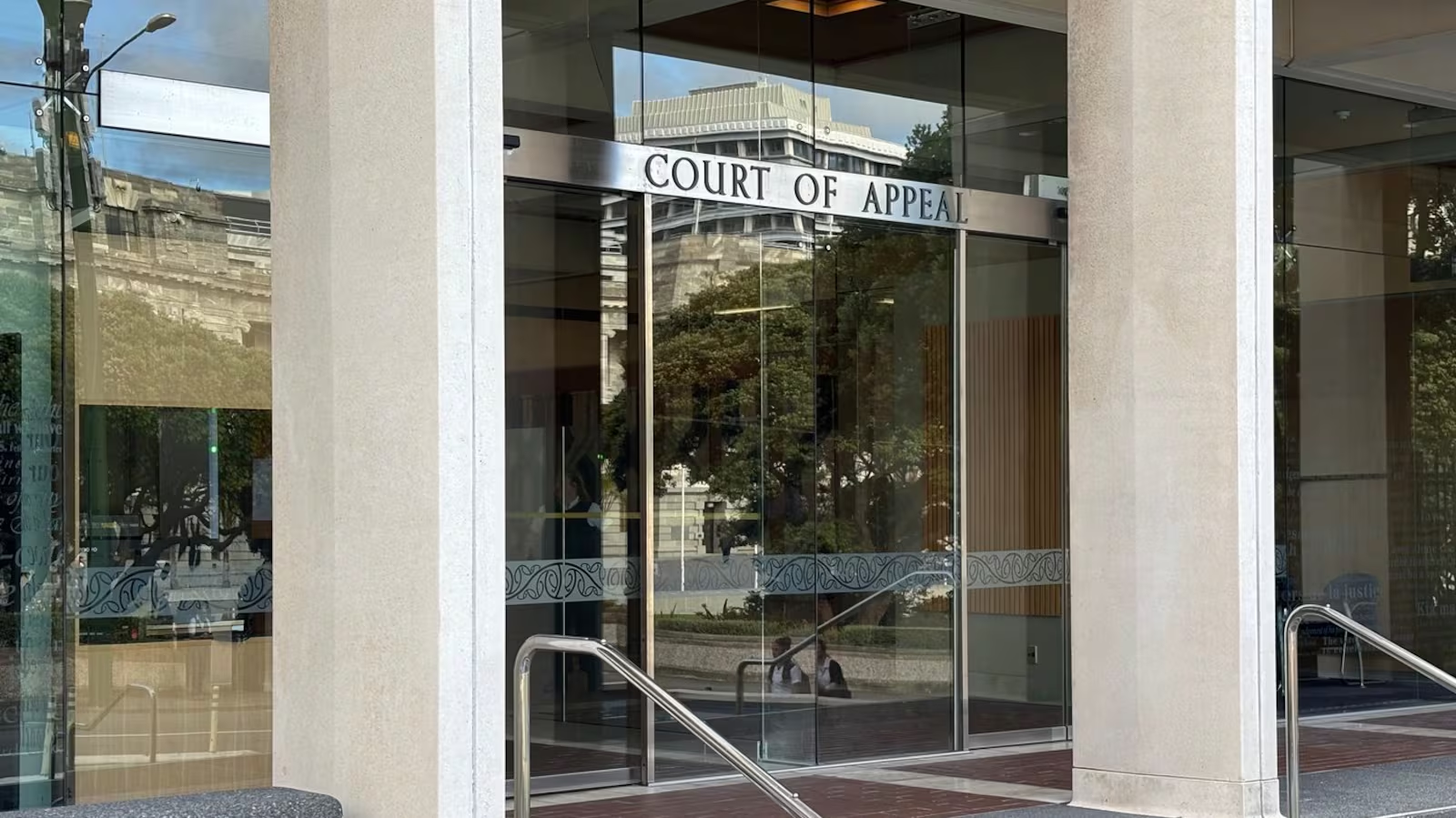
This week, the Court of Appeal in Wellington began hearing Tarrant’s challenge. He wants to recant the guilty pleas to terrorism, murder and attempted murder charges.

If the court agrees, the case could return for a full trial. That prospect is deeply unsettling for survivors and families who have worked to rebuild their lives.

The argument centered on prison conditions

Tarrant’s lawyers say he pleaded guilty during a mental collapse triggered by prison conditions. They argue he was held in unusually restrictive settings, including prolonged isolation, and that it eroded his ability to make rational decisions.

They say he felt unable to engage in the court process and that pleading guilty appeared to be a way to escape harsher restrictions.

His former lawyers, however, say the outcome was driven by the strength of the evidence and the reality that a racist “justification” defence would not be allowed under New Zealand law.

Evidence gaps and a disputed mental health claim

The appeal hinges on whether Tarrant was fit to enter guilty pleas at the time. His lawyers say he concealed symptoms of severe mental illness.

But his claims, as presented in court, are not backed by independent mental health evidence from experts, prison staff, or his former legal team, according to the details raised during the hearing.

Crown lawyers are expected to argue that he had opportunities to raise concerns, seek help, or request delays rather than abandoning a trial.

Survivors fear a new stage for notoriety

New Zealand moved quickly after the 2019 attacks to limit the spread of material linked to the killings, including banning a manifesto and footage that was shared online.

That history hangs over the appeal. Survivors have warned that renewed proceedings could hand Tarrant attention he sought from the start.

Outside court, some victims have rejected arguments that he deserves sympathy for the conditions of his imprisonment. For them, the priority remains accountability and the protection of communities targeted by hate.

What comes next for the appeal and the sentence

The three-judge panel is expected to deliver a decision at a later date. If the bid to withdraw the pleas fails, a separate hearing is expected to address Tarrant’s attempt to appeal his sentence.

For many New Zealanders, the case is not just a legal fight. It is a reminder that the harm of mass violence persists long after the headlines fade, and that the justice process can reopen wounds even years later.

Ontario tuition freeze ends as province adds $6.4B for campuses

0

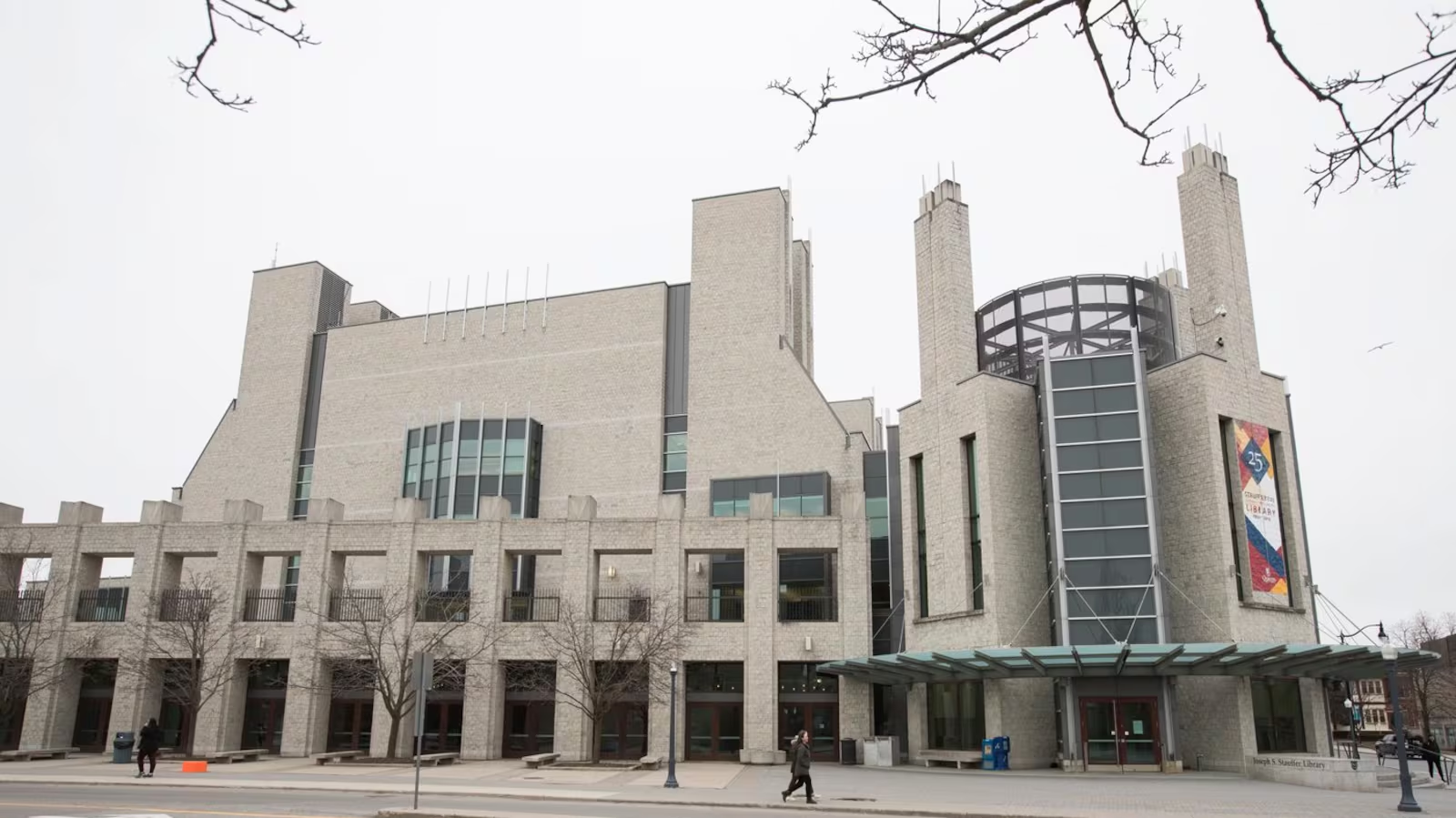
Ontario is injecting billions into colleges and universities while ending its long-running tuition freeze and reshaping student aid. The province says the changes are meant to stabilize a sector facing financial strain after years of tight operating funding, flat domestic tuition and fewer international students.

Colleges and Universities Minister Nolan Quinn announced a package the government says totals $6.4 billion in new funding over four years.

What the $6.4B is supposed to do

The province says the plan will expand training capacity and adjust funding to better reflect real costs. It includes funding to create 70,000 additional spaces in programs described as in-demand, along with more support for higher-cost programs and increased per-student funding.

Ontario is also reviewing and updating the funding formula that determines how money flows to institutions. Officials have framed that review as part of a broader effort to address long-term sustainability.

Tuition can rise again, but with a cap

The government is lifting the tuition fee freeze that has been in place since 2019. Under the new rules, colleges and universities can increase tuition by up to 2% per year for the next three years.

Ontario says the limit is designed to give schools more predictable revenue while keeping increases modest for students and families.

OSAP shifts away from grants and toward loans

Ontario is also changing the Ontario Student Assistance Program, known as OSAP, which provides financial aid to eligible students. The government says it will reduce the proportion of assistance delivered as non-repayable grants and rely more on loans.

Quinn said the shift is meant to keep OSAP financially sustainable as its costs have been rising.

The crisis Ontario says it is trying to fix

The announcement comes as institutions warn of a post-secondary financial crunch. Colleges and universities have pointed to a mix of pressures, including years of constrained public funding, domestic tuition that has been largely flat, and a sharp drop in international enrolment revenues after policy changes reduced student numbers.

Earlier calls from the sector warned that without new support, cuts to programs and staffing would continue.

What happens next for students and campuses

Ontario is betting that bigger operating support, more funded seats and controlled tuition increases will stop deeper reductions on campuses. At the same time, the pivot in OSAP could leave more students relying on repayable aid.

The province says the package is aimed at long-term stability. The next test will be how quickly institutions can expand high-demand programs, and how students absorb higher tuition alongside a student-aid system that leans more heavily on loans.