
Home Blog Page 15

Alexsandra Diaz Sets Two Youth World Records at IWF Championships in Colombia

0

A New Chapter in Philippine Weightlifting

The name Diaz has long carried weight — in the most literal sense — within Philippine sport. At the 2026 IWF World Youth Weightlifting Championships in Cali, Colombia, Alexsandra Ann Diaz ensured that legacy grew considerably heavier, capturing three gold medals and setting two youth world records in the Girls’ 48kg division to complete a clean sweep of the competition.

Alexsandra comes from the same family as Hidilyn Diaz, the Olympic gold medalist whose victory at the Tokyo 2020 Games became one of the defining moments in Philippine sporting history. The younger Diaz, a native of Zamboanga, now writes her own entry into that record.

The Performance, Stage by Stage

Alexsandra opened her campaign in the snatch, successfully lifting 77 kilograms to claim the first gold medal of the day. That result placed her in a strong position heading into the clean and jerk, where she would ultimately make history.

In the clean and jerk, she lifted 98 kilograms — surpassing the previous youth world record by a single kilogram — to secure her second gold and her first record of the championships. The margin was narrow, but the statement was unmistakable.

She was not finished. Her combined total of 175 kilograms eclipsed the previous youth world standard of 173 kilograms, earning her a third gold medal and a second world record in the same afternoon. The full sweep — snatch, clean and jerk, and total — left little room for debate about who had dominated the competition.

What the Records Represent

Youth world records in weightlifting are not merely statistical footnotes; they serve as reliable indicators of a lifter’s trajectory toward senior international competition. Breaking one record in a single championships is a significant achievement. Breaking two, while also sweeping all three gold medals, signals something more durable than a single exceptional day.

Philippine weightlifting has, over the past decade, built genuine credibility on the international stage — a process accelerated dramatically by Hidilyn Diaz’s Olympic title in 2021. The national program has since invested in developing younger athletes, and Alexsandra’s performance in Cali suggests that investment is bearing results.

Looking Ahead

Alexsandra Diaz is now among the most closely watched young weightlifters in the world. Her record-breaking campaign in Colombia does not guarantee future success at the senior level — the transition from youth to senior competition remains one of the more demanding passages in any athlete’s career — but it establishes a foundation that few lifters her age can match.

For a country that has learned, in recent years, to expect excellence from its weightlifters on the world stage, that foundation matters.

Whitehorse Council Opens the Door to Further Debate on Mineral Exploration Zoning

0

The council chambers at Whitehorse City Hall filled beyond capacity on Tuesday evening, residents spilling into standing room as a question that has divided this northern city came once again before its elected representatives: should greenspace on the municipality’s western fringe be opened to mineral exploration? By the end of the night, a majority of council had voted to send the matter through the bylaw process — not an approval, but a commitment to keep the conversation going, with all the uncertainty that entails.

At the centre of the dispute is Gladiator Metals, a Vancouver-based company that has been lobbying Whitehorse to allow it to search for high-grade copper across three parcels of land currently designated as greenspace under the city’s Official Community Plan (OCP). To proceed, the company needs the city to amend that plan — a document that took years to develop through rounds of, at times, intense public consultation, and one that many residents regard as a binding expression of what their community should look like.

This is not the first time Gladiator has brought the question to council. Earlier this year, council rejected the company’s initial proposal outright, with city staff warning that approving it would have undermined the city’s future capacity to regulate mining activity within its limits. The company returned with a revised approach, excluding some environmentally sensitive areas from its proposed work zones and adjusting certain policy definitions following weeks of back-and-forth with city administration. Several sticking points remain, however — particularly around provisions that could constrain the city’s regulatory authority going forward.

Gladiator’s position in Whitehorse rests on a legal peculiarity. Since 2012, the city has prohibited new mineral staking and mining across a large portion of its territory. But the company’s claims predate that ban, granting them a form of immunity from it. Having also cleared the Yukon Environmental and Socio-economic Assessment process and secured a Class 3 permit — which allows exploration work for five years, with environmental impacts rated as moderate to high risk — Gladiator has the legal standing to operate. The obstacle, from the company’s perspective, is purely one of land designation.

Twelve delegates addressed council on Tuesday, and most of them came to oppose the proposal. Their arguments converged on a single, quietly urgent point: the Official Community Plan exists for a reason, and greenspace designated through years of democratic deliberation should not be quietly unwound to accommodate a single company’s interests. One delegate put it plainly, arguing that residents should be able to engage with planning processes “at predictable times, in good faith,” and trust that their input actually shapes outcomes.

Michael Svoboda, another delegate, warned that redesignating the parcels would cross a threshold from which there is no return. “Holding a claim should not mean automatic entitlement to explore within city limits, in city greenspaces, in environmentally sensitive areas, or near residences,” he told council. A palpable frustration ran through the room — not simply over this proposal, but over what several speakers described as a broader erosion of trust in the information being presented and the process being followed.

Marcus Harden, president of Gladiator Metals and himself a delegate at the meeting, made the case for the economic stakes. He pointed to the Yukon’s dependence on federal transfer payments and argued that meaningful resource development — the kind that generates local economic activity — requires the ability to explore. “I’d like to be able to — in my time in this chair — be able to say we got somewhere, with some economic activity that wasn’t about mining Ottawa,” he said, in a phrase that captured both his frustration and the broader tension between resource economies and municipal planning.

The vote split the council. Councillors Paolo Gallina, Eileen Melnychuk, and Dan Boyd voted in favour of advancing the proposed amendment through the bylaw process; the remaining three councillors voted against. The result means the debate continues, but it does not settle anything. The city’s mineral exploration and development framework — a document that could clarify the rules governing this and future cases — is expected to be presented to council in late August or September, after which it would take several additional weeks to come into force.

For the residents who packed that chamber, the timeline matters. The greenspaces in question are not abstractions on a planning map — they are places people use, value, and assumed were protected. Whether the bylaw process that council has now endorsed will honour that assumption, or quietly erode it, is the question that will hang over Whitehorse through the rest of the summer.

Trump Wants Out of the Iran War. Tehran Knows It.

0

Iran is not begging for a deal. It is setting the price of one.

That distinction matters enormously, and it cuts through the noise surrounding the ongoing conflict in the Persian Gulf. U.S. President Donald Trump has made no secret of his desire to see the Strait of Hormuz reopened and the war wound down. Tehran has read that desire clearly, and it is exploiting it with considerable strategic patience — the same patience that smaller, poorer adversaries have used before to outlast a superpower whose domestic politics impose a ticking clock.

The historical parallel is uncomfortable but instructive. During its decade-long involvement in Vietnam, the United States military lost nearly 10,000 aircraft — a figure that captures both the staggering industrial capacity of mid-twentieth-century America and the ultimate futility of applying that capacity against an adversary operating on a completely different timescale. Washington measured the war in months and electoral cycles. Hanoi measured it in decades. North Vietnam absorbed far greater casualties than the United States, but its leadership could accept those losses in ways that a democratic government, answerable to voters, simply could not. The side willing to endure more punishment for longer won. America negotiated a face-saving exit, its adversary conceded essentially nothing, and the governments Washington had backed in South Vietnam, Laos and Cambodia were eventually crushed.

For Iran, that history is not a cautionary tale. It is a model.

Last month, the Trump administration signed a memorandum of understanding with Tehran that, in exchange for a promise to reopen a waterway that had been fully open before the conflict began, lifted sanctions on Iranian oil for sixty days, dangled the prospect of significantly larger rewards, and effectively made Iran’s permission for Gulf shipping conditional on the United States restraining Israel in Lebanon — to the direct benefit of Iranian-backed Hezbollah. The agreement also included commitments to further talks on Iran’s nuclear program, a provision that functions less as a substantive diplomatic objective than as a fig leaf covering a significant American retreat.

The ink was barely dry before the arrangement began to unravel. Iran resumed targeting vessels in and around the Strait of Hormuz, and the United States launched new air strikes against Iranian positions. Bahrain, Kuwait and Qatar found themselves caught in crossfire that once again threatened the interim arrangement. The logic behind Tehran’s behaviour is not difficult to follow. Iran negotiates the way Trump himself is known to negotiate: extract a concession, then push for another. Having wrested real gains from the memorandum, Tehran now believes — not unreasonably, given recent history — that it can force further American retreats by squeezing the strait and pushing oil prices higher.

Trump’s Truth Social posts have presented a different picture, one in which American strikes have devastated Iran’s military and Tehran is desperate for relief. Some left-leaning American commentary has framed the conflict as entirely Trump’s creation, implying that the solution is simply to stop. Neither framing captures what is actually happening. Trump did make a serious error in initiating this war, and that error carries real consequences. But Iran has been dictating the pace and terms of the conflict for some time now, and it is doing so by targeting the two pressure points most likely to move American policy: oil prices and domestic political sentiment.

Anti-war sentiment runs strong across both Democratic and Republican voter bases in the United States. So does the desire for cheap gasoline. Trump is acutely aware of both. That awareness is precisely why he is in a hurry to close this file, while Tehran, facing no comparable electoral pressure, is not. The contrast in urgency is itself a strategic asset for Iran.

The stakes of Iran’s endgame are significant. What Tehran is ultimately pursuing is the ability to levy a toll on the Strait of Hormuz — to compel ships and the Gulf states, all of them American allies, to pay for the “safety” of their energy shipments. Safety, that is, from Iranian attack. It is a straightforward protection racket, and if it succeeds, it would fundamentally reshape the balance of power in the Middle East. American allies in the region would face a transformed security environment, and U.S. credibility as a guarantor of Gulf stability would be severely damaged.

And yet, caving to those demands would deliver something Trump badly wants in the short term. After the memorandum was signed, oil prices fell. That is the transaction Iran is offering: more concessions in exchange for lower prices at the pump, the political metric Trump has made central to his economic messaging. Thirteen American service personnel have died in this conflict, and 42 U.S. aircraft have been reported destroyed or damaged — figures that, by the standards of Vietnam, are small, but that most American voters already consider too high a price for too uncertain a return. Tehran is counting on exactly that calculus.

The war in the Persian Gulf is not over. The Strait of Hormuz remains largely closed. And Iran, patient and purposeful, is waiting to see how much more Washington is willing to trade away to end a conflict it no longer has the political appetite to sustain.

What a $13 Billion Meta Data Centre Means for a County North of Edmonton

0

What is actually being proposed here?

Meta, the American technology giant behind Facebook, Instagram, and WhatsApp, has announced plans to build a data centre in Sturgeon County, located just north of Edmonton, Alberta. The project carries an estimated price tag of $13 billion, making it one of the largest single private infrastructure investments in Canadian history. Local officials have signalled that the facility is “welcome” in the region, and initial details about how the site would be powered and supplied with water are beginning to emerge.

Data centres of this scale are enormous consumers of both electricity and water — electricity to run the servers themselves, and water to cool the vast quantities of heat they generate. Understanding how those two logistical challenges would be addressed is central to evaluating what this project would actually mean for the county and for Alberta more broadly.

Why Sturgeon County, and why now?

Sturgeon County sits in a part of Alberta with relatively affordable land, proximity to established energy infrastructure, and access to a skilled labour pool drawn from the Edmonton metropolitan area. These factors make it an attractive destination for large-scale industrial and technology investment. The county has historically hosted petrochemical facilities and agri-food operations, so the regulatory and logistical frameworks for managing large industrial sites are already reasonably mature.

The timing also reflects a broader North American trend. Technology companies are racing to build out data centre capacity to support the explosive growth of artificial intelligence applications, cloud computing, and streaming services. Canada has emerged as a competitive destination in part because of its relatively stable political environment, its existing grid infrastructure, and — in some regions — access to cleaner sources of electricity.

How would the facility be powered and supplied with water?

The specific logistics of power and water supply are still being worked through, but county officials have begun outlining the general framework. Alberta’s electricity grid, which operates independently from the rest of Canada’s interconnected system, would need to absorb a significant new load — a facility of this size can consume as much electricity as a small city. That raises genuine questions about grid capacity and the source of that power, particularly as Alberta continues to navigate its own energy transition away from coal.

Water supply presents a parallel challenge. Cooling systems for large data centres typically require substantial volumes of water, either for direct cooling or for evaporative systems. How that water would be sourced, treated, and returned to the environment is a question with real consequences for local watersheds and agricultural users who depend on the same supply. County officials have indicated these logistics are under active discussion, though firm details remain forthcoming.

What does this mean for the local community?

Proponents of the project point to significant economic benefits: construction jobs during the build phase, permanent technical and operational positions once the facility is running, and increased municipal tax revenue for Sturgeon County. A project of this magnitude could meaningfully reshape the county’s fiscal position and its capacity to fund local services over the long term.

At the same time, large data centres do not typically generate employment at the same density as traditional manufacturing facilities — they require relatively few workers to operate once built, despite their enormous footprint and resource demands. That tension between capital investment and job creation is worth holding in mind as public discussion of the project develops.

What questions remain open?

Several important dimensions of this project have yet to be resolved publicly. The environmental assessment process, the specific contractual arrangements between Meta and provincial or municipal authorities, and the question of what incentives — if any — the Alberta government has offered to attract the investment all remain unclear. These are not minor details; they determine who bears the costs and who captures the benefits of a facility at this scale.

The project also sits within a larger conversation about the role of foreign technology giants in Canadian infrastructure. Data centres handle enormous quantities of information, and the regulatory environment governing data sovereignty, privacy, and security is still evolving at the federal level. How this facility fits into that framework is a question that extends well beyond Sturgeon County’s borders.

Blue Origin Seeks $10 Billion in New Funding — What It Means for SpaceX and the Commercial Space Race

0

Jeff Bezos’s space venture, Blue Origin, is reportedly pursuing $10 billion in fresh funding, a move that signals the company’s ambition to dramatically accelerate its growth and close the gap with dominant rival SpaceX.

The fundraising effort, if successful, would represent one of the largest capital injections in the commercial space sector to date. Blue Origin, founded by Bezos — who also built Amazon into a global retail and technology giant — has long been viewed as a well-funded but slower-moving competitor to Elon Musk’s SpaceX, which has pulled ahead in launch frequency, contracts, and public visibility.

The scale of the reported raise raises immediate questions about what Blue Origin intends to do with the capital. The company has been developing its New Glenn heavy-lift rocket, expanding its lunar program under NASA contracts, and building out its commercial launch capabilities. A $10 billion infusion would give it the runway to pursue several of those fronts simultaneously.

SpaceX’s Lead — and Blue Origin’s Opening

SpaceX currently dominates the commercial launch market, buoyed by its reusable Falcon 9 rocket, the in-development Starship system, and a deep roster of government and private contracts. Its Starlink satellite internet constellation has also become a significant revenue stream in its own right. By almost any operational metric, SpaceX is the industry’s benchmark.

Yet the commercial space sector is not a winner-take-all market. Government agencies, satellite operators, and defence contractors have consistently expressed interest in maintaining more than one viable launch provider — both to manage costs and to reduce dependence on a single company. That structural demand creates genuine space for a well-capitalized Blue Origin to compete.

New Glenn completed its first successful orbital mission earlier this year, a milestone that gave the company credibility it had previously lacked. Combined with Blue Origin’s existing NASA partnerships — including a contract for a lunar lander under the Artemis program — the timing of a major funding round is not coincidental.

What the Money Would Need to Accomplish

Catching up to SpaceX is not simply a matter of writing large cheques. The gap in launch cadence, infrastructure, and operational experience is substantial.

None of this is beyond reach for a company backed by one of the world’s wealthiest individuals. But the history of the space industry is littered with well-funded ventures that underestimated the complexity of execution.

Whether Blue Origin’s funding push translates into a genuine competitive challenge for SpaceX — or remains a story of potential rather than performance — will depend on how effectively it deploys capital over the next several years. The commercial space race, in other words, is far from settled.

Erdogan Gifts NATO Leaders Engraved Pistols at Ankara Summit; Carney’s Firearm Transferred to RCMP

0

Turkish President Recep Tayyip Erdogan presented every NATO leader, including Prime Minister Mark Carney, with a personalized, engraved revolver and live ammunition as the alliance’s summit in Ankara concluded on Wednesday — a gift that Canadian authorities have since transferred to the RCMP for decommissioning.

An Unusual Diplomatic Gift

The Prime Minister’s Office confirmed that the firearm was not singled out for Carney alone but was distributed to all heads of government attending the summit. A BBC News report described the weapon as a revolver, presented alongside live rounds to each of the alliance’s leaders as they departed the Turkish capital.

No photograph of the firearm has been released publicly.

Canadian Authorities Act in Accordance with Law

Global Affairs Canada issued a statement to reporters travelling with the Prime Minister, clarifying precisely how the gift would be handled under Canadian law and government policy. The statement left little ambiguity:

“All official gifts are handled in accordance with applicable Canadian laws, security requirements and government policies,” the department’s statement read.

A Future Home at a Canadian Museum?

Once decommissioned, the firearm will not simply be discarded. According to a senior government official, Ottawa intends to find an appropriate placement for the weapon, with a Canadian museum cited as a likely destination. The suggestion points to a broader practice in which official gifts of historical or diplomatic significance are preserved in public institutions rather than retained for personal use or destroyed outright.

The episode illustrates the occasionally delicate intersection of diplomatic custom and domestic law — a tension that Canadian institutions, in this case the RCMP and Global Affairs Canada, appear to have navigated swiftly and by the book.

Netflix Brings Short-Form Video to Canada and Five Other Countries Starting August 3

0

Netflix is changing the channel on what streaming looks like.

The platform announced it will begin rolling out short-form video content on August 3 for subscribers in Canada, the United States, the United Kingdom, Ireland, Australia, and New Zealand — marking one of the most significant shifts in the service’s content strategy in years. The move follows Netflix’s earlier expansions into live programming, video games, and video podcasts, each of which tested the boundaries of what a subscription streaming service could be.

The new content comes through agreements with a range of established digital and print media brands: Penske Media, BuzzFeed Studios, Condé Nast, Hearst Magazines, People Inc., and Tastemade. Those names carry recognizable titles — Vanity Fair, Vogue, Rolling Stone, Bon Appétit, People, Variety, Billboard, Harper’s Bazaar, and Elle, among others. The deal was first reported by Variety, which is itself owned by Penske Media and will contribute content under the arrangement. Hearst confirmed its participation to AFP, though offered no further details.

The programming spans a wide range of formats and lengths, from clips of roughly two minutes to longer segments of twenty minutes or more. Specific series coming to the platform include Vanity Fair’s Lie Detector Test and How Well Do They Know Each Other?, BuzzFeed Celeb’s 30 Questions and Tasty, Billboard’s 24 Hours, People’s My Life in Pictures, Tastemade’s Struggle Meals, Harper’s Bazaar’s Burning Questions, Travel + Leisure’s Travel Unfiltered, and AD’s Walking Tour, among others. Netflix says additional publishers will be folded into the arrangement over time.

The strategy is, in one sense, pragmatic. Short-form licensed content costs Netflix relatively little compared to original productions, giving the company a low-risk way to test whether its audience — built largely on prestige drama and comedy — has an appetite for web-native formats like celebrity interviews, lifestyle segments, and how-to videos. It is the kind of experiment a platform runs when it senses its core model is under pressure.

And pressure there is. A Bloomberg report published this week found that Netflix is struggling to retain viewers between the first and second seasons of its top shows — a trend that has reportedly unsettled executives. The causes are familiar enough: high cancellation rates, long gaps between seasons, and uneven quality. Short, frequently refreshed content from trusted media brands could help fill those gaps and keep subscribers from drifting away during the long waits between major releases.

Whether Canadian subscribers — who already navigate a distinct content landscape shaped by CRTC regulations, French-language programming obligations, and regional licensing agreements — will see the same full slate as their American counterparts remains to be seen. Netflix has not specified whether the Canadian library will mirror the U.S. offering exactly. That question matters. Canada’s streaming environment is not simply a northern extension of the American one, and the arrival of content from outlets like Variety or People raises quiet questions about whether homegrown digital publishers will find a similar path to the platform.

For now, the experiment begins August 3. Netflix is betting that the binge model, for all its past dominance, is no longer enough on its own — and that a little bit of everything might be exactly what keeps people subscribed.

Mechanical Failure at Langdale Terminal Leaves Sunshine Coast Residents Scrambling for Ferry Access

0

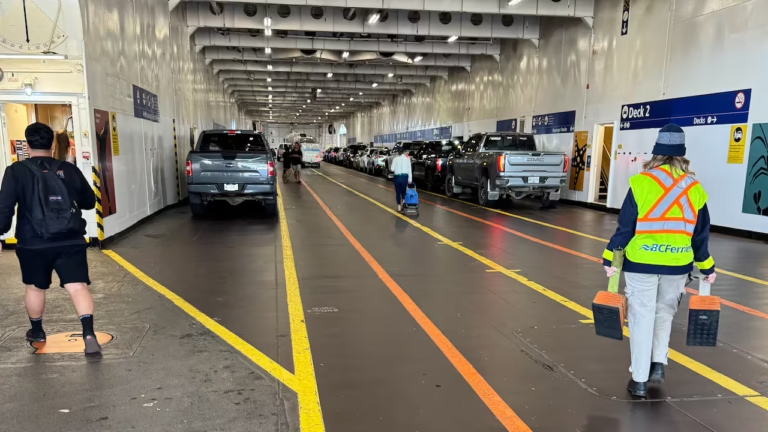
On the morning of July 7, Jessica Price snapped a photograph that told the story more plainly than any press release could. The 11 a.m. sailing from Langdale to Horseshoe Bay was departing with room to spare — visible, frustrating empty space on a vessel that residents had been told was too full to accommodate their bookings. For the communities strung along British Columbia’s Sunshine Coast, that image captured something deeper than a scheduling inconvenience.

A mechanical failure affecting the upper loading ramp at Berth 1 of the Langdale terminal has forced B.C. Ferries to load vehicles exclusively through Berth 2, onto the main vehicle deck only. The result is a sharp reduction in the number of vehicles each sailing can carry. Standby travel has been suspended entirely. Advance reservations are now mandatory in both directions between Langdale and Horseshoe Bay. And some previously confirmed reservations have been cancelled outright.

Initial estimates suggest repairs could take up to ten days, with reduced-capacity operations expected to remain in place through at least July 15. Maintenance crews are working continuously, and the provincial MLA for Powell River–Sunshine Coast, Randene Neill, has indicated that B.C. Ferries hoped to provide an updated repair timeline by Wednesday afternoon. But for residents who depend on this route to reach the mainland, the timeline offers cold comfort.

“That’s our connector to our services, our entertainment, for travelling, everything,” said one Sunshine Coast resident. “It’s not just about people coming here for a beautiful holiday. It’s causing a lot of chaos.”

The disruption has landed with particular weight on those with medical needs. Gibsons Mayor Silas White said he has heard from residents cancelling medical appointments on the mainland — a consequence he described plainly as “a disaster.” He has urged B.C. Ferries to reverse its mandatory reservation policy for Langdale, pointing to a situation that has left some residents stranded on the Vancouver side with no available bookings to return home. “I’ve even heard from people who are stuck on the other side and they’re seeing there’s no availability for them to get back,” White said.

B.C. Ferries has acknowledged the severity of the situation for those with urgent health needs. A spokesperson confirmed that the corporation’s medical assured loading and travel assistance programs remain active, and that people arriving without a reservation for medical reasons can still be accommodated. Ritinder Matthew, B.C. Ferries’ director of communications, said crews are working as quickly and safely as possible to restore full service, and encouraged all travellers to monitor service notices before heading to the terminal.

Still, the frustration is hard to separate from a longer pattern of vulnerability. The Sunshine Coast is not connected to the provincial highway network. The ferry is not a convenience — it is infrastructure. Mayor White has been unequivocal on that point: “It’s not acceptable to our ferry-dependent communities.”

The sight of sailings departing with empty space while confirmed reservation holders wait on shore has sharpened that frustration considerably. The gap between available capacity and actual loading reflects the physical constraints of operating through a single berth — but it is a distinction that offers little reassurance to someone who has missed a specialist appointment or cannot get home.

B.C. Ferries says it is doing everything possible to keep the route running and to prioritize those with the greatest need. For the residents of the Sunshine Coast, the coming days will test that commitment — and, once again, underscore how much the functioning of a single mechanical ramp can determine the shape of daily life for an entire coastal region.

Quebec Moves to Restrict Over-the-Counter Diphenhydramine After Teen’s Fatal Overdose

0

A Death That Demanded a Response

Quebec is proposing to move medications containing diphenhydramine — the active sedating ingredient in Benadryl and related antihistamines — from open pharmacy shelves to behind-the-counter storage, a change that would require pharmacists to document every sale in a patient’s file. The proposal, published as a draft regulation in the Gazette officielle du Québec and currently open for public consultation, stops short of requiring a prescription. But it represents a meaningful tightening of controls on a substance that a provincial coroner has called dangerously under-regulated. The measure flows directly from a 2023 inquest into the overdose death of an 18-year-old in St-Mathias-sur-Richelieu — and it raises a question that the coroner himself could not answer: why did it take this long?

The Case That Prompted the Regulation

On the morning of December 11, 2023, the young man’s mother found him unconscious in his bed. Toxicological analysis confirmed a lethal concentration of diphenhydramine in his blood. Coroner Vincent Denault, reviewing the circumstances, was unambiguous in his frustration. “I cannot understand why the sale of diphenhydramine is not better controlled,” he wrote in his findings. He pointed to a specific inconsistency that is difficult to dismiss: Gravol, another over-the-counter product that also contains diphenhydramine, is already kept behind the pharmacy counter in Quebec — yet Benadryl and similar single-ingredient formulations remained freely available on open shelves. That regulatory gap, Denault concluded, is indefensible given what science already knows about the drug’s toxicity.

Denault was not breaking new ground. He noted that he had already contributed to three previous Quebec coroner investigations involving diphenhydramine fatalities. The drug has a documented history of misuse: it produces euphoric and hallucinogenic effects at high doses, and the scientific literature confirms it has been used both recreationally and in suicide attempts. A particular spike in poisonings occurred around 2020, when a so-called “Benadryl challenge” circulated on TikTok, encouraging users to consume dangerous quantities of the medication. “The deaths of children have put a face to this dangerous trend,” Denault wrote — a phrase that carries weight precisely because it is not hyperbole.

What the Proposed Regulation Would Actually Change

The draft regulation, if adopted, would not make diphenhydramine a prescription drug. Patients could still obtain it without seeing a physician. What would change is the architecture of access. Pharmacists would be required to keep the product behind the counter, engage directly with the person purchasing it, record the sale in that person’s pharmaceutical file, and conduct a basic pharmacological review of that file. These are modest procedural steps, but they matter. Behind-the-counter status introduces a human interaction — a moment of professional judgment — between a potentially vulnerable person and a substance that can kill at doses not far above the therapeutic range.

The recommendation Denault made to the provincial office of professions was precisely this: classify diphenhydramine intended for oral administration in a regulatory category that demands more active pharmacist management. Quebec’s proposed regulation appears to implement that recommendation directly. The consultation process now underway gives the public, health professionals, and industry stakeholders an opportunity to weigh in before the rule is finalized. That process is appropriate. Regulatory changes affecting access to widely used medications deserve scrutiny, and the concerns of patients who rely on these products for legitimate purposes — managing allergies, treating insomnia — deserve to be heard.

The Broader Implication

Quebec’s move reflects something important about how provincial governments can exercise their jurisdiction over pharmacy regulation in ways that respond to genuine public health evidence. The province is not waiting for a federal reclassification of diphenhydramine. It is using the tools available to it — the regulatory authority of the Ordre des pharmaciens and the provincial professions framework — to close a gap that has already cost lives. Whether other provinces will follow, or whether Health Canada will eventually act at the national level, remains to be seen. What is clear is that the status quo — open-shelf availability of a substance with a documented lethal threshold, a history of misuse, and a pattern of preventable deaths — was never a neutral policy choice. It was an oversight. Quebec appears ready to correct it.

Brooklyn Detective Shot by Friendly Fire in Fourth of July Incident, NYPD Confirms

0

A Brooklyn shooting incident that police initially attributed to an armed suspect has turned out to be a case of friendly fire, with the New York Police Department confirming on Monday that Detective Robert L. Karroll was accidentally shot by a fellow officer early Sunday morning — not by the 18-year-old man at the centre of the encounter.

Detective Karroll was struck once in the back, the bullet absorbed by his bulletproof vest. In the hours immediately following the shooting, the NYPD had publicly stated that the detective was shot by a man who brandished a firearm at officers near the corner of Nostrand Avenue and St. Johns Place in the Crown Heights neighbourhood of Brooklyn, shortly before 4:15 a.m. That account did not hold.

The reversal is significant.

Police Commissioner Jessica S. Tisch, speaking at a news conference at Kings County Hospital — where Detective Karroll was recovering — had already begun walking back the initial narrative on Sunday, declining to specify who had actually fired the shot that struck her officer. She acknowledged that investigators lacked body-worn camera footage of the shooting itself, explaining that it had unfolded “so quickly and unexpectedly” that the cameras had not captured the critical moment. By Monday, the department confirmed in a written statement what the footage gap had left uncertain: the wound came from within the officers’ own ranks.

The sequence of events that brought Detective Karroll to that corner began well before the shooting. He and his fellow officers had been on patrol in Manhattan on the Fourth of July when, just before midnight, they were reassigned to Brooklyn. Several hours later, around 4:05 a.m., an 18-year-old man — whose name the police have not released — drew a firearm outside a deli on Nostrand Avenue near Sterling Place and pointed it at another person in the street before entering the deli. He remained inside briefly, then left and fired at a passing vehicle, striking it; the Uber driver and his passenger escaped unharmed.

The man then walked one block south on Nostrand Avenue and approached the driver’s side of Detective Karroll’s police vehicle with his gun drawn. Officers opened fire. The suspect fled on foot and was arrested approximately ten minutes later, near the corner of Union Street and Rogers Avenue. It was in that exchange — chaotic, fast-moving, unfolding in the early hours of a holiday weekend — that Detective Karroll was struck by a round fired by one of his own colleagues.

The NYPD has not yet said whether a formal investigation into the friendly-fire incident is underway, nor has it identified the officer whose shot struck Detective Karroll. The case raises familiar questions about coordination and situational awareness in high-pressure, low-light encounters — questions the department will likely face in the days ahead.