
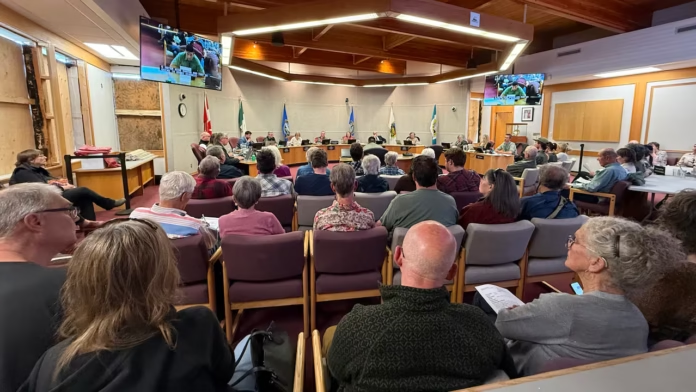
The council chambers at Whitehorse City Hall filled beyond capacity on Tuesday evening, residents spilling into standing room as a question that has divided this northern city came once again before its elected representatives: should greenspace on the municipality’s western fringe be opened to mineral exploration? By the end of the night, a majority of council had voted to send the matter through the bylaw process — not an approval, but a commitment to keep the conversation going, with all the uncertainty that entails.
At the centre of the dispute is Gladiator Metals, a Vancouver-based company that has been lobbying Whitehorse to allow it to search for high-grade copper across three parcels of land currently designated as greenspace under the city’s Official Community Plan (OCP). To proceed, the company needs the city to amend that plan — a document that took years to develop through rounds of, at times, intense public consultation, and one that many residents regard as a binding expression of what their community should look like.
This is not the first time Gladiator has brought the question to council. Earlier this year, council rejected the company’s initial proposal outright, with city staff warning that approving it would have undermined the city’s future capacity to regulate mining activity within its limits. The company returned with a revised approach, excluding some environmentally sensitive areas from its proposed work zones and adjusting certain policy definitions following weeks of back-and-forth with city administration. Several sticking points remain, however — particularly around provisions that could constrain the city’s regulatory authority going forward.
Gladiator’s position in Whitehorse rests on a legal peculiarity. Since 2012, the city has prohibited new mineral staking and mining across a large portion of its territory. But the company’s claims predate that ban, granting them a form of immunity from it. Having also cleared the Yukon Environmental and Socio-economic Assessment process and secured a Class 3 permit — which allows exploration work for five years, with environmental impacts rated as moderate to high risk — Gladiator has the legal standing to operate. The obstacle, from the company’s perspective, is purely one of land designation.
Twelve delegates addressed council on Tuesday, and most of them came to oppose the proposal. Their arguments converged on a single, quietly urgent point: the Official Community Plan exists for a reason, and greenspace designated through years of democratic deliberation should not be quietly unwound to accommodate a single company’s interests. One delegate put it plainly, arguing that residents should be able to engage with planning processes “at predictable times, in good faith,” and trust that their input actually shapes outcomes.
Michael Svoboda, another delegate, warned that redesignating the parcels would cross a threshold from which there is no return. “Holding a claim should not mean automatic entitlement to explore within city limits, in city greenspaces, in environmentally sensitive areas, or near residences,” he told council. A palpable frustration ran through the room — not simply over this proposal, but over what several speakers described as a broader erosion of trust in the information being presented and the process being followed.
Marcus Harden, president of Gladiator Metals and himself a delegate at the meeting, made the case for the economic stakes. He pointed to the Yukon’s dependence on federal transfer payments and argued that meaningful resource development — the kind that generates local economic activity — requires the ability to explore. “I’d like to be able to — in my time in this chair — be able to say we got somewhere, with some economic activity that wasn’t about mining Ottawa,” he said, in a phrase that captured both his frustration and the broader tension between resource economies and municipal planning.
The vote split the council. Councillors Paolo Gallina, Eileen Melnychuk, and Dan Boyd voted in favour of advancing the proposed amendment through the bylaw process; the remaining three councillors voted against. The result means the debate continues, but it does not settle anything. The city’s mineral exploration and development framework — a document that could clarify the rules governing this and future cases — is expected to be presented to council in late August or September, after which it would take several additional weeks to come into force.
For the residents who packed that chamber, the timeline matters. The greenspaces in question are not abstractions on a planning map — they are places people use, value, and assumed were protected. Whether the bylaw process that council has now endorsed will honour that assumption, or quietly erode it, is the question that will hang over Whitehorse through the rest of the summer.

