
Pentagon Suspends Defence Talks With Canada, Citing Spending Gaps and F-35 Delays
The United States has suspended its participation in a landmark bilateral defence body, with a senior Pentagon official warning on Thursday that Canada has failed to take the steps necessary to become a “credible” security partner — pointing specifically to lagging military spending and an unresolved review of a major fighter jet purchase.
A Historic Body Put on Hold
The Pentagon announced on May 18 that it was “pausing” its involvement in the U.S.-Canada Permanent Joint Board on Defense (PJBD), the senior advisory body on North American continental defence that has existed since 1940. The suspension marks a significant diplomatic signal from Washington at a time of already strained relations between the two countries.
“Canada has yet to make the hard decisions and tradeoffs needed to put it on track to become a credible partner in the mutual defense of our continent and hemisphere,” the Pentagon official said, speaking on condition of anonymity.
Spending Targets and Fighter Jet Delays
The official said Canada must develop a concrete, resource-backed plan to raise its core defence spending from 2% to 3.5% of GDP by 2035 — a target significantly higher than the NATO benchmark of 2%.
The Pentagon also took direct aim at Canada’s prolonged review of its plan to purchase 88 Lockheed Martin F-35 fighter jets. That review was expected to conclude around September 2025 but remains incomplete.
Complicating matters, Canada has floated the possibility of splitting its future fighter fleet — acquiring some F-35s while also purchasing Gripen jets from Swedish manufacturer Saab. The idea has emerged against a backdrop of deepening trade tensions with Washington.
“The Canadian government’s delays and lack of transparency around its ongoing F-35 review are just one example of the prioritization of politics over our shared responsibility for North America’s defense,” the official said. “The Department welcomes a rapid conclusion to this review.”
The Canadian government did not immediately respond to a request for comment.
A Relationship Under Pressure
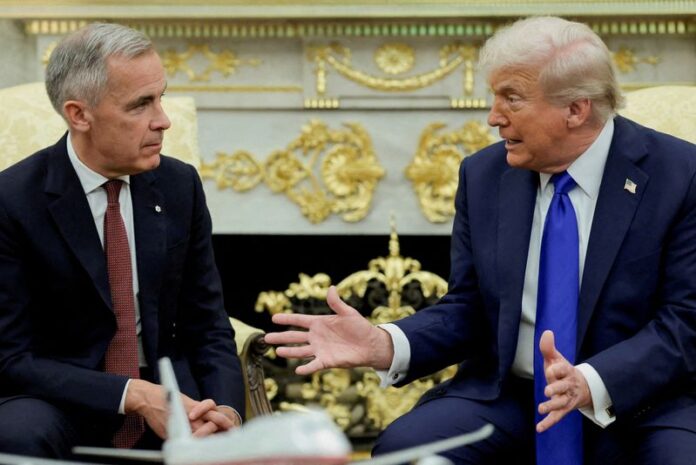
The dispute over defence spending is unfolding within a broader deterioration of Canada-U.S. relations. President Donald Trump and Prime Minister Mark Carney have clashed repeatedly over trade policy, as well as Trump’s stated interest in acquiring Greenland and his suggestion that Canada could become the 51st American state.
Meanwhile, the Pentagon has identified the Arctic as an increasingly critical zone for U.S. national security and economic interests, and has been pressing NATO allies to meaningfully strengthen their own defence capabilities.
Carney has publicly acknowledged that Canada’s historically close ties to the United States, once considered an asset, have become a source of vulnerability. He has moved to deepen relationships with what he describes as “middle powers”, positioning Canada within a coalition of allies less dependent on Washington.
Despite the Pentagon’s move, Carney has sought to play down the significance of the PJBD suspension, framing it as one episode within a broader and ongoing relationship.

