It began, as so many things do in the current American political moment, with a post on social media. On October 4, Elon Musk wrote on X that he was done with the term “AI.” His exact words: “No more AI. SI It’s better.” Within minutes, an X user going by XFreeze asked whether that meant xAI — the company Musk founded to develop the Grok chatbot — might be renamed “SpaceXSI.” Musk replied simply: “Yes, we will make that change.”
No formal corporate announcement followed. No regulatory filing, no press release, no official statement from xAI’s communications team. But the exchange was enough to signal something significant: one of the most powerful figures in the global technology industry was publicly aligning himself with a White House push to retire the phrase “artificial intelligence” from the federal lexicon entirely.
Weeks earlier, President Donald Trump had signed an executive order directing agencies across the executive branch to replace the terms “artificial intelligence” and “AI” with “Super Intelligence” and “SI” in all official communications. The order argued that modern AI systems had advanced so far beyond the technology’s original conception that the old name no longer fit. Trump had previewed the change at the United Nations General Assembly, telling delegates that the word “artificial” made the technology sound “fake” — a curious objection, but one that apparently carried weight inside the White House.
Before signing the order, Trump had even crowdsourced the new name on Truth Social, asking users to choose between “super intelligence” and “superior intelligence.” More than 50,000 people responded, and 65 percent backed “super intelligence.” The result gave the administration a veneer of popular mandate for what is, at its core, a branding decision with potentially sweeping consequences for how governments and industries talk about one of the defining technologies of the era.
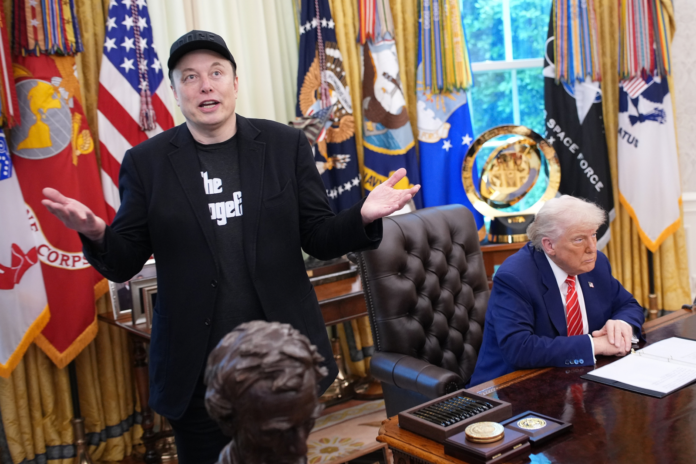
The executive order arrived on the same day Trump hosted a White House summit with some of the most consequential figures in the technology sector. Musk was there, alongside Amazon founder Jeff Bezos, Nvidia CEO Jensen Huang, Anthropic CEO Dario Amodei, OpenAI co-founder Greg Brockman and Microsoft CEO Satya Nadella. Discussions centred on the rapid development of AI systems and their potential societal impact — a conversation that now carries the added layer of a government insisting the technology be called something else altogether.
Trump also announced the creation of a Super Intelligence Force, a new federal body tasked with coordinating the government’s approach to the technology and overseeing its engagement with consumers, public-interest groups, religious organizations, critical infrastructure providers and technology companies. According to The Wall Street Journal, the task force has 120 days to deliver a report assessing the risks and opportunities of super intelligence and recommending a federal governance framework.
The force will be led by a notable constellation of officials: Director of National Intelligence Jay Clayton, Federal Trade Commission Chairman Andrew Ferguson, Under Secretary of War for Research and Engineering Emil Michael and Office of Personnel Management Director Scott Kupor. It reports directly to the president and to White House Chief of Staff Susie Wiles. Trump described super intelligence as a technology with greater transformative potential than both the Industrial Revolution and the internet — a claim that, whatever one makes of the terminology debate, reflects the genuine weight policymakers are now placing on the field.
That weight makes the terminology question more than cosmetic. Marketing expert Jean-Pierre Dubé of the University of Chicago had previously warned that “super intelligence” already carries a well-established meaning in technology and academic circles, where it conventionally refers to hypothetical systems that exceed human cognitive performance across all domains. Grafting that term onto present-day large language models and chatbots risks muddying a distinction that researchers and ethicists have long relied upon. Dubé was direct: widespread adoption of the new terminology would almost certainly depend on whether leading companies and executives chose to embrace it.
Musk’s informal endorsement, then, matters — even if it arrived in the form of a two-sentence exchange on a social media platform he owns. xAI’s Grok competes directly with products from OpenAI, Anthropic, Google and Microsoft. If Musk follows through on a corporate rebrand, it would represent the first major industry signal that Trump’s linguistic overhaul might travel beyond the federal government’s own documents and portals.
The administration has already moved on other fronts to embed the new framing in public-facing infrastructure. It launched America.gov, a chatbot-style portal designed to help citizens navigate federal programs, services and benefits — a tool that, by design, will operate entirely within the new “SI” vocabulary.
Whether the rest of the technology sector follows remains genuinely open. The executives who gathered at the White House summit have not publicly committed to the new terminology. The 120-day clock on the Super Intelligence Force’s report will likely bring the question back into sharp focus. By then, it should be clearer whether Musk’s offhand reply on X was the first domino or simply an isolated gesture of alignment with a president whose favour carries considerable commercial value.
TBPANews contacted xAI and the White House for comment on October 4.

