
The cuts came quietly, but their consequences are anything but.
Since September 2024, the World Food Programme has reduced by 50 percent the number of Palestinians in the occupied West Bank receiving food assistance, citing what it describes as “critical funding constraints” driven by declining contributions from international donors. The decision landed on a population already reeling from Israeli military operations that have forcibly displaced tens of thousands from refugee camps across the northern West Bank, and it has pushed families who were barely surviving into outright destitution.
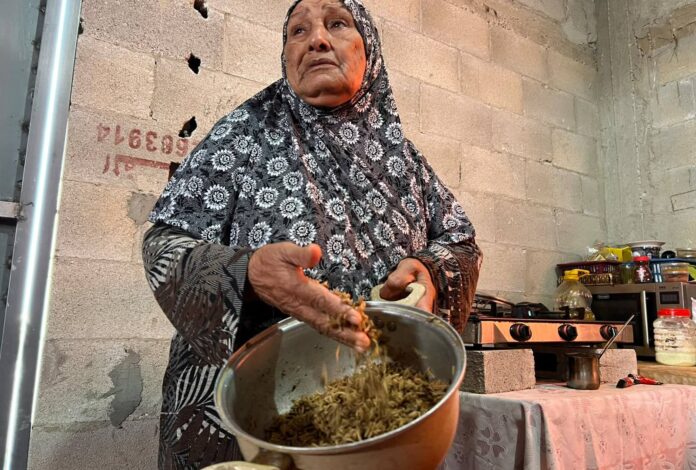
Fawza Awad, a 75-year-old widow from the Tulkarem refugee camp, was displaced in January 2025 when Israeli military operations swept through the camp and demolished her home, replacing it with a road to facilitate the movement of military vehicles. She now lives in a cramped, unfinished structure belonging to her daughter, sharing the space with her son, his wife, and their child. One of her other sons has been held in Israeli detention since 2024. The rest, who previously worked inside Israel, are now unemployed. The food assistance the family once relied upon stopped five months ago. “We used to receive modest food aid barely enough for two or three people, but now that has stopped completely,” she told Al Jazeera, describing monthly medication costs of at least 200 shekels ($64) that no one helps her cover.
At the al-Muwahhad School in the Thannabeh suburb of Tulkarem, more than 1,000 Palestinians displaced from the Tulkarem and Nur Shams refugee camps are sheltering in a building never designed for long-term habitation. Among them, Rabab Qasim, 47, and her husband Talib Abu Sarriya, 72, have been living with their three children in a 30-square-metre room for two consecutive years, with no income and total dependence on aid that has now vanished. Rabab suffers from a herniated disc requiring monthly treatment she cannot afford, and sleeps on a worn mattress on the floor. Talib, who once ran a modest vegetable stall in the camp, told Al Jazeera the family frequently goes to bed without having eaten.
The WFP’s own quarterly food security analysis places the scale of the crisis in stark relief. Approximately 900,000 people in the West Bank are currently experiencing food insecurity, a figure that has more than doubled since 2023, when Israel launched its military campaign in Gaza and intensified operations across the West Bank. Seventy-six percent of Palestinian households in the West Bank have experienced a significant decline in income. Twelve percent of the population now has what the WFP classifies as poor food consumption, and one-third of households cannot afford a nutritionally adequate diet. Rural areas and southern governorates have been hit hardest.
In Khirbet al-Rakeez, a village in Masafer Yatta south of Hebron, Said al-Amour, 61, has not received any WFP assistance for seven months. In April 2025, during one of the repeated settler attacks on his community, he was shot by a settler, resulting in the amputation of his leg. He continues to face periodic assaults. Monthly medical treatment now costs him at least 1,200 shekels ($385), money he does not have. His only livelihood consists of a few olive trees that settlers regularly attempt to seize. “They are trying to steal our land,” he said. “Now, they have cut off the aid I used to receive that helped my family remain steadfast here.”
The WFP continues to provide assistance to roughly 200,000 Palestinians in the West Bank through cash transfers, food vouchers, direct food supplies, livelihood programmes, and nutritional services, but it has acknowledged plainly that it lacks the resources to reach all families in need. In a statement to Al Jazeera, the agency clarified that the suspension of aid does not reflect a finding that individual beneficiaries are ineligible, but rather a sweeping reduction applied across the board regardless of individual circumstances, with the possibility of reinstatement communicated by text message.
Economist and human rights activist Ubai Aboudi described the situation as a compounding humanitarian and financial crisis. He pointed to Israel’s complete withholding of customs revenues collected on behalf of the Palestinian Authority since May 2025, a measure that has left the PA unable to pay public sector salaries. He noted that tens of thousands of Palestinians who previously worked in Israel and in illegal settlements have been without work permits since October 2023. He also highlighted Israeli restrictions on Palestinian and international non-governmental organizations, including the suspension of registration for 37 international organizations and the closure of some local groups, which have further constrained the capacity to deliver humanitarian assistance. “Around half a million Palestinian families need food assistance, while the actual need may be greater,” Aboudi said. “With aid declining from the World Food Programme and other sources, many families are unable to secure food.”
The convergence of military displacement, settler violence, economic strangulation, and the retreat of international humanitarian funding has created conditions in which hunger is no longer an emergency exception in the West Bank, but a daily and widening reality.

