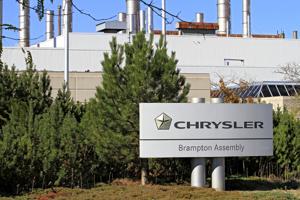
On the morning of November 9, a line of trucks, pylons and workers carrying Unifor flags appeared at the gates of Stellantis’s long-idle Brampton assembly plant. The environmental consultants from Pinchin Ltd. who had arrived to begin their assessment of the property never got inside. That blockade, now in its third week, has pushed one of Canada’s most consequential auto industry disputes into Ontario Superior Court.
Stellantis filed a statement of claim last week seeking an immediate injunction against Unifor, Canada’s largest private-sector union, arguing the blockade is designed to derail the sale of the 2.95 million-square-foot facility to Roshel, a Brampton-based defence manufacturer. The environmental assessment is a condition of Roshel’s due diligence, and without it, the deal cannot close.
“Unifor is attempting to frustrate the proposed transaction by preventing Pinchin from conducting the necessary environmental work as part of Roshel’s due diligence,” the company wrote in its claim. Stellantis added that it still expects the sale to close officially by mid-December, and that the blockade will not change that outcome, though it acknowledged the financial harm is “extremely difficult, if not impossible, to quantify in monetary terms at this time.”
Named as defendants are Unifor national president Lana Payne and Ardis Snow, who heads Unifor’s unit at the Brampton plant. The company is also seeking an unspecified amount in damages. Payne, for her part, did not soften her position. “The sale of the plant to Roshel is unacceptable to our union,” she said in a written statement. “We will continue to work with all parties to try to get a different outcome.”
The legal confrontation unfolds against a backdrop of urgent, multi-party negotiations. Federal Industry Minister Melanie Joly, who has warned that Stellantis must repay “hundreds of millions of dollars” in government subsidies if the sale proceeds, is expected at a four-way meeting Wednesday, the third such gathering in two weeks, alongside union officials, provincial representatives and Stellantis North America’s chief operating officer Pablo Di Si. Sources confirmed Joly also met Di Si on Tuesday ahead of that session.
York University labour studies professor Steven Tufts sees the current action as potentially the opening move in a longer campaign. “I’m wondering if this is a warm-up blockade for a broader effort to keep the company from moving equipment out,” he said, noting that worker anger would intensify sharply if machinery began leaving for American plants.
The Brampton plant has sat idle since December 2023, when Stellantis shut it down for retooling to produce a new version of the Jeep Compass. The company later paused that retooling, citing shifting market conditions and tariffs imposed by U.S. President Donald Trump, before redirecting Compass production to facilities in the United States. Contract talks between Stellantis and Unifor broke down in September, largely over the plant’s uncertain future, setting the stage for the confrontation now playing out in court and at the bargaining table simultaneously.
Roshel, founded in 2016 and headquartered in Brampton, already operates plants in Shelby Township, Michigan and Springfield, Ohio alongside its existing 400,000-square-foot Brampton facility. CEO Roman Shimonov has said he intends to produce both military and civilian vehicles at the larger Stellantis site. The company has supplied armoured vehicles to police forces in the United States and Canada, delivered thousands of vehicles to Ukraine, and drawn criticism in both countries for selling vehicles to U.S. Immigration and Customs Enforcement. Roshel declined to comment on the lawsuit.
The statement of claim was sent November 20, giving Unifor 20 days to file a defence, with a possible 10-day extension if the union gives formal notice of its intent to contest. Whatever happens in court, the workers whose livelihoods depend on that plant are watching Wednesday’s meeting with the understanding that the gap between a closed deal and a shuttered future may still be negotiable, even if narrowing fast.

