
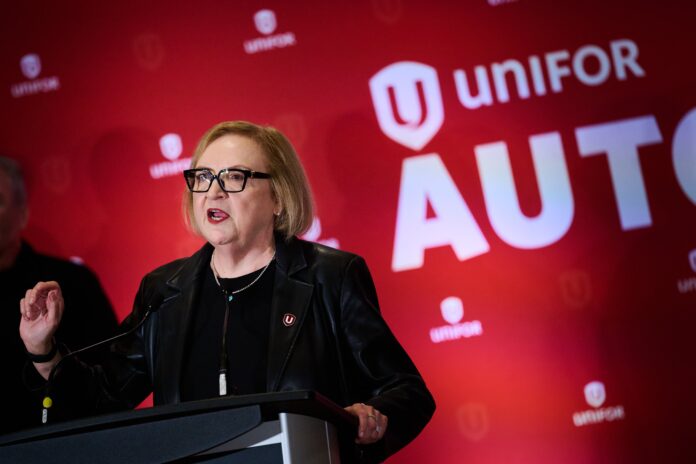
On a weekend when most Canadians are thinking about the tail end of summer, more than 9,000 autoworkers represented by Unifor will be casting ballots that could set the stage for a major labour confrontation with one of the world’s largest vehicle manufacturers. The vote, held Saturday and Sunday, asks Stellantis workers across Canada whether to authorize a strike — a decision that carries particular weight for the hundreds of families still waiting to learn the fate of a shuttered plant in Brampton, Ontario.
Unifor plans to announce the results at the start of next week. The union has been careful to frame the exercise not as a declaration of war, but as a negotiating instrument. “A strike authorization gives the bargaining committee the authority to call a strike if necessary,” reads a statement signed by Unifor national president Lana Payne and other members of the bargaining committee. “It does not automatically mean a strike will take place.”
A Standstill at the Table
Contract talks between Unifor and Stellantis began September 1 in Toronto, following the union’s pattern bargaining process — the same approach that had already produced ratified agreements with Ford Motor Co. and General Motors in Canada earlier in the summer. But where those negotiations moved to conclusion, the Stellantis file ground to a halt.
The previous collective agreement expired September 20 without a tentative deal in place. By that point, the two sides were already stuck on several core issues, chief among them job security and the question of what happens to the Brampton assembly plant — a facility Stellantis has indicated it wants to sell.
The Brampton plant has been idle since 2023, when more than 2,000 workers were laid off. It had been earmarked for retooling to produce Jeep models, a process that began in early 2024, before Stellantis paused the plan and eventually announced it was shifting Jeep Compass production to Illinois. The plant has sat empty ever since, its future unresolved and its former workforce in limbo.
The Roshel Factor
Talks took a sharp turn on September 11, when Stellantis signed a memorandum of understanding with Roshel, a defence contractor, for a potential sale of the Brampton facility. Unifor says that development brought negotiations to a standstill. The union has since filed a grievance alleging the move to shift Jeep Compass production to the United States violated the terms of the previous collective agreement.
Roshel CEO Roman Shimonov has offered a measure of reassurance, saying the company is willing to consider hiring laid-off Brampton workers as soon as this year, through the federal government’s Light Utility Vehicles procurement program and other defence and automotive opportunities. Shimonov has also announced plans to establish a Canadian Centre of Excellence for Defence Manufacturing at the Brampton site, a project he says could involve more than 2,000 jobs.
For its part, Stellantis maintains it is bargaining in good faith. In a September letter to employees, Stellantis Canada president and CEO Trevor Longley acknowledged that “market and trade conditions have directly impacted the original business case” for the plant, while arguing the potential sale could support future operations at the site. Company spokesperson LouAnn Gosselin echoed that position this week, saying Stellantis “remains committed to bargaining in good faith” and to reaching “a negotiated agreement that recognizes the contributions of our employees.”
Ottawa’s Role — and Its Silence
The federal government has become an unavoidable presence in this dispute. Unifor’s Lana Payne has written directly to federal Industry Minister Mélanie Joly, urging Ottawa to block the potential sale of the Brampton plant and to clarify whether the memorandum of understanding with Roshel breached commitments Stellantis had previously made to the government. Joly’s office did not respond to a request for comment.
Prime Minister Mark Carney weighed in last fall, saying he had expressed disappointment directly to Stellantis’ global leadership over the decision to move Jeep Compass production south of the border. Carney reminded the company of its obligations under funding arrangements with Ottawa — arrangements that included commitments to maintain the Brampton plant — and warned of consequences if those obligations went unmet. Whether that warning carries practical force remains to be seen.
What the Vote Means
The strike authorization vote is, at its core, a signal — a way for workers to tell their employer how seriously they take the impasse. Unifor has been explicit that job action is a last resort, and the union’s leadership will be hoping the mandate, if granted, is enough to move Stellantis back to the table in a more constructive frame of mind.
But behind the procedural language lies a more urgent human reality. For the thousands of workers who lost their jobs when the Brampton plant went dark, and for those at other Stellantis facilities across Canada who are watching the negotiations closely, the outcome of this weekend’s vote is not an abstraction. It is a question about whether collective bargaining — and the institutions built around it — can still deliver results when a multinational company and a federal government are both, in their own ways, hedging their commitments.

