When Elections Feel Like Intrusions
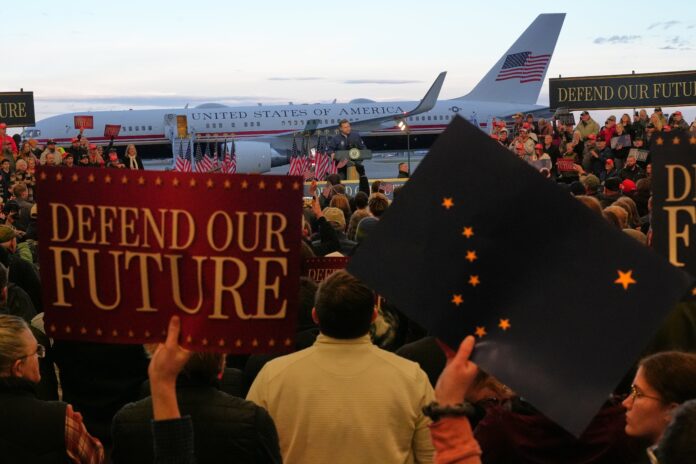
Campaign season has arrived in Alaska with unusual force — and for at least one Willow resident, it has made itself felt in the most personal of spaces: the cellphone inbox. That small detail points to something larger. The 2024 election cycle is saturated with outside money, partisan messaging, and a deepening sense that the two major parties are fighting for institutional control rather than governing on behalf of ordinary people.
The thesis Mark Miller advances in his letter to the editor is blunt and worth taking seriously: when political parties prioritize power over each other above the interests of their constituents, the democratic republic they are supposed to sustain begins to corrode. He traces this warning to one of the framers of the American Constitution — an attribution that, while imprecise, reflects a genuine intellectual tradition. James Madison, in particular, warned extensively about the dangers of faction in Federalist No. 10, arguing that unchecked partisan rivalry was among the gravest threats to republican self-government.
Outside Money and the Question of Democratic Legitimacy
Miller’s most concrete concern is the flow of campaign donations from outside Alaska into races for the state’s federal representation. He argues, pointedly, that money influencing who represents Alaskans ought to come from Alaskans. This is not a fringe position. The question of whether large-scale out-of-state fundraising distorts local democratic accountability is a live and serious debate in campaign finance law and political science alike.
Alaska has long occupied a distinctive place in American political geography — a vast, resource-rich state with a small population, a powerful congressional delegation relative to its size, and a political culture that prizes independence. When national interest groups, whether progressive or conservative, pour millions into Alaskan races, they are not simply backing candidates; they are purchasing influence over federal policy on energy, Indigenous land rights, and Arctic sovereignty. The legitimacy concern Miller raises deserves more rigorous public scrutiny than it typically receives.
Partisan Themes and Their Contradictions
Miller sketches the competing messages of the two parties with a sharp, if sometimes uneven, hand. Democrats, he notes, have campaigned heavily on the cost of living and economic relief — a striking posture given that inflation accelerated during the Biden administration and the party struggled to contain it. Their emphasis on taxing the wealthy, particularly billionaires, reflects a genuine shift in the party’s economic centre of gravity, driven in part by its progressive wing. Whether that shift represents sound policy or electoral positioning is a legitimate question that voters across the country are weighing.
His comparison of progressive tax rhetoric to Soviet-era class politics is the letter’s most tendentious passage, and it conflates very different political traditions. Social-democratic tax policy, as practised in Scandinavia, Canada, or postwar Western Europe, operates within robust democratic institutions and has produced some of the world’s highest living standards. The Soviet experience was defined not by taxation but by the violent elimination of political pluralism — a categorically different phenomenon. The comparison does not hold under scrutiny, even if the underlying anxiety about concentrated ideological power is worth acknowledging.
On energy and foreign policy, Miller touches on genuinely complex terrain. The war in Ukraine has disrupted global energy markets in ways that affect fuel prices well beyond the conflict zone, and Ukrainian strikes on Russian refining infrastructure have added further pressure to supply. His passing reference to missile attacks on Saudi oil infrastructure reflects real volatility in the Middle East energy corridor. These are legitimate factors in the fuel price debate — factors that resist simple partisan attribution, whether blame falls on Trump-era decisions or Biden-era policy choices.
What the Letter Actually Reveals
Stripped of its more colourful historical analogies, Miller’s letter captures something genuine about the mood of many voters heading into a high-stakes election: frustration with a political system that feels increasingly managed by national forces and ideological imperatives rather than local needs and practical governance. The warning about two-party rivalry consuming the republic is older than the republic itself, and it has never been fully answered. That it resurfaces, in a letter from a resident of Willow, Alaska, written in the middle of a campaign season that has invaded his phone, suggests the concern is not going away.
The implication is uncomfortable for both parties. If the dominant parties continue to treat elections primarily as contests for institutional power — the House, the Senate, the presidency — rather than as mandates to address the specific, material concerns of specific communities, the democratic legitimacy they depend on will keep eroding. Alaska, with its distinct geography, economy, and mix of Indigenous, settler, and resource-industry communities, is a particularly sharp lens through which to see that erosion at work.

