
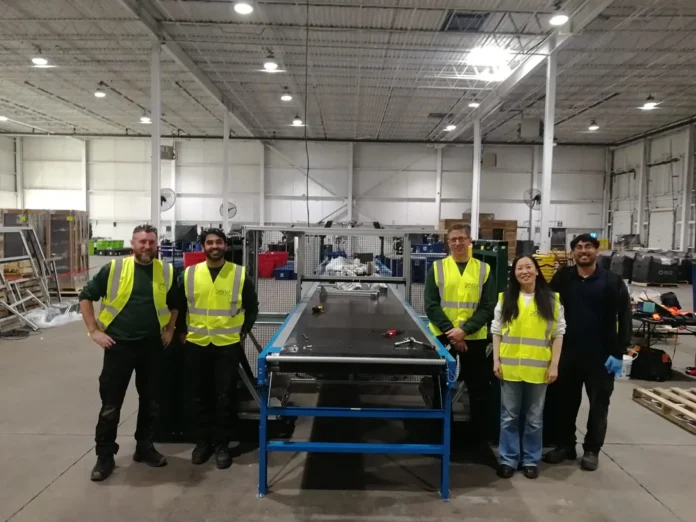
The recycling bins were meticulously labelled, colour-coded, and positioned throughout the office with the kind of careful intention that signals a company taking its environmental commitments seriously. Then, at the end of each day, the cleaning staff emptied them all into the same bag. Amy Ma, then a software developer at a London bank, watched this happen and felt something shift. The performance of sustainability, she realized, was not the same thing as sustainability itself — and the gap between the two ran much deeper than one well-appointed office building.
The more Ma examined the problem, the more structural it appeared. Recycling, as an industry, depends heavily on human beings standing along conveyor belts and sorting through streams of mixed waste by hand — a slow, expensive, and error-prone process that shapes the economics of the entire sector. The technology to do better, she believed, already existed in adjacent fields. It simply hadn’t been applied here with enough ambition or rigour. “I saw the technology and thought, we can do so much better,” she recalls.
A Robot Built Differently
That conviction eventually became Danu Robotics, a six-year-old company based in Edinburgh, Scotland, that Ma founded to bring a genuinely competitive sorting robot to market. The machine, which the company calls H.E.R.O., is designed to move through a recycling stream faster and more cheaply than human sorters — and with meaningful technical differences from the robotic competitors already operating in the space. Where many rival systems, including those offered by companies like Glacier and RecycleEye, rely on suction-based arms to grab and redirect materials, H.E.R.O. uses a pincer claw. The distinction matters: suction systems can struggle with irregular, wet, or compressible materials, the kinds of objects that appear constantly on a real sorting line.
But the more significant differentiator, Ma argues, is not the hardware. It’s the software strategy underneath it. Danu leverages artificial intelligence to continuously improve H.E.R.O.’s performance over time, meaning the robot learns from each deployment and becomes progressively more capable. This kind of iterative, data-driven refinement is common in consumer technology and enterprise software, but it remains relatively rare in industrial robotics — and particularly rare in the waste management sector, which has historically been slow to absorb new technology at scale.
The Numbers Behind the Pitch
The commercial logic Ma presents to prospective customers is straightforward and deliberately concrete. Because recycling facilities generate revenue from the materials they successfully sort and sell, a more effective sorting system translates almost immediately into additional income. Ma estimates that a working H.E.R.O. installation generates roughly $485,000 in additional revenue for a facility, set against an initial investment of $160,000 and annual maintenance costs of approximately $24,000. Those figures, if they hold up under real-world conditions, represent a compelling return — and they position Danu as meaningfully cheaper than the competition.
The market Danu is targeting is substantial. Recycling sorting across Europe and North America represents a roughly $20 billion opportunity, and the company has already begun to establish a foothold. It has secured $500,000 worth of signed contracts and holds letters of interest from two large customers. More than 200 potential clients sit in its sales pipeline — a figure that, even accounting for the inevitable attrition of early-stage sales processes, suggests genuine demand. On the strength of that commercial momentum, Danu recently closed $5 million in late-seed funding to sustain its push into the market.
Beyond the Sorting Facility
With machines already shipping to initial customers, Ma is focused on what comes next: making H.E.R.O. smaller, sturdier, and more adaptable. The current version is built for dedicated waste-sorting facilities — large, fixed installations where the robot can be integrated into an existing conveyor line. But Ma’s longer-term vision reaches well beyond that setting. A more compact, portable version of the robot could be deployed at the point where waste is actually generated, rather than after it has already been mixed and transported to a central facility.
“Once it’s smaller, it can be used as a stand-alone recycling solution for events, for shopping centres, hospitals, or airports to recycle their waste at the source,” Ma told TechCrunch. “And that’s the way we can really change how we’re managing our packaging waste.” The ambition embedded in that statement is considerable. Sorting waste at the source — before contamination degrades the value of recyclable materials — would address one of the most persistent and costly inefficiencies in the entire recycling chain, the same chain that Ma first glimpsed through the lens of a well-funded London office that couldn’t quite manage to keep its bins separate.

