
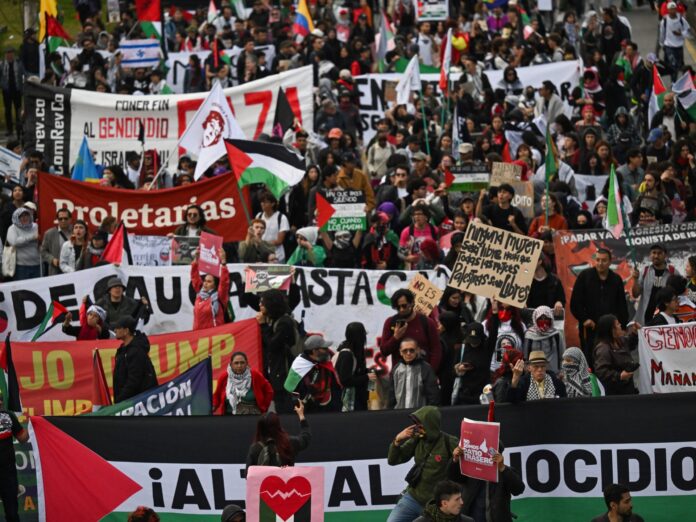
Hundreds of demonstrators took to the streets of Bogotá on Wednesday to protest their government’s decision to restore diplomatic and economic relations with Israel, marking three years since the Hamas-led attacks of October 7, 2023, and the war on Gaza that followed.
A Sharp Reversal in Foreign Policy
The rally began in front of the Israeli embassy in Bogotá, where protesters condemned President Abelardo de la Espriella’s decision to reopen a Colombian embassy in Jerusalem — a move that signals a significant departure from the stance of his predecessor.
Former President Gustavo Petro had severed diplomatic ties with Israel and halted Israeli arms imports, positioning Colombia as one of the more vocal critics of Israel’s military campaign in Gaza. De la Espriella, sworn in last August, has moved swiftly in the opposite direction.
Within days of taking office, his government also recognized Israel’s claim of sovereignty over the occupied Syrian Golan Heights, a position that puts Colombia in a small minority of states worldwide and drew immediate condemnation from human rights advocates.
Protesters Speak Out
For many demonstrators, the policy shift carries a moral weight that goes beyond diplomatic procedure. “When diplomatic relations with Israel were broken off, the message was that we would not be a nation complicit in their atrocities,” said Nicolás Isaza, one of the participants. “Today our government is no longer drawing a line against the atrocities being committed in Palestine,” he added.
The sentiment on the streets reflects a broader tension between de la Espriella’s foreign policy vision and the convictions of a significant portion of Colombian civil society, which had rallied behind Petro’s more confrontational stance toward Israel.
A Strategic Calculation
De la Espriella campaigned on a promise of close relations with both the United States and Israel, framing those ties as essential tools in Colombia’s long-running struggle against domestic armed groups. The approach reflects a traditional security-first logic that prioritizes alignment with Washington over the kind of solidarity diplomacy that defined the Petro years.
Whether that calculation will hold politically remains an open question, as Wednesday’s protest demonstrated that the issue carries genuine mobilizing power among Colombians who see their country’s foreign policy as an extension of its moral commitments.

