
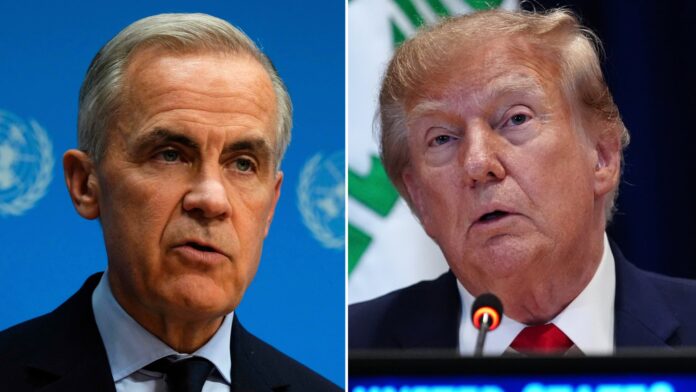
There are weeks in Canadian public life when the sheer accumulation of events resists easy summary, when the ordinary machinery of diplomacy, defence planning, and political posturing all seem to accelerate at once, producing a kind of compressed intensity that demands careful attention rather than breathless cataloguing. The week of September 22 to 25, 2026, was one of those weeks — shaped above all by a single, carefully chosen phrase from Prime Minister Mark Carney, and by the predictable storm it generated on both sides of the border.
In an interview with The New York Times published on Wednesday, Carney acknowledged that he had examined the possibility of a U.S. military invasion of Canada. He described it as an “extreme tail risk” — a term drawn from financial risk modelling, denoting an event of enormous potential consequence that remains highly improbable — and he was unambiguous about his reasoning. “That’s not a base case,” he told the Times, “but it would be irresponsible not to” prepare for it. The word “invasion” was not his; the Times bureau chief who conducted the interview, Matina Stevis-Gridneff, later clarified on CTV that Carney had paused for several seconds before answering, that he “clearly reflected very, very carefully on what he wanted to say,” and that the framing belonged to the newspaper. Still, the substance was unmistakable: the prime minister of Canada had, on the record, confirmed that his government had run scenarios involving hostile military action by its closest ally and largest trading partner.
The reaction was immediate, and divided along predictable lines. Defence Minister David McGuinty, speaking to reporters ahead of a cabinet meeting Thursday, reached for the language of institutional normalcy. “It is normal,” he said flatly. “All militaries in the world spend time analyzing risk scenarios.” Artificial Intelligence Minister Evan Solomon, pressed by CTV’s chief political correspondent Vassy Kapelos on what concrete preparations might look like, was similarly composed: “That’s the way every government functions. You run any scenario, so you’re prepared for everything.” Neither minister would offer specifics, and neither seemed inclined to.
Not everyone accepted the framing so calmly. Peter MacKay, who served as both defence minister and foreign affairs minister under Stephen Harper, told CTV News Channel on Thursday that he found Carney’s remarks not merely puzzling but counterproductive. “It takes us from the realm of retaliation to provocation,” MacKay said, arguing that what Canada most urgently needed was to return to the negotiating table on tariffs, not to signal adversarial contingency planning to Washington. “I’m not sure what the effort was here, to perhaps play to a domestic audience, to send a message to the White House, but I don’t think it’s working in our favour.” His critique deserves to be taken seriously, even if one ultimately disagrees with it — the diplomatic costs of public risk-management language are real, and the line between responsible prudence and strategic signalling is rarely clean.
Tom Mulcair, the former federal NDP leader turned political analyst, offered the counter-argument with characteristic directness: “It’s not because someone imagined it in some vague committee on Parliament Hill in Ottawa. It’s because Donald Trump said he was going to try to make Canada the 51st state.” That context matters enormously. Canada’s contingency planning does not exist in a vacuum; it exists in a political environment where the sitting American president has repeatedly mused, publicly and without evident irony, about annexing his country’s northern neighbour. CTV’s U.S. political analyst Eric Ham pointed to the American intervention in Venezuela and the escalating tensions over Greenland as evidence that Trump-era foreign policy has expanded the range of scenarios that responsible governments must consider.
Trump himself, for what it is worth, told CBS News back in May 2025 that military action against Canada was “highly unlikely” — “I don’t see it with Canada. I just don’t see it, I have to be honest with you.” His comments about Greenland in the same breath were notably less reassuring. On Wednesday, he turned to Truth Social to accuse Canada of “destroying itself by allowing millions and millions of people into the Country” who were “essentially unchecked and unvetted,” adding that “it is a Liberal takeover that will end up very badly” and citing what he called Canada’s “big” unemployment rate as evidence of Liberal mismanagement.
The unemployment figures Trump invoked deserve more than a passing glance. Canada’s rate stood at 6.4 per cent in August, according to Statistics Canada — more than two percentage points above the American figure of 4.1 per cent. But the comparison is less straightforward than it appears. The two countries measure unemployment differently: Canada counts people who are not working due to family responsibilities as unemployed, while the United States does not. A TD Economics study released in the fall of 2025 estimated the Canadian rate would have been at least one percentage point higher still had population growth not been slowed. And Statistics Canada itself noted that accelerated employment losses in trade-dependent industries were directly linked to the tariffs Trump imposed on Canadian goods — a causal chain that makes his critique particularly circular.
On immigration specifically, Trump’s claims collide directly with the data. Statistics Canada reported that Canada’s population grew by only 0.2 per cent in the second quarter of 2026, that immigration was down 4.2 per cent year-over-year, and that the number of non-permanent residents had fallen by 0.7 per cent. The Carney government’s first budget, delivered in late 2025, set explicit targets to “responsibly manage immigration to alleviate pressures on housing demand.” Permanent resident admissions, which had peaked at 483,640 in 2024, fell to approximately 393,500 in 2025 and are projected to stabilize at 380,000 annually from 2026 to 2028. Foreign Affairs Minister Anita Anand made these points plainly when asked to respond to Trump’s Truth Social post, noting that the government had moved deliberately to reduce intake and stabilize levels. Ottawa’s target is to bring temporary resident volumes down to five per cent of the population by the end of 2027.
Against this backdrop of friction with Washington, Carney’s broader strategic posture is coming into sharper focus. In the same Times interview, he spoke of expanding Canada’s economic ties with China and reducing both military and technological dependence on the United States — including, notably, a reduction in reliance on Elon Musk’s Starlink satellite systems. He also addressed Canada’s ongoing review of its planned purchase of 88 American F-35 fighter jets, acknowledging that the Swedish Saab Gripen represents “a real decision because of differing capabilities, because of strategic dependencies, and because of the economic return.” Canada has already committed to 16 F-35s to replace its aging CF-18 Hornets, but Carney ordered a review of the remaining 72 aircraft contract after Trump first imposed tariffs on Canadian goods. In what amounts to a quietly remarkable footnote to all of this, Canada’s first F-35 took its maiden flight Wednesday in Fort Worth, Texas — the first new fighter jet bearing Canadian markings in 44 years — with barely a word of acknowledgment from the Canadian military. The milestone passed in near-silence, a reflection of how politically complicated the purchase has become.
There were other currents running through the week, less dramatic but not without significance. In Ottawa, Vietnamese President Tô Lâm met with Carney, and the two leaders discussed a new agreement on people-to-people ties, energy, agriculture, and defence cooperation. Vietnam is Canada’s largest trading partner within ASEAN; Canada exported $1.3 billion in merchandise to Vietnam last year and imported $19.3 billion. Carney also confirmed that Indian Prime Minister Narendra Modi will visit Canada in December to sign a trade deal — a development that would have seemed improbable not long ago, given the profound deterioration in Canada-India relations following Ottawa’s allegations of Indian foreign interference and transnational repression in 2023. That the relationship has been sufficiently repaired to contemplate a free trade agreement speaks to the sustained diplomatic effort Carney’s government has invested in rebuilding it.
On the potash file, a brief drama resolved itself more quietly than it began. Trump had revealed earlier in the week that the United States was in talks to buy potash from Belarus at lower prices — a move that would have dealt a significant blow to a Canadian industry that supplies roughly 40 per cent of the world’s potash. Carney responded with a message of what he called “admiration” for the Canadian potash sector and expressed confidence that Canada would remain the world’s most reliable and cost-competitive supplier. By Tuesday, Trump was telling reporters at the United Nations General Assembly that the U.S. would “continue to go with Canada” — though he added, without apparent embarrassment, that Belarus had offered to sell for “a much lower price.” The episode illustrated, with almost theatrical clarity, the volatility of the current bilateral relationship and the degree to which Canadian industries now operate under a permanent cloud of American unpredictability.
At the United Nations, Carney co-hosted the OceanEye International Alliance event, committing $82 million to a global ocean observation program and announcing plans to expand Canada’s protected lands and waters to two million square kilometres by the end of the decade. He spoke of deploying autonomous underwater gliders to monitor activity beneath Arctic ice. “We can’t protect what we can’t see,” he said — a phrase that resonated beyond its immediate context. The event followed his trip to Strasbourg, where discussion of Canada’s potential associate membership in the European Union made headlines around the world, and it reinforced the sense of a government actively working to diversify Canada’s international relationships and reduce the structural vulnerability that comes from overwhelming dependence on a single partner.
In a separate Times piece, Carney offered a glimpse into his thinking about his own political future. Asked whether he would seek a second term, he was characteristically measured: “It’s too early to start asking.” He noted that much of what his majority government has committed to — major infrastructure and energy projects, the restructuring of Canada’s economic relationships — will take another year and a half to two years to produce results that Canadians will actually feel. He described this timeline as “beyond” the current political cycle, without suggesting he regarded that as a problem. It read less like a politician hedging than like a central banker thinking in longer time horizons than the electoral calendar typically permits.
And in Ottawa’s Central Park neighbourhood, city council voted unanimously to begin the process of renaming Trump Avenue — a street that had borne the current president’s name since a time when he was known primarily as a real estate developer rather than a disruptive force in continental politics. It was a small thing, in the grand scheme of what Canada is navigating. But there was something fitting about it: a country quietly, deliberately, and without drama, revising the names it has given to the landscape it inhabits.

