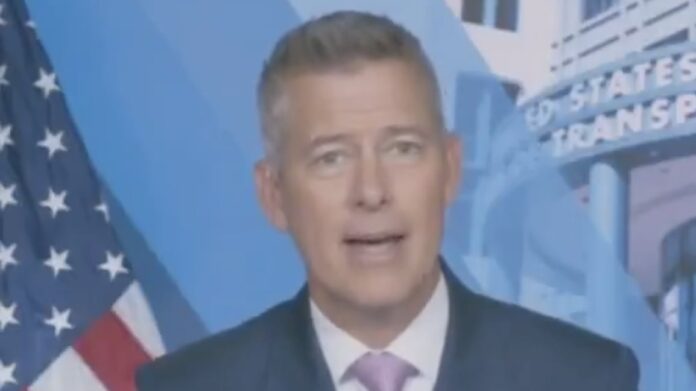
Transportation Secretary Sean Duffy faced pointed questioning Monday over his 2019 congressional vote against an appropriations bill that included more than $10.4 billion in Federal Aviation Administration funding, as the United States grappled with the aftermath of a nationwide FAA systems failure that grounded flights across the country.
Duffy, 55, appeared on CNBC’s Squawk Box as part of a six-network media blitz following the four-hour ground stop on Friday night. He had been publicly calling for $30 billion in new FAA funding, a figure he had raised by $20 billion on the very day the agency’s systems failed.
Co-host Becky Quick confronted Duffy directly. She asked whether he regretted his January 2019 vote against the Transportation, Housing, and Urban Development and Related Agencies Appropriation Act, legislation that would have directed significant additional resources to the FAA. Duffy responded with a nervous chuckle before pushing back.
“All of the FAA reauthorizations that funded the FAA, I voted for all of those,” Duffy said. “That vote was not a funding proposal for the FAA.” His claim drew immediate scrutiny. The 2019 appropriations package, brought to the floor during a government shutdown, explicitly included over $10.4 billion for FAA research, navigation facilities and air traffic operations.
House Republicans at the time opposed the bill on the grounds that President Trump might veto it, or that it would not adequately fund air traffic control programs. The bill ultimately passed both chambers and, combined with a separate compensation spending package, delivered $17.5 billion to the FAA for fiscal year 2019. Prior to that vote, Duffy had supported FAA funding bills in 2012, 2014 and 2018.
Duffy shifted responsibility squarely onto the current Congress. “Are you going to all vote for funding that will allow us to fix the system? That’s the question of this moment, at this time, for this Congress,” he said. He also argued that decades of congressional appropriations had produced little tangible improvement, claiming that roughly $15 billion given to the FAA over the past 25 years had yielded results where “barely anything was done.”

