
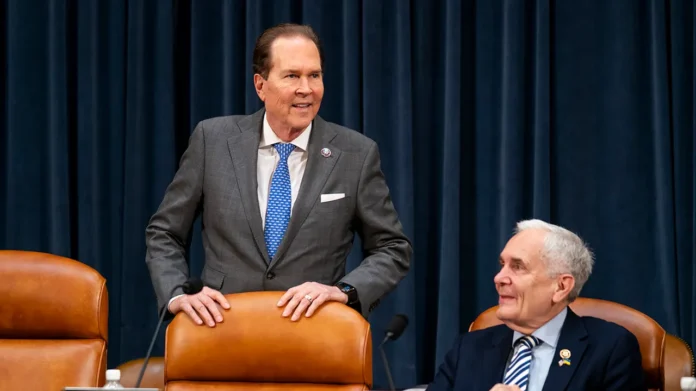
In a political climate defined by gridlock and partisan trench warfare, a piece of American healthcare legislation is quietly gathering remarkable cross-aisle momentum. The Alzheimer’s Screening and Prevention Act, known as the ASAP Act, has attracted 215 co-sponsors in the House of Representatives and 50 in the Senate — a level of bipartisan support that has become genuinely unusual in Washington.
The bill was introduced jointly by Representative Vern Buchanan, a Republican from Florida, and Representative Paul Tonko, a Democrat from New York. Their central argument is straightforward: blood-based biomarker tests capable of detecting Alzheimer’s disease and other dementias in their early stages already exist and have received FDA approval or clearance, yet most Medicare beneficiaries cannot easily access them because no reliable coverage pathway exists.
The ASAP Act would direct the Secretary of Health and Human Services to establish exactly that pathway — a formal mechanism through which Medicare would cover these blood tests when ordered for eligible patients.
The Clinical and Economic Case
The scale of the diagnostic gap is striking. Fewer than ten percent of people living with mild cognitive impairment ever receive a formal diagnosis, which means the vast majority of those affected are identified too late to benefit meaningfully from available treatments. Early detection changes that calculus entirely, opening a window for intervention that currently closes before most patients even know they need it.
Cost is a central part of the argument the bill’s sponsors are making. Blood-based biomarker tests are substantially less expensive than a PET scan, which has historically been the primary imaging tool used to identify Alzheimer’s-related changes in the brain. Despite that cost advantage, out-of-pocket expenses for blood tests remain prohibitive for many patients, particularly seniors on fixed incomes. The ASAP Act is designed to close that gap by routing coverage through Medicare, making the tests financially accessible to a much broader population.
The equity dimension is not incidental. As Buchanan and Tonko argue, access to cutting-edge diagnostic tools should not be determined by a patient’s income or postal code. That framing allows the bill to appeal simultaneously to progressive concerns about healthcare equity and to conservative emphases on patient choice and fiscal prudence — an ideological overlap that helps explain its unusually wide support.
What It Means Beyond Washington
For Canadians watching American healthcare debates, this legislation offers an instructive contrast. Canada’s universal system already provides a structural foundation for equitable access to diagnostic tools, but coverage decisions for emerging technologies — including blood-based biomarkers — remain uneven across provinces and territories. The policy challenge of ensuring that diagnostic innovation reaches patients regardless of where they live or what they earn is not uniquely American.
The ASAP Act does not resolve the deeper structural tensions in the American healthcare system, and it would be overstating the case to describe one bill, however broadly supported, as a turning point. What it does represent is a concrete, evidence-grounded legislative response to a specific gap in care — one that both parties, for their own distinct reasons, have found sufficient common ground to support.
Whether the bill advances through the full legislative process remains to be seen. But its current trajectory — 265 co-sponsors across both chambers — suggests that early Alzheimer’s detection has, for now, found the rare status of a healthcare issue that Washington is willing to act on together.

