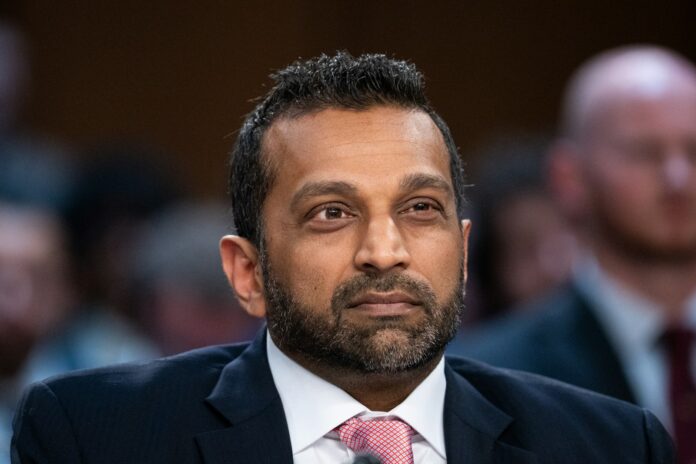
The Federal Bureau of Investigation is not supposed to make campaign ads. That is not a subtle point of constitutional law or a matter of interpretive dispute — it is a foundational principle of democratic governance, one that distinguishes law enforcement from propaganda. Yet under Director Kash Patel, the FBI appears to have crossed that line with striking boldness, and the implications for American democratic institutions deserve serious scrutiny.
A Video That Should Not Exist
On Tuesday, the FBI posted a two-minute video to social media that targeted Abdul El-Sayed, a Democratic candidate running for a Michigan Senate seat in November’s midterm elections. The video was not a public safety announcement. It was not a neutral crime-statistics briefing. It was, by any reasonable standard, a partisan attack ad — one produced and distributed using the resources of a federal law enforcement agency. The narration condemned what it called “democratic socialist leaders” for supporting defunding the police, and it featured footage of prominent Democrats including former Vice President Kamala Harris, Representatives Alexandria Ocasio-Cortez, Cori Bush, and Ilhan Omar. El-Sayed’s inclusion was unmistakable in its electoral intent: he is an active candidate, and the video aired in the lead-up to a competitive election.
The video’s factual claims compound the problem. Its central argument — that cities which moved toward defunding police experienced surging crime — is not well supported by available data. Crime rates in the United States have broadly declined over recent years, a trend that complicates any simple narrative linking progressive policing rhetoric to public safety failures. The FBI, an agency whose credibility depends on its relationship to evidence, broadcast a message that its own data does not cleanly support.
The video also praised Patel’s leadership directly and highlighted a sharp increase in violent-crime arrests under his tenure. That figure, however, has been disputed. Reports indicate that Patel’s FBI has adopted a practice of double-counting arrests made in conjunction with other law enforcement agencies, inflating the numbers in ways that serve the director’s public image rather than reflect operational reality. The bureau is, in other words, using manipulated statistics to promote its own director inside a video that attacks his political opponents. This is not law enforcement. It is public relations.
The Legal and Institutional Stakes
Federal law is unambiguous on this point. Government funds cannot be used for campaign purposes, partisan political messaging, or propaganda. These prohibitions exist precisely because a government capable of deploying its own agencies as electoral weapons is a government that has fundamentally broken faith with the citizens it serves. An attack video targeting a named Democratic candidate, built around contested claims and aired weeks before a midterm election, fits comfortably within all three prohibited categories. The irony is pointed: an FBI video preaching law and order almost certainly violated federal law in its production and distribution.
Yet the expectation that anything will be done about it remains low. The Trump administration has demonstrated, consistently, that it views the instruments of the federal government as extensions of its political operation rather than as institutions with independent mandates. This FBI video did not emerge in isolation. The administration has already spent at least $5.6 million in taxpayer funds — money redirected from the Department of Homeland Security, specifically from U.S. Customs and Border Protection — to produce and air at least fifteen campaign-style advertisements promoting the president’s agenda ahead of the midterms. The FBI video fits a pattern, not an aberration.
What This Means for Democratic Norms
The deeper concern here is institutional. Canadians watching this from across the border have the benefit of a comparative lens: the RCMP, for all its complicated history, operates under legal frameworks specifically designed to insulate it from direct partisan deployment. The erosion of that insulation in the United States — where the FBI, the Department of Homeland Security, and Customs and Border Protection are all now implicated in what amounts to a government-funded re-election campaign — represents a qualitative shift in how executive power is being exercised. It is not merely norm-breaking. It is the active construction of a different kind of state, one in which the line between governing and campaigning has been deliberately dissolved.
Patel’s FBI is not an outlier within this administration. It is a feature of it. And the question that follows is not simply whether these specific videos violated specific statutes — though they almost certainly did — but whether the democratic architecture that is supposed to prevent this kind of capture is still functioning. The answer, at the moment, is not reassuring.

