
A Line Drawn on Relitigation
The attempt by a Richmond industrial landowner to reopen the longest trial in Canadian history has failed — and the reasoning matters as much as the result.
In a decision released Monday, B.C. Supreme Court Justice Barbara Young dismissed applications by Montrose Properties and its affiliated companies to be added as defendants and reopen the Cowichan Aboriginal title proceedings. Justice Young found the request constituted an abuse of process through relitigation, drawing a firm line against what she described as a “wait-and-see” approach to constitutional litigation. The ruling reinforces both the finality of judicial proceedings and the integrity of the Aboriginal title recognition that emerged from a 513-day trial — the longest in Canadian history — that concluded in November 2023.
The underlying case is historic in scope. In August 2025, the B.C. Supreme Court recognized that the Quw’utsun (Cowichan) Nation holds Aboriginal title over approximately 300 hectares of land in Richmond, a territory historically known as Tl’uqtinus, where the Nation maintained a settlement. The court also recognized the Nation’s right to fish the south arm of the Fraser River, declared most Crown and municipal fee simple titles in the area invalid, and ordered the parties to negotiate a resolution within 18 months. All original parties — the federal government, the Province of British Columbia, and the City of Richmond — have filed notices of appeal.
Who Is Montrose, and What Did It Want?
Montrose Properties is the largest single private landowner within the recognized title area, holding approximately 120 hectares of industrial land that includes a Coca-Cola bottling plant and a Canadian Tire distribution depot. Its stake in the outcome is substantial, and its frustration is understandable on its face. The company argued that it received no formal notice of the original proceedings, that private landowners’ interests were never directly represented at trial, and that the declaration of Aboriginal title over its lands has caused concrete financial harm — including the collapse of a multi-million-dollar warehouse development after a lender and prospective tenant withdrew, and stalled negotiations with Fortis and Enbridge over a potential landfill gas facility.
Yet Justice Young was unpersuaded. While she acknowledged that Montrose received no formal notice, she found that the company was aware of the proceedings and chose not to seek party status during the trial itself. That choice, made over years of highly publicized litigation, could not be undone after the judgment landed unfavourably. “Allowing a new party to relitigate these issues, before this court, nearly two years after the conclusion of a 513-day trial, improperly interferes with the principle of finality,” she wrote in her 34-page judgment.
The concern about a “floodgate” effect was central to her reasoning. The title area encompasses land held by numerous private owners beyond Montrose. Permitting one late-arriving applicant to reopen the record, Justice Young found, would invite others to do the same — a process she described as “inefficient, disruptive to the parties, and would not enhance the integrity of the administration of justice.” The appropriate avenue, she concluded, is the appeal process already underway at the B.C. Court of Appeal, where Montrose may also apply to intervene.
The Deeper Constitutional Stakes
This ruling sits within a constitutional framework that Canadians are still learning to navigate. Aboriginal title, as affirmed by the Supreme Court of Canada in Tsilhqot’in Nation v. British Columbia (2014), is a collective right held by Indigenous peoples over lands they occupied prior to Crown sovereignty. It is not a minor administrative classification — it is a constitutionally protected interest that the Crown can infringe only if it meets a demanding justification standard. The Cowichan court found that the Crown’s granting of private titles on Tl’uqtinus lands did not meet that standard.
The Cowichan Nation has been consistent and explicit: they are not seeking to invalidate the titles held by individual private landowners, and they are not laying claim to those lands directly. Their action targets the Crown’s historical conduct — the unlawful disposition of Indigenous territory after British Columbia joined Confederation in 1871, when the province began selling Cowichan lands without legal authority, despite reserve lands having been set aside for the Nation by a colonial governor in the 1850s. The distinction between Crown responsibility and private landowner liability is legally and politically significant, even if it has not fully quieted anxiety among property holders.
That anxiety has found some political response. The B.C. government has announced up to $150 million in financial support for Montrose and other affected private landowners while the legal questions continue to work through the courts — an acknowledgment that the transition from historical wrong to practical resolution carries real costs, and that the state bears some responsibility for managing them.
What Comes Next
Montrose CEO Ken Low stated Tuesday that the company is reviewing the decision and considering its legal options, adding that “private property rights must be protected.” The company has 30 days to decide whether to appeal Monday’s ruling and may also seek intervener status in the Court of Appeal proceedings already initiated by the federal government, the Province, and the City of Richmond.
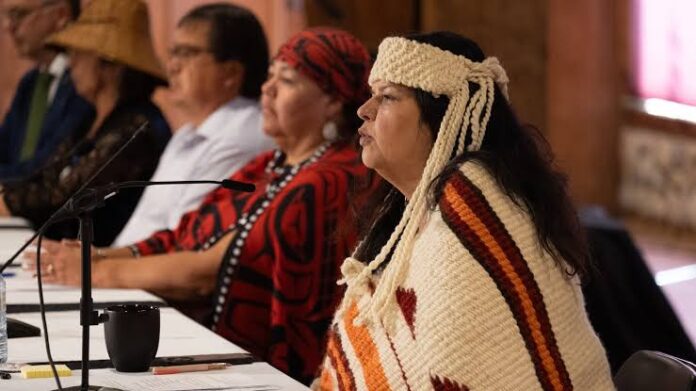
Cowichan Tribes Chief Cindy Daniels welcomed the result, saying the Nation can now focus on “respectful reconciliation work.” Shana Thomas, hereditary chief of Lyackson First Nation — part of the broader Cowichan Nation — put it plainly: “Aboriginal title cannot be treated as an afterthought.”
The implication of Justice Young’s ruling extends beyond this particular dispute. It signals that constitutional recognition of Aboriginal title, achieved through exhaustive litigation, cannot be casually undone by parties who monitored proceedings from the sidelines and found the outcome inconvenient. The proper forum for challenging the substance of the Cowichan decision is the Court of Appeal — and that is precisely where the argument will now continue. The question of how Aboriginal title, Crown responsibility, and private property rights coexist in Canadian law remains genuinely unresolved. But it will be resolved through the institutions designed for that purpose, not through procedural end-runs around a concluded trial.

