A Province Under Smoke
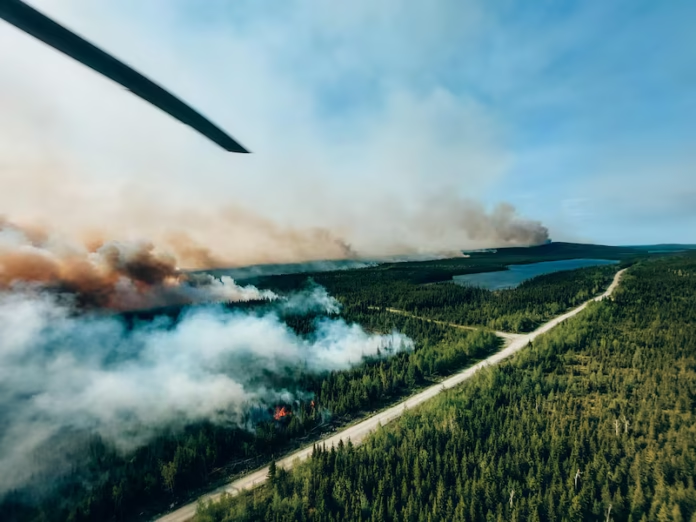
Quebec is contending with a significant wildfire emergency, with more than 100 active fires recorded across the province as of Monday afternoon. The crisis is concentrated overwhelmingly in the north, stretching across vast stretches of boreal forest and placing several remote and Indigenous communities under acute pressure. The scale of the situation reflects a pattern that has become increasingly familiar to Canadians in recent summers — and one that demands both immediate response and longer-term reckoning.
According to data from SOPFEU — the Société de protection des forêts contre le feu, Quebec’s wildfire prevention and suppression agency — 88 fires were burning in the northern zone as of 3 p.m. on Monday, June 29, while a further 19 were recorded in the intensive zone, which encompasses the central and southern regions of the province. That distinction matters: the intensive zone receives more active suppression resources, while fires in the vast northern territory are often monitored rather than directly fought.
Chisasibi Cut Off: A Cree Community in the Crosshairs
The most immediate human consequence of the fires has fallen on Chisasibi, a Cree community situated near James Bay in northern Quebec. The access road to the community has been closed until further notice, effectively isolating residents from ground-level supply and evacuation routes while emergency operations continue. Residents and visitors have been formally asked not to attempt to enter or leave the community.
Chisasibi is home to several thousand members of the Cree Nation of Eeyou Istchee, a community whose relationship with the land and whose vulnerability to environmental disruption carries a significance that extends well beyond the immediate emergency. The closure of the access road is not merely a logistical inconvenience — it is a reminder of how thinly serviced many northern Indigenous communities remain, and how quickly a wildfire season can sever the connections that sustain them.
Air Quality and the Coming Days
Simon Legault, a meteorologist with Environment and Climate Change Canada (ECCC), has warned that residents across affected areas may experience eye discomfort and very poor air quality as smoke disperses from the active fire zones. He has encouraged people to take precautions when going outside, particularly those with respiratory conditions or other vulnerabilities.
The forecast offers a measure of ambiguity rather than clear relief. Legault noted that some rainfall in the coming days could help “clean” the air and ease pressure on certain fires — but that same precipitation carries the risk of thunderstorm activity, which can in turn ignite new blazes through lightning strikes. “That might create some other wildfires,” he said plainly. “It really depends where you are and when that rain will be falling.”
That conditional forecast captures something essential about wildfire management: the natural systems that might offer respite can simultaneously introduce new hazards, and the margin for optimism is rarely uncomplicated.
SOPFEU’s Response: Monitoring and Active Suppression
SOPFEU spokesperson Mélanie Morin confirmed that the agency is employing a differentiated approach to the fires currently burning across the province. Some fires are under active suppression, with crews and aerial resources deployed to contain and extinguish them; others, particularly in the remote northern zone, are being monitored for behaviour and trajectory rather than directly fought — a standard and resource-driven practice when fires burn far from populated areas or critical infrastructure.
The distinction between monitored and actively fought fires is one that can be difficult for the public to parse, but it reflects the operational reality of managing wildfire across a province as geographically vast as Quebec. SOPFEU’s capacity, like that of wildfire agencies across Canada, is finite, and prioritization is unavoidable.
A Broader Context
Quebec’s current situation is part of a wider national pattern. Canadian wildfire seasons have grown longer, more intense, and more geographically unpredictable over the past decade, a trend that climate scientists link directly to rising temperatures, shifting precipitation patterns, and the accumulation of dry fuel across the boreal forest. The 2023 season, which saw record-breaking fire activity across much of the country, placed enormous strain on provincial and federal suppression resources alike and prompted renewed debate about long-term preparedness.
The fires burning today across Quebec’s north are a continuation of that story — one that implicates federal and provincial governments, Indigenous communities whose territories are most directly affected, and the broader public whose air quality, infrastructure, and sense of security are all touched by what burns in the boreal.

