
Prime Minister deflects annexation rhetoric as trade deal review approaches
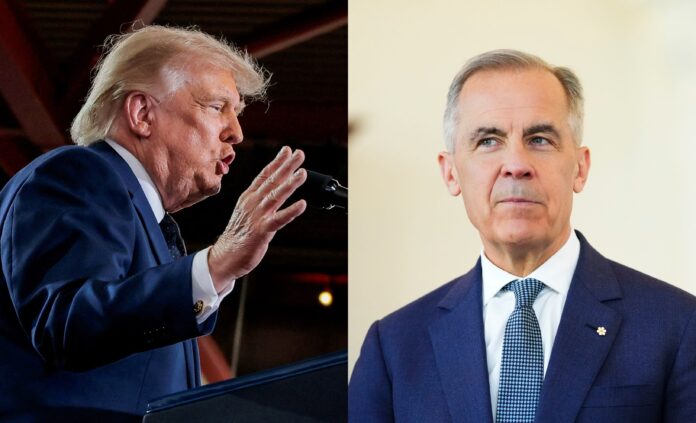
U.S. President Donald Trump revived his “51st state” taunt against Canada on Monday night, posting the phrase on Truth Social alongside an article about Canada’s economy entering a technical recession. Prime Minister Mark Carney responded with deliberate calm — a strategic posture that one political expert links directly to upcoming trade negotiations.
“We’re not going to respond or react to everything that he posts,” Carney told reporters Tuesday, dismissing Trump as an “exceptionally active user of social media” and waving off the remark.
A calculated silence ahead of CUSMA review
Trump’s post was reshared Tuesday morning by U.S. Ambassador to Canada Pete Hoekstra, amplifying its reach. When asked whether Canada should expel the ambassador over the move, Carney rejected the suggestion, saying Ottawa must continue working with U.S. representatives.
The more restrained tone from Carney — who ran an “elbows up” campaign against Trump’s rhetoric — reflects shifting political priorities, according to Daniel Béland, a political scientist and professor at McGill University.
“During the campaign, it was elbows up and it was politically expedient to push back against Trump’s rhetoric in a more frontal way,” Béland told Yahoo News Canada. “As this deadline in terms of the review of CUSMA is looming, I think there’s a sense that it’s better not to provoke Trump.”
The Canada-United States-Mexico Agreement (CUSMA) is scheduled for review next month, a high-stakes process that will shape Canadian trade for years to come.
“I think now the focus is on getting things done, or at least not to hurt what’s happening behind closed doors with regard to CUSMA,” Béland said.
Rhetoric as leverage, not policy
Trump first floated the idea of Canada becoming the 51st state in late 2024, during a meeting with then-prime minister Justin Trudeau at Mar-a-Lago. What began as a provocative aside quickly became a recurring theme in speeches, interviews, and social media posts.
Béland argues the annexation talk serves a strategic purpose for Washington. “There is certainly something here about calling into question the sovereignty of Canada,” he said. “It’s a way to symbolically weaken Canada and say it’s not a real country, it’s not a country that could defend itself without the United States.”
While Béland considers actual annexation unrealistic, he says the rhetoric has already reshaped how many Canadians perceive their southern neighbour — transforming the United States, in his words, “from an ally to an adversary of Canada.”
He also cautioned against Ottawa engaging in a public war of words. “Trying to start an argument about Trump would just exacerbate this kind of childish behaviour and rhetoric,” he said.
Canadians push back — but opinions are divided
While Carney chose restraint, many Canadians on social media did not. Reactions ranged from fierce declarations of independence to a smaller contingent willing to entertain the idea.
The range of responses reflects the complexity of the Canada-U.S. relationship at a moment of unusual strain. As the 51st state rhetoric enters its second year, the dominant sentiment among Canadians remains a firm defence of the country’s sovereignty — even as their government opts to keep its powder dry ahead of critical trade talks.

