Canada to Strengthen Forced Labour Laws After Trump Threatens New Tariffs
Prime Minister Mark Carney announced Wednesday that his government will introduce new legislation targeting forced labour in supply chains, hours after the Trump administration proposed an additional 10 per cent tariff on Canadian goods over concerns that Ottawa is not doing enough to enforce existing bans.
The Tariff Threat
The Office of the United States Trade Representative, led by Jamieson Greer, released a report Tuesday identifying Canada, Mexico, the United Kingdom and several other countries as insufficiently enforcing forced labour import prohibitions. A steeper 12.5 per cent duty is proposed for dozens of countries with partial or no bans on forced labour in supply chains.
The report was produced under Section 301 of the Trade Act of 1974, a legal mechanism the Trump administration began using in March to build a more durable foundation for its tariff agenda after the U.S. Supreme Court struck down the president’s preferred tool — the International Emergency Economic Powers Act (IEEPA) — which had underpinned his “Liberation Day” tariffs and fentanyl-related duties on Canada, Mexico and China.
In response to that ruling, Trump imposed a 10 per cent worldwide tariff under Section 122 of the same 1974 act, but those duties expire after 150 days unless Congress votes to extend them. Section 301 tariffs could prove more lasting, though they require a period of public consultation before taking effect — with hearings scheduled to begin in July.
Canada’s Response
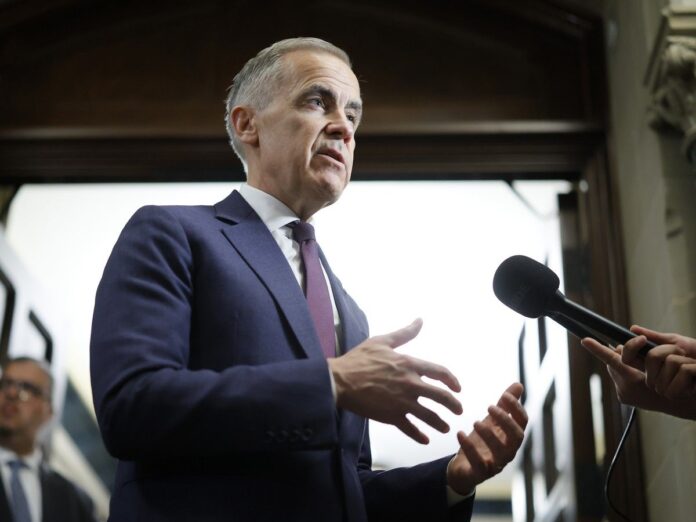
Carney told reporters in Ottawa that Canada already has a “very strong legislative regime” against forced labour. “We don’t want any element of forced labour coming in goods and services, and we want to use our influence to eliminate this practice of forced labour and child labour,” he said, adding that new legislation is expected within weeks.
Canada-U.S. Trade Minister Dominic LeBlanc met with Greer in Washington earlier Wednesday, ahead of a scheduled review of the continental trade pact. LeBlanc said the two officials discussed Canada’s commitment to fighting forced labour, and he acknowledged the tariff threat was not unexpected. “This does not come as a surprise, as the United States has stated its intention to replace existing baseline global tariffs imposed under Section 122 when they expire in July,” LeBlanc wrote on X.
The Enforcement Gap
The U.S. report levelled pointed criticism at the Canada Border Services Agency (CBSA), noting that although Canada’s import prohibition on forced labour goods has been in effect for nearly six years, “the number of enforcement actions Canada has taken to prevent the entry of forced labour goods is minimal.” It also accused Canada of being a “dumping ground” for goods barred from entering the United States.
The CBSA does not publicly publish statistics or information on its enforcement efforts — a gap the report highlighted and that Canadian critics have echoed. Conservative MP Adam Chambers said the information parliamentarians receive from the federal government on enforcement has been “completely underwhelming.” He added: “If you look at the number of shipments that have been stopped in Canada for forced labour versus the United States as an example, clearly the current laws are not working in the way that they should.”
What Is Already on the Books
Canada updated its customs law on forced labour rules in 2020, during the last renegotiation of the Canada-U.S.-Mexico Agreement (CUSMA). In 2023, Parliament passed legislation requiring Canadian companies to report annually on efforts to prevent child and forced labour from entering their supply chains.
The Canadian Ombudsperson for Responsible Enterprise (CORE), created under the previous Trudeau government to investigate abuses by Canadian corporations abroad — including the use of forced labour — has been without a permanent ombudsperson for nearly a year.
Limited Immediate Impact on Trade
The proposed tariffs would apply only to goods that do not comply with CUSMA rules of origin, meaning nearly 90 per cent of Canada’s exports to the United States would be exempt. The measures cannot be imposed immediately and must go through public comment and formal review before taking effect.

