
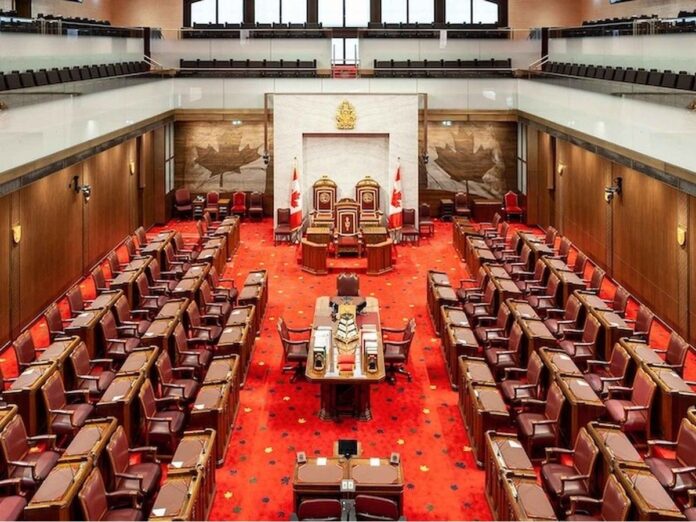
The Senate chamber sits largely out of public view, its red-carpeted halls a world removed from the constituencies and kitchen tables that define Canadian political life. Yet decisions made there shape legislation, delay bills, and carry real weight in the federal system. And in July 2026, Prime Minister Mark Carney quietly changed the rules for how its members get appointed — a move that has rekindled one of the most persistent debates in Canadian constitutional history.
A Shift in the Appointment Criteria
Carney’s changes to the Senate appointment process were substantive, if understated. His government removed the non-partisanship criterion that had defined the Independent Senators Group model championed by Justin Trudeau, replacing it with an emphasis on expertise in key Canadian strategic industries. The intent, presumably, was to make the upper chamber more useful — a body of knowledgeable voices capable of scrutinizing complex legislation on energy, technology, trade, and health.
The reform reflects a real frustration. The Senate, as it existed under the Trudeau-era model, was neither fully independent nor fully accountable. Senators appointed as nominally non-partisan often behaved in loosely ideological clusters anyway. The pretense of pure independence masked the absence of any democratic mandate. Carney’s pivot toward expertise at least acknowledges that the chamber should serve a function beyond rubber-stamping.
But the question political scientist Patrice Dutil raises — and it is a serious one — is whether expertise alone is the right answer. Canada, the argument goes, does not need a Senate of credentialed specialists. It needs a Senate that reflects the people it claims to serve.
The Democratic Deficit That Persists
This is not a new argument. Senate reform has haunted Canadian politics for decades, surfacing in constitutional negotiations, dying on the floor of the Commons, and generating royal commissions that produce reports no one reads. The Meech Lake Accord, the Charlottetown Accord, the Harper government’s incremental attempts at elected terms — all foundered on the constitutional complexity of changing an institution that touches the interests of every province, every region, and every vision of what Canada should be.
The Supreme Court’s 2014 reference on Senate reform made the terrain even clearer, and more daunting. Meaningful structural change — elected senators, fixed terms, an altered distribution of seats — requires not just a federal act of will but the consent of at least seven provinces representing fifty percent of the population. Abolition requires unanimity. The bar is deliberately high.
What Carney can do without triggering that constitutional machinery is limited but not trivial. Appointment criteria matter. The culture of the chamber shifts with the people in it. A Senate populated by industry insiders and technical experts may well produce sharper clause-by-clause analysis of legislation. But it will not resolve the deeper legitimacy problem: that senators are still appointed, still unelected, and still accountable to no one but their own conscience and the prime minister who named them.
What Representation Actually Requires
The original logic of the Senate was regional representation — a counterweight to the rep-by-pop dominance of the House of Commons, a place where the smaller provinces could find their voice. That logic has never fully worked in practice. Prince Edward Island’s four senators and Ontario’s twenty-four sit in the same chamber, but the regional balance has always been distorted by the political calculations of appointing governments. The West, historically underrepresented in federal cabinets and caucuses, has long viewed the Senate with particular skepticism — a grievance that remains alive in Alberta and Saskatchewan today.
Indigenous peoples, meanwhile, have a constitutional relationship with the federal Crown that the Senate has never adequately reflected. The ongoing work of reconciliation, treaty implementation, and the recognition of Indigenous self-governance demands institutional engagement, not merely consultation. An appointed chamber of industry experts is unlikely to fill that gap.
Quebec’s relationship to Senate reform is its own distinct thread. Sovereigntists have long argued the Senate symbolizes a federalism that serves central Canadian interests. Federalists in Quebec, including many who have defended the constitutional order vigorously, have nonetheless been skeptical of reform models that would give the upper chamber greater democratic legitimacy — fearing a more powerful Senate could constrain the National Assembly’s room to maneuver. Any reform path runs directly through that tension.
The Limits of What One Prime Minister Can Do
Carney’s government faces a structural reality that no amount of political will can fully dissolve. The tools available within the existing constitutional framework are real but narrow. Appointment criteria can be refined. The advisory board process can be strengthened or weakened. The culture of the chamber can be nudged. None of that amounts to democratic accountability.
What a serious reform agenda might look like, within those constraints, is worth spelling out clearly.
None of these steps requires reopening the Constitution. All of them would represent genuine progress beyond the current model. The question is whether the Carney government has the appetite to go further than a quiet adjustment to appointment criteria.
A Chamber That Must Earn Its Place
The Senate will not be abolished. It will not be elected anytime soon. The constitutional math makes both outcomes vanishingly unlikely in any foreseeable political environment. What remains possible is something more modest but still meaningful: an upper chamber that is more transparent, more regionally sensitive, more connected to the communities whose legislation it reviews, and less visibly a reward for the well-connected.
That is not a small thing. The Senate’s legitimacy problem is corrosive. Canadians who see it as a patronage vehicle — and polling consistently suggests many do — are less likely to trust the institutions it is part of. Democratic erosion rarely arrives as a single dramatic rupture. It accumulates, quietly, in the gap between what institutions claim to be and what people experience them as.
Mark Carney came to office with a reputation for institutional seriousness. The Senate appointment changes of July 2026 suggest he understands the chamber needs to evolve. Whether he is willing to push that evolution as far as it needs to go — past the comfort of expertise and into the harder terrain of accountability and representation — is a question his government has not yet answered. The red carpet still runs the length of that chamber. The people it serves are still waiting to recognize themselves in it.

