
A limestone cave on Turkey’s Mediterranean coast is quietly rewriting what scientists thought they knew about the relationship between Neanderthals and modern humans — and the evidence is startlingly intimate.
What the Cave Revealed
Archaeologists excavating Üçağızlı II Cave, situated on a stretch of coastline just north of Syria that once served as a prehistoric corridor between the Levant and Eurasia, have uncovered layers of human occupation spanning tens of thousands of years. The findings, published on July 6 in the journal PNAS, document two distinct periods of habitation: Neanderthals occupied the cave between approximately 77,000 and 59,000 years ago, followed by Homo sapiens from roughly 59,000 to 47,000 years ago.
The researchers identified the occupants not through complete skeletons — only teeth and a partial jawbone were recovered — but by analyzing the internal microstructure of fossilized teeth, a method precise enough to distinguish between the two species. The age of sediment layers was established through optically stimulated luminescence, a technique that measures how long buried mineral grains have been shielded from sunlight.
What the layers revealed across both periods was, in a word, consistency. Despite the biological turnover from one species to the next, the archaeological record showed what the study’s authors describe as “substantially uniform hunting-gathering strategies and lithic technology.”
The Same Tools, the Same Prey, the Same Shells
The parallels between the two occupations run deep. Both Neanderthals and modern humans sourced their raw materials — primarily flint — from the same local deposits. Both hunted the same animals: wild goat (Capra aegagrus), fallow deer (Dama mesopotamica), roe deer (Capreolus capreolus), and wild boar (Sus scrofa). The stone tools they left behind belong to the same technological tradition.
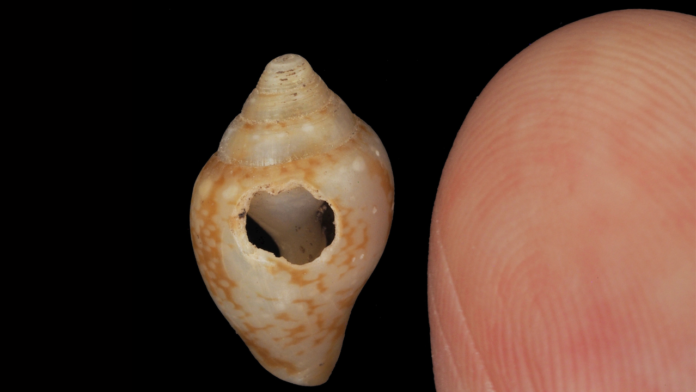
Perhaps most striking is the evidence for shared symbolic behaviour. Across multiple layers corresponding to both species, archaeologists recovered 29 shells of a small marine snail, Columbella rustica, brought into the cave not as food but apparently as personal ornaments. Some shells had been pierced, as though intended to be strung. One shell from the Neanderthal occupation bore signs of deliberate heating that altered its colour — a modification that implies intention, aesthetic awareness, and a degree of cultural meaning.
“Our findings indicate a deep level of cultural interaction,” said study co-author Naoki Morimoto, a paleoanthropologist at Kyoto University. “These two distinct but closely related human groups were not just adapting to the same environment: they were probably sharing symbolic preferences.”
A Pattern Emerging Across the Region
Üçağızlı II Cave does not stand alone. The picture it presents echoes findings from Tinshemet Cave in Israel, where researchers recently reported similar signs of shared behaviour between Neanderthals and modern humans from approximately 130,000 to 80,000 years ago — a far earlier window of interaction. Together, these two sites suggest that cultural continuity across the Neanderthal-to-modern-human transition was not an anomaly but a recurring feature of life in the Levant.
The contrast with sites elsewhere in Europe is instructive. At Mandrin Cave in France, Neanderthals and modern humans appear to have alternated occupation in distinct, separate pulses between roughly 56,800 and 41,500 years ago, without leaving evidence of a continuous shared culture. The Levantine sites point toward something qualitatively different — not mere coexistence, but active exchange.
April Nowell, a Paleolithic archaeologist at the University of Victoria who was not involved in the study, described the implications as significant. “By demonstrating cultural continuity and elevated levels of interaction, sites such as Tinshemet and Üçağızlı II are changing what we thought we knew about Neanderthals, Homo sapiens and other contemporary Homo groups,” she told Live Science. “A fascinating region just got even more so.”
The Deeper Mystery: Similarity and Extinction
Cultural overlap of this degree only sharpens the question that has long shadowed Neanderthal research: if these two groups shared so much, why did Neanderthals disappear around 40,000 years ago while modern humans did not?
Nowell notes that two species cannot occupy the same ecological niche indefinitely. Some research into Neanderthal cognition has suggested they were less cognitively flexible than modern humans — with more limited capacity for language and a narrower range of creative and self-aware behaviour — though that interpretation remains contested, and a growing body of evidence pushes back against any simple hierarchy of intelligence between the two groups.
What the archaeological record at sites like Üçağızlı II may be telling us, Nowell argues, is that the decisive differences between Neanderthals and modern humans were not the ones most visible in stone tools or shell ornaments. The real divergence may lie in dimensions the fossil record has yet to illuminate.
What Comes Next
The researchers are candid about the limits of what a single cave site can establish. Whether the cultural similarities observed at Üçağızlı II resulted from direct contact between the two groups, from parallel adaptation to the same environment, or from some combination of interbreeding and information exchange remains an open question. The site’s position along a known prehistoric migration corridor makes direct contact a plausible hypothesis, but hypothesis is not yet conclusion.
What the evidence does establish, with reasonable confidence, is that the boundary between Neanderthals and modern humans — at least in this corner of the ancient world — was far more porous than the old textbook narrative allowed. They hunted the same animals, knapped the same stone, and carried the same small shells into the same dark cave. Whether they did so together, or in succession, or in some more complicated entanglement of the two, the distance between them keeps shrinking.

