
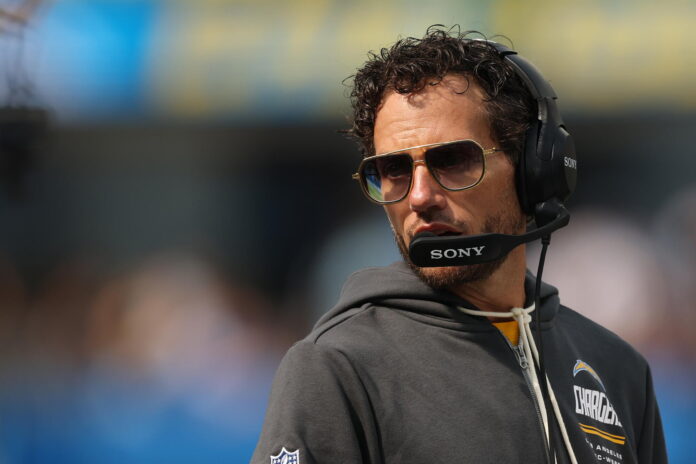
The scoreboard told the story plainly enough. On Sunday afternoon in Kansas City, the Los Angeles Chargers managed six points against the Chiefs — no touchdowns, no momentum, no answers — and walked away with their sixth consecutive loss to open the season. Somewhere in the press box, the question that had been building for weeks finally became unavoidable: how much longer can Mike McDaniel hold on?
According to Pro Football Talk, there is now “growing buzz” inside the organization that head coach Jim Harbaugh will part ways with McDaniel, his first-year offensive coordinator, before the team returns from its bye week. The Chargers currently rank dead last in the NFL in offensive DVOA — the advanced metric that measures overall offensive efficiency — and are averaging a meagre 15 points per game across six defeats. They have scored just 84 points all season.
Harbaugh, when pressed directly after the Kansas City loss on whether McDaniel would still be calling plays when the team next takes the field, offered little in the way of reassurance. “We’re going to look at everything,” he said, adding that the offense “needs to be addressed.” That is the kind of careful, non-committal language that, in professional football, tends to precede a personnel change.
The circumstances around McDaniel are unusual, even by NFL standards. He had been under contract with the Miami Dolphins through 2028 before being fired last offseason, and he is widely believed to still be drawing the bulk of his salary from Miami, with his Chargers pay offsetting a portion of that larger deal. In other words, McDaniel took the Los Angeles job — at least in part — to keep coaching while remaining financially secured by his former employer. It was an arrangement that seemed workable in theory. In practice, it has produced the league’s worst offense.
The disappointment cuts deeper because the expectations were genuinely high. When McDaniel joined the Chargers, there was real excitement about what he might do with quarterback Justin Herbert and rookie running back Omarion Hampton. McDaniel had presided over a Miami offense that averaged at least six yards per play in both 2022 and 2023 — a mark of genuine efficiency that suggested he could unlock Herbert’s considerable talent. That success has not crossed the country with him. The turnovers, the pre-snap penalties, the stalled drives: they have been constant and compounding.
If McDaniel is let go, the leading internal candidate to take over play-calling duties is Adam Gase, currently the team’s passing game specialist and a former head coach of the New York Jets. The prospect has not been warmly received among the Chargers’ fan base, and the skepticism is understandable — Gase’s tenure in New York was widely regarded as a failure, and at least one supporter captured the mood bluntly online: “Adam Gase is a worse OC than Mike McDaniel — that’s how bad the offensive ecosystem is for the Chargers.” Others went further, calling for Harbaugh himself to be held accountable for the team’s dysfunction.
That last sentiment reflects something important. Offensive coordinators bear the most immediate responsibility for play-calling, but the broader culture of a football team — its discipline, its preparation, its capacity to execute under pressure — flows from the head coach. Harbaugh arrived in Los Angeles last season with an enormous reputation built at the University of Michigan and, before that, with the San Francisco 49ers. The Chargers gave him considerable resources and trust. Six games into this season, with zero wins and a historically ineffective offense, the pressure is no longer confined to the coordinator’s office.
The bye week offers a pause, and perhaps a decision. The Chargers return to action with a road game against the 2-4 Los Angeles Rams — a divisional opponent that, despite its own inconsistencies, will not be forgiving. Whatever Harbaugh chooses to do with his offensive staff, he will need to do it quickly, and he will need it to work. The season is not yet mathematically over, but it is moving in that direction with uncomfortable speed.
For Mike McDaniel, a coach who arrived in Los Angeles with something still to prove, the window may already be closing.

