
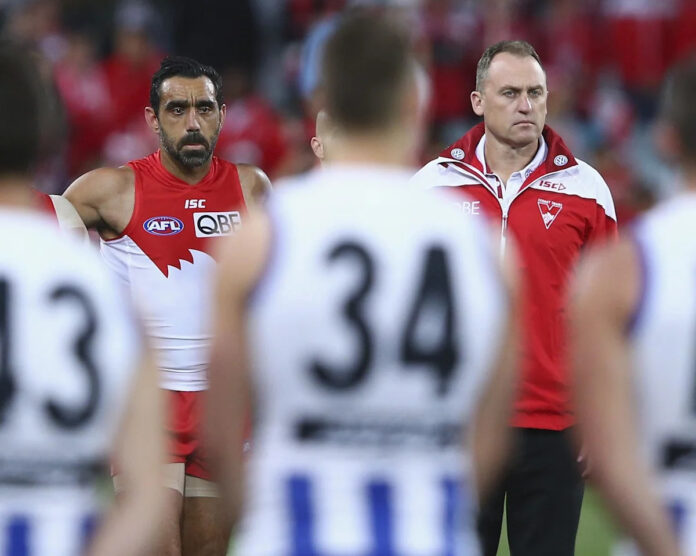
Former Sydney Swans head coach John Longmire has publicly acknowledged his regret for not doing more to shield two-time Brownlow medallist Adam Goodes from what he describes as “diabolical, almost unforgivable” treatment during the final years of the Indigenous footballer’s AFL career, writing candidly about the episode in an autobiography released this week.
A Belated Reckoning
In the memoir, titled Pain, Perspective & Premierships, Longmire reflects on the sustained, targeted booing that Goodes endured from opposition crowds — treatment that intensified after Goodes called out a 13-year-old Collingwood supporter for directing a racial slur at him during a match in 2013. “Adam Goodes was not just a champion footballer, he was a leader and a man of immense courage,” Longmire writes. “What he endured was diabolical, almost unforgivable.”
Longmire led the Swans for more than a decade, having won the 2012 AFL premiership in his second season as head coach. He had served as an assistant coach while Goodes was emerging as one of the country’s finest players, and stepped into the top role with Goodes at the peak of his powers as a midfielder-forward. He resigned from the position in 2024.
The booing of Goodes by opposition fans was condemned by many at the time, yet the AFL itself did not issue an unreserved apology until 2019 — four years after Goodes’s retirement in 2015. That institutional delay has since become part of a broader reckoning with racism in Australian sport.
What Longmire Wishes He Had Done
“In hindsight, I should have threatened to pull our players off the ground if the booing didn’t stop,” Longmire writes. “It might not have changed anything but it would have brought the matter to a head and forced the industry — and the community — to consider what this continued behaviour was doing to one of the game’s greats.”
He acknowledges the gravity of such a step while standing by its logic. “It would have been an extreme act — but then what was happening to Adam was extreme too.”
Longmire traces the escalation of the booing to two specific moments: the 2013 Collingwood match itself, and the days that followed, when then-Magpies president Eddie McGuire suggested on radio that Goodes could be used to promote the musical King Kong — a remark widely condemned as racist. McGuire had initially apologised on behalf of the club after the match, but, as Longmire puts it, “torched that apology with an insensitive comment on radio a few days later that cut to the core.” McGuire subsequently offered a personal apology directly to Goodes and publicly to the media.
Goodes and the Weight of Casual Racism
In the 2019 documentary The Australian Dream, Goodes recounted taking McGuire’s phone call with measured clarity. “When I finally took his call, I just said ‘you’re not a friend,'” Goodes said. “He just forgot where he was, he forgot that he was on radio, and it was just an off-the-cuff thing that he would say at a barbecue, at a bar, and it just highlighted my point. That casual racism is there, it’s alive and it’s flourishing in our communities.”
McGuire, for his part, described the remark in the same documentary as “just a mistake, it was a misspoken moment.”
The booing intensified again in 2014 after Goodes was named Australian of the Year — an honour that appeared to deepen the hostility directed at him from sections of football crowds rather than generate broader solidarity. Longmire reflects on that painful irony: “It saddens me to know that the place Adam once felt most comfortable — on the football field, showing his skills to the world — ended up being the place where he felt most uncomfortable.”
Longmire’s Career Since the Swans
Longmire’s professional life has continued on a more difficult trajectory since his departure from Sydney. Last month, he missed out on the head coaching position at the newly established Tasmania Devils, with Ken Hinkley appointed to the role instead. After the 2012 premiership, Longmire went on to contest four further grand finals without winning any of them — a record that frames much of the reflective tone his autobiography adopts.
The book’s release has nonetheless drawn the most attention for its treatment of Goodes, whose experience remains one of the most discussed and painful chapters in recent Australian sporting history.

