
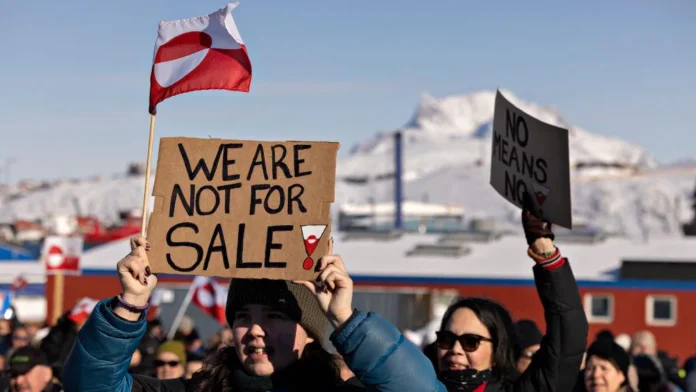
Indigenous leaders across the Arctic are warning that renewed U.S. interest in Greenland is reviving colonial-era assumptions and could sideline Inuit rights and decision-making as global powers compete for influence in the region. The concern has been amplified in recent weeks by fresh statements from U.S. President Donald Trump about U.S. control of Greenland and the diplomatic fallout that followed in Denmark and Greenland.
Greenland sovereignty and Inuit self-determination
In Canada, Inuit Tapiriit Kanatami (ITK) president Natan Obed said the arguments being used to justify U.S. pressure on Greenland could be repurposed against Canada’s Arctic, calling for greater investment in Inuit Nunangat as a practical way to strengthen sovereignty and resilience. ITK has warned that claims about defence “underinvestment” can become a pretext for outside interference in northern homelands.
Leaders of the Inuit Circumpolar Council, which represents Inuit from Alaska, Canada, Greenland and Russia’s Chukotka region, have also criticized repeated assertions that Greenland must be controlled by the United States, arguing the rhetoric reflects a view of Greenlanders and other Indigenous peoples as obstacles in geopolitical planning rather than partners with rights and authority in their own territories.
Greenland’s government rejects U.S. control language
Greenland’s Prime Minister Jens-Frederik Nielsen said on February 2 that Washington still fundamentally seeks “ownership and control” even after Trump publicly backed away from threats of using military force. Nielsen described the pressure as unacceptable and said it has contributed to anxiety among Greenlanders, including children, as the dispute has intensified.
Denmark’s foreign ministry said senior officials from the United States, Denmark and Greenland began talks last week aimed at addressing U.S. security concerns in the Arctic while respecting Danish “red lines,” as Copenhagen and Nuuk continue to insist Greenland’s future must be decided by Greenlanders.
Land, security and the strategic stakes in the Arctic
The dispute is also colliding with Greenland’s legal and cultural approach to land. Under Greenlandic law, people can own houses but not the land beneath them, reflecting Inuit traditions of collective stewardship rather than private freehold ownership—an idea highlighted by Greenlanders as incompatible with talk of “buying” the island.
Strategically, Greenland already hosts the U.S. military’s northernmost installation, Pituffik Space Base, operating under a defence agreement dating back to 1951 between the United States and Denmark. As Arctic shipping, surveillance and resource competition draw more attention, Inuit organizations say decisions about security and development must include Indigenous governments and rights-holders rather than treating the Arctic as empty space to be divided by states.

