
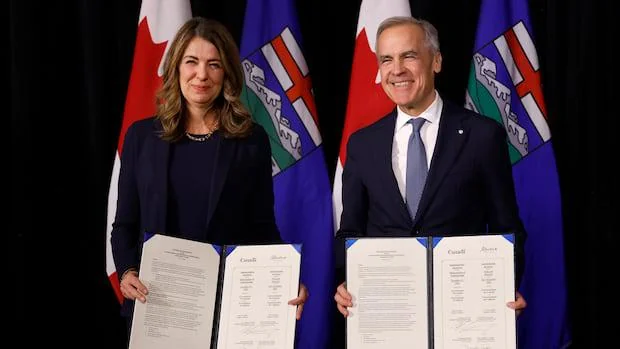
The Union of British Columbia Indian Chiefs formally called on Prime Minister Mark Carney and Alberta Premier Danielle Smith on Sunday to stop advancing the proposed West Coast oil pipeline, arguing that expanding fossil fuel production will deepen the climate crisis and that Indigenous communities have not been meaningfully consulted on a project that is already well into its planning stages.
In a letter addressed directly to both leaders, the UBCIC — an organization representing numerous First Nations across the province — drew a direct line between fossil fuel expansion and the intensifying disasters already reshaping Canadian landscapes. “The destructive and disastrous consequences of expanding fossil fuel production extend far beyond any single territory,” the letter states. “From catastrophic wildfires to destructive floods and rising seas, the impacts of climate change are already being felt across this country. Every new fossil fuel project deepens that crisis.” The chiefs released the letter on the International Day of the World’s Indigenous Peoples, a timing that underscored the organization’s intent to frame its opposition in terms of both constitutional rights and global environmental responsibility.
At the heart of the UBCIC’s objection lies a procedural grievance with significant constitutional weight. The organization argues that the federal and provincial governments have already determined the project’s corridor, identified prospective development partners, and publicly made the economic case for the pipeline — effectively treating consultation as a formality rather than a genuine process. Meaningful consultation, the group insists, cannot occur when First Nations are invited only to discuss how a predetermined project will unfold, not whether it should proceed at all. This distinction matters under Canadian constitutional law, where the Crown’s duty to consult is well established but its depth and timing remain contested terrain.
The proposed pipeline is a substantial infrastructure undertaking. Running approximately 1,250 kilometres from Bruderheim, Alberta, to a port near Delta, British Columbia, it would carry upwards of one million barrels of crude oil per day for shipment to international markets. The Alberta government is listed as the project’s proponent, while ownership would be shared among Trans Mountain, the Alberta Petroleum Marketing Commission, and Pembina Pipeline Corporation. The project is also linked, by agreement between Ottawa and Edmonton, to a carbon capture initiative known as the Pathways project — the two being conditionally dependent on each other.
The federal government took a significant step last week toward granting the pipeline a national interest designation under the Building Canada Act, a designation that would allow Ottawa to fast-track the project and bypass certain environmental review requirements. The government has opened a public comment period on the designation, accepting feedback until mid-September. The Building Canada Act, which passed with support from the Conservatives more than a year ago, has so far been used to advance three other projects toward national interest status: the Grays Bay road and port project in Nunavut, the Mackenzie Valley Highway in the Northwest Territories, and the Nuclear Waste Management Organization’s deep geological repository in northern Ontario.
Neither Carney’s nor Smith’s offices responded to a request for comment on Sunday. Alberta’s Ministry of Indigenous Relations, however, defended the project in an emailed statement, arguing that the pipeline would deliver long-term economic benefits and energy security to Indigenous communities. Press secretary Karah Folk noted that the pipeline submission is currently under review by the Major Projects Office, which she said “will consult with Indigenous communities as part of determining whether the project is in the national interest.” The ministry added that the government remains committed to ongoing dialogue with First Nations and other partners as the review continues — a characterization the UBCIC flatly rejects as insufficient given the project’s current state of advancement.
Carney and Smith jointly announced the proposed pipeline in Calgary on July 2, 2026, framing it as a nation-building project intended to strengthen Canadian economic autonomy in a shifting global trade environment. Ottawa has described the Major Projects Office, headquartered in Calgary, as a vehicle for advancing projects of national interest that also advance Indigenous economic participation and meet Canada’s climate commitments — a balancing act the UBCIC argues is fundamentally incompatible with approving new fossil fuel infrastructure at this scale.

