A Threat Built on Shaky Ground
U.S. President Donald Trump announced Monday that Washington is pursuing a deal to purchase potash from Belarus, a close Russian ally, at prices he claims would undercut what American farmers currently pay to Canadian suppliers. The announcement is striking — but not for the reasons Trump intends. The evidence strongly suggests this is a geopolitical provocation dressed up as economic policy, one that would likely cost American farmers more, not less, while deepening ties with a regime that the United States itself has sanctioned for human rights abuses and complicity in Russia’s invasion of Ukraine.
The thesis here is straightforward: Trump’s Belarus potash gambit is strategically incoherent. It punishes Canada — the overwhelmingly dominant and logistically superior supplier — in favour of a sanctioned state whose product would be more expensive to ship, harder to procure, and more ethically compromised. It is the latest escalation in a trade war that has already seen talks collapse, and it deserves to be examined on the merits, not taken at face value.
Canada’s Dominance Is Not a Vulnerability — It’s a Fact of Geography
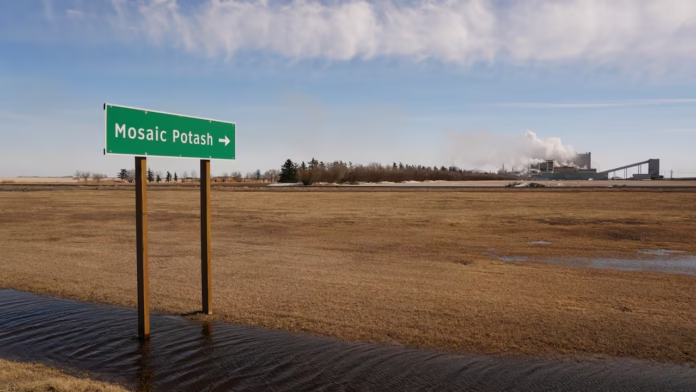
The numbers are unambiguous. Canada is the world’s leading exporter of potash, shipping approximately 22.9 million tonnes in 2024 — more than 39 per cent of global exports. The United States imports nearly 85 per cent of its potash from Canada. Belarus ranks third in global production, behind Russia and Canada, and its access to export markets has been severely constrained since Western sanctions were imposed and Lithuania closed a key Baltic port to Belarusian shipments.
Geography alone makes the comparison unfavourable to Lukashenko’s Belarus. University of Regina economics professor Jason Childs put it plainly: “I’m skeptical just because you’ve got so much more transportation to deal with.” Saskatchewan sits close to the American agricultural heartland. Belarus does not. Unless Belarus were to offer production costs so dramatically lower as to absorb the added freight burden — and there is no evidence it can — American farmers would not see the savings Trump is promising.
Fertilizer analyst Josh Linville of StoneX was equally blunt. “I’m afraid the impact would be limited. We have not struggled to find potash,” he said. “We have more than enough to go around.” The United States is not facing a potash shortage. It is not scrambling for supply. The premise of Trump’s announcement — that Belarus represents a better deal — rests on a problem that does not exist.
The Sanctions Paradox and the Ethics of the Deal
What makes this announcement particularly difficult to square is the diplomatic history surrounding Belarus. The United States, Canada, and the European Union all imposed sanctions on the Lukashenko regime following its brutal crackdown on pro-democracy protesters and its decision to allow Russian forces to use Belarusian territory as a staging ground for the full-scale invasion of Ukraine in 2022.
Those sanctions were not symbolic. They reflected a shared Western commitment to democratic norms and collective security. In December 2025, the U.S. agreed to lift sanctions on Belarusian potash after Lukashenko released 123 political prisoners — a release brokered with the help of Trump’s own envoy. The move was controversial. It is now being followed by a prospective trade deal that would funnel American agricultural dollars directly to Minsk.
Saskatchewan Premier Scott Moe responded by defending his province’s potash industry as both ethically and economically superior to international alternatives. He is not wrong on either count. Canadian potash is mined under robust environmental and labour standards, exported through transparent supply chains, and delivered efficiently to American buyers. The contrast with a Lukashenko-run state enterprise is not subtle.
The Real Calculation: Trade War Escalation, Not Farm Policy
The timing of Trump’s announcement is revealing. Canadian potash has remained exempt from the tariffs imposed during the broader Canada-U.S. trade war — a war that intensified sharply after trade talks collapsed last month. Ottawa walked away from the negotiating table after Washington introduced last-minute demands that included restrictions on Canada’s ability to sign trade agreements with other countries. Since then, Trump has imposed multiple rounds of tariffs and import restrictions.
The Belarus potash announcement followed Prime Minister Mark Carney’s expression of interest in Canada becoming the European Union’s first associate member — a move Trump characterized as potentially hostile and threatened to retaliate against. Read in sequence, the pattern is clear. This is not farm policy. It is leverage.
The problem with using potash as leverage is that it is a blunt instrument that would cut both ways. As Professor Childs noted, if Belarus and Russia re-enter the North American market in a meaningful way, overall potash prices would fall — and that would hurt Canadian producers, particularly in Saskatchewan, which has built its provincial economy in part around this resource. “If they enter the North American market, then we’re competing against another supplier and that’s going to hurt our costs,” Childs said. “That’s going to hurt the price we can get for our product.”
That is a real consequence. It would not, however, guarantee cheaper fertilizer for American farmers, who would still face the logistical costs of Belarusian supply chains. The burden would be redistributed, not eliminated.
What This Means for Canada
For Canada, the Belarus announcement is the clearest signal yet that the Trump administration is willing to pursue economically irrational moves if they inflict political pain on Ottawa. That is a sobering reality. It demands a response that is firm, clear-eyed, and grounded in Canada’s genuine strengths as a trading partner — not one that escalates for escalation’s sake, but one that refuses to be destabilized by provocation.
Canada holds real cards here. Proximity, infrastructure, established supply relationships, and ethical sourcing all favour Canadian potash. The American farming community knows this. Linville’s assessment — that the U.S. has more than enough supply and has not struggled — is not a reassurance for Canadians so much as an indictment of the premise driving Trump’s announcement.
The deeper implication is this: when a trading partner begins shopping for sanctions-lifted authoritarian suppliers to replace a stable democratic neighbour, the relationship has moved beyond ordinary trade friction. Canada must continue to diversify its export markets and deepen its ties with the EU and other partners — not out of spite, but out of strategic necessity. The Belarus gambit is a reminder that economic interdependence, however deep, is no substitute for a foreign policy that protects Canadian interests on its own terms.

