
A Meeting Freighted with Symbolism
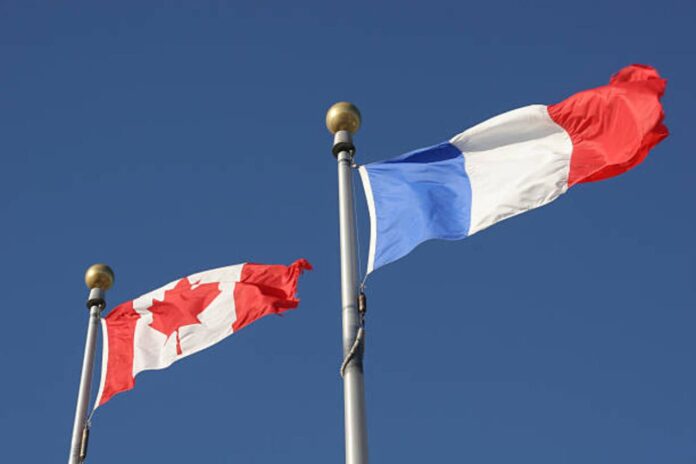
When Prime Minister Mark Carney and French President Emmanuel Macron stood together on the archipelago of Saint-Pierre and Miquelon last Sunday, the setting was anything but incidental. The French territory sits just off the coast of Newfoundland — one of the few places on earth where Canada and France are separated by only a handful of kilometres of open Atlantic water — and it served as a deliberate, vivid reminder that Europe and Canada are, in certain respects, already neighbours. Macron’s visit was only the second time a sitting French president had ever set foot on the islands, a fact that underscored the weight both governments attached to the occasion. The joint media conference that followed produced a framework for cooperation spanning space-launch systems, ground-based infrastructure, energy, defence, fisheries, telecommunications, and critical minerals — a breadth of ambition that reflects how substantially Ottawa’s strategic priorities have shifted in recent months.
What the Partnership Actually Covers
Space and Technology
The centrepiece of the announcement, at least in terms of novelty, is the commitment to pursue joint work on space-launch systems and the ground-based infrastructure that supports them. Canada has long maintained a presence in the space sector — most visibly through its contributions to robotic systems on the International Space Station — but a bilateral cooperation agreement with France opens the possibility of deeper integration with European launch capacity, including the infrastructure associated with the European Space Agency and France’s own considerable expertise in that domain. The timeline and funding for this initiative remain to be determined, which means the agreement is currently more a statement of political intent than an operational programme; the substantive negotiations lie ahead. That caveat notwithstanding, the direction of travel is clear, and it aligns with Ottawa’s broader interest in reducing strategic dependencies that have, in recent years, been concentrated uncomfortably close to a single partner.
Energy, Fisheries, and the Broader Economic Agenda
Beyond space, the two countries announced plans to expand cooperation across energy, fisheries, telecommunications, and economic development — sectors where the geographic proximity of Saint-Pierre and Miquelon to Atlantic Canada creates both practical opportunities and, historically, occasional friction. The fisheries dimension is particularly layered, given the long-running and sometimes contentious history of fishing rights in the waters around the archipelago. That both governments chose to frame fisheries as an area for cooperation rather than contention is itself a meaningful signal. On energy, the partnership fits within a wider European interest in diversifying supply chains and reducing dependence on Russian gas, while for Canada it represents a chance to position its liquefied natural gas and clean-energy resources as strategically valuable to allies who are actively looking for alternatives.
The Geopolitical Context: Trump’s Shadow
Neither Carney nor Macron was subtle about the broader context animating the meeting. U.S. President Donald Trump has made no secret of his desire to exercise some form of control over both Greenland and Canada, and only days before the Saint-Pierre summit he published a social-media post depicting the American flag covering the entirety of North America — including the Caribbean and the waters where Saint-Pierre and Miquelon sits. The choice of venue, in that light, carried an unmistakable message: France’s sovereign presence in the western Atlantic is real, Canada’s sovereignty is not negotiable, and both countries intend to demonstrate that through concrete, practical partnership rather than mere rhetoric. The meeting came only days after Canada was offered associate membership in the European Union, and less than two weeks after Trump’s provocative post — a sequence of events that gives the Carney government’s European pivot an urgency it might not otherwise have carried.
“Only a few kilometres separate Canada and France at their closest point,” Carney said at the joint press conference. “Our values are even closer.” Macron, for his part, argued that the two countries “see the present from the same angle,” invoking their shared commitment to democracy, the rule of law, international law, and free and fair trade — formulations that, in the current moment, read as pointed contrasts to the approach emanating from Washington. The historical resonance is genuine: parts of what is now Canada were once French colonies, French remains one of Canada’s two official languages, and Quebec’s distinct political culture has always maintained a particular affinity with France that goes well beyond diplomatic courtesy.
Canada’s Broader European Rapprochement
The France agreement is best understood not as a standalone initiative but as one component of a larger strategic reorientation that the Carney government has been pursuing with considerable energy since taking office. Ottawa has signalled its support for moving beyond the existing Canada-EU Comprehensive Economic and Trade Agreement — already a substantial framework — toward a much more ambitious and wide-ranging partnership that would encompass strategic sectors including artificial intelligence, critical minerals, and defence procurement. The associate-membership offer from the EU, unprecedented in its form, suggests that European capitals are receptive to that ambition, even if the precise institutional architecture of a deeper relationship remains to be worked out through what will inevitably be complex multilateral negotiations. Canada’s interest in strengthening these ties is not simply a reaction to American pressure, though that pressure has certainly accelerated the timeline; it also reflects a long-standing Liberal conviction that Canada’s prosperity and security are best served by a diversified network of deep partnerships rather than overwhelming dependence on a single bilateral relationship.
What remains to be seen is whether the political momentum generated by high-profile summits like the one in Saint-Pierre can be translated into durable institutional agreements with real funding, real timelines, and real accountability. Announcements of intent are the easy part. The harder work — negotiating the specifics of space-launch cooperation, resolving the perennial complexities of fisheries management, aligning regulatory frameworks for energy trade — will unfold largely out of the public eye, in the months and years ahead. The foundation laid on that small Atlantic archipelago is real, but it is still only a foundation.

