
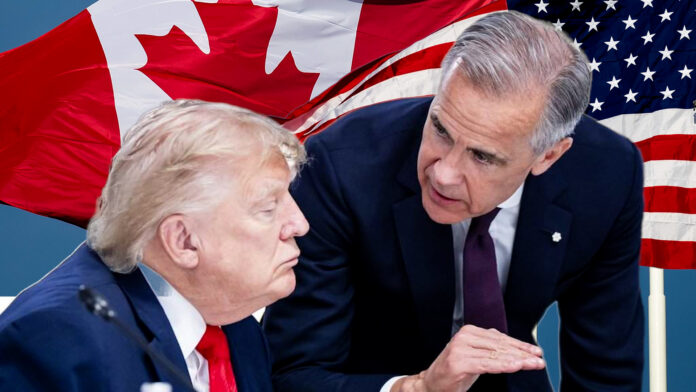
What is actually at stake in the Canada-U.S. trade standoff?
As of midnight Wednesday, new American tariffs are set to strike $29 billion worth of Canadian goods — unless negotiators on both sides can bridge their differences in time. The clock is running, and so far, no deal has been announced. Canada’s Trade Minister Dominic LeBlanc and Chief Trade Negotiator Janice Charette have remained in Washington this week, signalling that Ottawa views the talks as too consequential to conduct at arm’s length. On Monday, the two met directly with U.S. Trade Representative Jamieson Greer and Commerce Secretary Howard Lutnick, the two American officials who hold the most sway over the shape of any eventual agreement.
The tone coming out of those meetings has been measured rather than triumphant. When LeBlanc addressed reporters afterward, he offered no breakthrough and no breakdown — only the frank acknowledgment that “our job is not yet done.” That phrase, spare as it is, captures the essential uncertainty: Canadian and American officials are still at the table, which is better than the alternative, but the distance between their positions has not yet been closed. For Canadian exporters, manufacturers, and the workers whose livelihoods depend on cross-border commerce, the next twenty-four hours carry real weight.
It is worth remembering what these tariff negotiations represent in a broader sense. The Canada-U.S. trade relationship is the largest bilateral trading relationship in the world, and the rules governing it touch virtually every sector of the Canadian economy, from agriculture and automotive production to energy and financial services. When Washington moves to impose new duties on $29 billion in Canadian goods, the downstream effects ripple well beyond the directly targeted industries — they reshape supply chains, affect employment, and test the political durability of federal trade policy.
Where does Prime Minister Carney stand, and what leverage does Canada have?
Prime Minister Mark Carney has staked considerable political capital on his government’s ability to manage the relationship with the Trump administration without capitulating to its demands. That balancing act — firm enough to satisfy Canadian public opinion, flexible enough to keep negotiations alive — defines the strategic challenge facing Ottawa right now. LeBlanc’s continued presence in Washington reflects a deliberate choice to keep the conversation at a senior level, signalling seriousness without conceding ground publicly.
Canada’s leverage in these talks is real but asymmetric. The United States is Canada’s overwhelmingly dominant export market, which means Canadian producers feel the pain of tariffs more acutely than their American counterparts feel the pain of Canadian countermeasures. At the same time, Canada supplies the United States with energy, critical minerals, and integrated manufacturing components that American industry genuinely depends on — and that dependence creates pressure on Washington too. The negotiating dynamic is not one of equals, but it is not one of total helplessness either, and understanding that distinction matters for any honest assessment of where Canada stands.
What is happening inside the Conservative Party?
While the trade drama unfolds in Washington, a separate but consequential political story is developing at home. The Conservative Party of Canada is grappling with a fundamental strategic question: what does its path back to power actually look like? After failing to win the most recent federal election against a Liberal Party led by Carney, the party and its leader Pierre Poilievre face the difficult work of rebuilding credibility and finding a message that resonates with a broader coalition of Canadians.
Poilievre’s political situation is genuinely complex. He built his leadership on an insurgent, cost-of-living-focused critique of the Trudeau Liberals, and that critique landed effectively enough to make the Conservatives competitive — but not competitive enough to form government. Now, with Carney in office and the political terrain shifted by an ongoing trade conflict with the United States, the Conservative leader must decide whether to adapt his positioning or double down on the formula that brought him this far. Neither choice is without risk, and the party’s internal conversations about direction are, by all accounts, still very much in progress.
For observers of Canadian parliamentary democracy, this moment is a reminder of how quickly political fortunes can shift and how much the external environment — in this case, a trade war initiated by a foreign government — can reshape the domestic political calculus. The Conservatives must find a way to be relevant and credible on the file that currently dominates public attention, even as the government controls the levers of actual negotiation. That is the structural challenge of opposition in a Westminster system, and it is one Poilievre’s team is working through in real time.
What should Canadians watch for next?
The immediate focal point is the midnight Wednesday deadline. If LeBlanc and Charette secure an agreement — or even a framework that delays the new tariffs — the political pressure on the Carney government eases considerably, at least in the short term. If the deadline passes without a deal and the tariffs take effect, the government will face harder questions about its strategy and its willingness to deploy countermeasures of its own. Canadian retaliatory tariffs have been part of Ottawa’s toolkit before, and their use — or non-use — will itself become a political story.
Beyond the immediate deadline, the broader trajectory of Canada-U.S. trade relations under the current American administration remains deeply uncertain. Each round of negotiations has produced partial progress and new complications, and there is little reason to expect a clean, comprehensive resolution in the near term. For Canadians, that means living with ongoing economic uncertainty — a reality that will continue to shape federal politics, provincial responses, and the daily decisions of businesses and workers from coast to coast to coast.

