
Tariff Uncertainty ‘Really Hurting Investment’ in Manitoba, Trade Representative Warns
Manitoba’s trade representative to the United States says ongoing uncertainty over American tariffs is damaging business investment in the province — a message driven home just one day after he led a provincial delegation to Washington to push for greater predictability at the border.
A Surprise Announcement
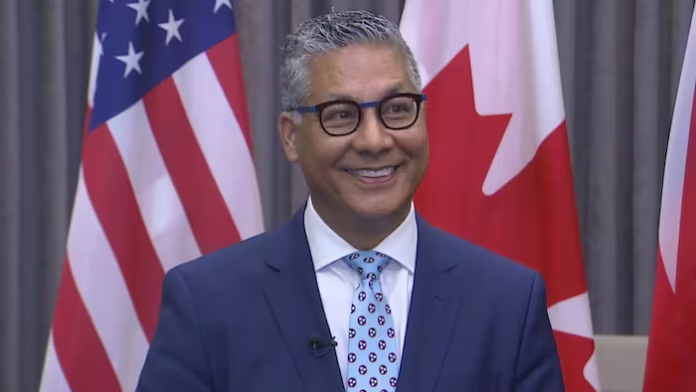
Richard Madan said he received no advance warning before the U.S. announced a new proposed 10 per cent additional tariff on Canada and other countries on Wednesday, citing an investigation into forced labour in supply chains.
The announcement came the day after Madan led Manitoba’s first formal delegation to meet with senior U.S. trade representatives — a six-person group that included representatives from the Manitoba Chambers of Commerce, the Manitoba Pork Council, Keystone Agricultural Producers, and the Business Council of Manitoba, as well as Paul Soubry, former CEO of bus manufacturer New Flyer Industries.
Manitoba’s Message to Washington
The delegation focused on the mutual benefits of the trade relationship between Manitoba and the United States. Madan highlighted the province’s role in the continental pork supply chain, noting that much of the pork processed in Manitoba is shipped south for further processing in states like Iowa and Missouri.
“We went in there with a very positive message, essentially how Manitoba helps the United States,” Madan said.
The latest proposed tariff increase would not apply to goods compliant under the Canada-U.S.-Mexico Agreement (CUSMA), meaning a significant portion of Manitoba’s exports to the U.S. would remain unaffected. Agriculture dominates those exports, which totalled more than $7 billion in goods between January and June of last year.
Uncertainty the Real Problem
Despite the partial exemptions, Madan warned that unpredictability itself is inflicting real economic damage. A survey his office conducted, drawing on input from more than 100 business, labour, and Indigenous groups across the province, found that stability and predictability matter just as much to Manitoba businesses as raw market access.
“The ongoing uncertainty is really hurting investment in the province,” Madan said. “That was a message that we heard from the delegation loud and clear.”
The report, released last week, identified those concerns as a central theme among stakeholders.
Kinew Calls for Pushback
Manitoba Premier Wab Kinew took a more combative tone in Winnipeg on Wednesday, demanding the Trump administration reverse course.
“We want to see the Trump administration back down from trying to attack our economy. There’s no reason for it,” Kinew said. “And if the Trump administration attacks us, we have to push back.”
NFI Group: ‘Noisy and Messy, But Not Disastrous’
Soubry, who stepped down as CEO of NFI Group — the Winnipeg-based bus manufacturer formerly known as New Flyer — at the start of the year and now serves as an adviser to the company, offered a measured assessment of the tariffs’ impact on the firm.
“The impact has been noisy and messy, but not disastrous,” he said.
However, Soubry noted that a combination of older buy-American procurement rules and the new tariffs has pushed NFI Group to expand its manufacturing footprint in the United States rather than in Canada.
“As a Manitoban, it’s kind of a frustrating story,” Soubry said. “A Manitoba business that now has more people employed in the U.S. than we do in Canada.”
Soubry said the Washington meetings were nonetheless productive, both in educating U.S. officials about Manitoba’s economic role and in giving provincial business leaders a clearer sense of how American negotiators intend to approach trade talks. His takeaway was blunt: “The Americans are going to be tough.”

