
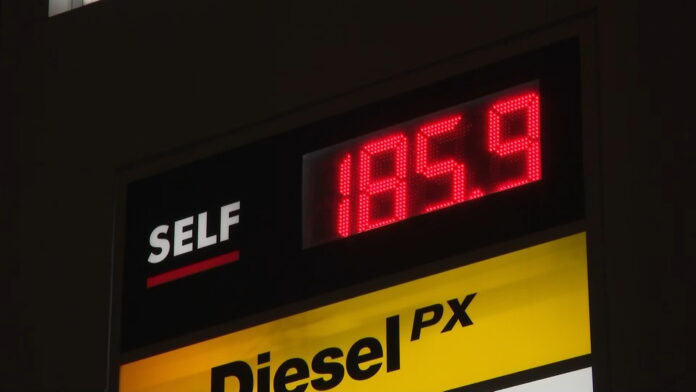
Pump prices jump more than 30 cents per litre in Calgary and Edmonton
Alberta motorists faced a sharp overnight spike in gasoline prices Wednesday, with pump prices in Calgary and Edmonton surging by more than 30 cents per litre — a jolt that one industry analyst says may signal a lasting “new normal” driven by the ongoing war in Iran and the closure of the Strait of Hormuz.
According to fuel-tracking website GasBuddy, Edmonton’s cheapest price Wednesday sat around $1.50 per litre, while many stations in the city climbed as high as $1.849. In Calgary, the lowest price hovered just under $1.60, with other stations reaching $1.869 per litre.
How Alberta compares to other major cities
Alberta’s prices, while painful for drivers, remain below those seen in Vancouver, where GasBuddy reported the lowest available price at $2.079 per litre Wednesday. Toronto offered somewhat more relief, with the cheapest price recorded at $1.596 per litre.
The spike comes despite a 10-cent federal excise tax cut on gasoline that took effect April 20 — a reduction that has done little to cushion the blow of rising global crude prices.
‘It’s like a tax increase’
“Fuel is outrageous right now. It’s a little bit uncontrollable,” said Francois Saad, who was filling his SUV at an Edmonton station Wednesday morning. He said it now costs him between $140 and $160 to fill his tank with 50 to 60 litres.
Richard Masson, former CEO of the Alberta Petroleum Marketing Commission, told Global News the price surge is rooted in global supply disruptions caused by the Iran conflict.
“What’s going on is the Strait of Hormuz has not been opened, and so global supply remains low,” Masson said. “A number of refineries that would normally be producing got damaged during the war, and the kinds of oil getting to refineries don’t fit as well — so they can’t make all the gasoline and diesel they would like to.”
Masson explained the price gap between Calgary and Edmonton by pointing to geography: Edmonton is home to Alberta’s refineries, and refined products must be shipped by pipeline or truck to Calgary and other markets, adding to the cost.
He described elevated fuel prices as functioning like a tax on household budgets. “Higher gasoline prices, higher natural gas prices flow through to your bottom line right away,” he said. “Effectively, you’re going to have to cut somewhere else in your budget to keep things balanced.”
Global crude prices continue to climb
Benchmark crude prices rose sharply Wednesday. West Texas Intermediate for June delivery climbed nearly US$7 per barrel to reach US$106.88, while Brent Crude briefly surged above US$120 before settling at around US$118 per barrel.
Masson cautioned that a quick return to pre-war conditions is unlikely. “We can’t be sure that if the Strait of Hormuz opens, it won’t get closed again — and there are insurance issues, crewing issues, and tankers out of position all over the world,” he said. “It’s not going to be a flick of the switch to come back to normal. There’s going to be a new normal.”
Drivers eye electric vehicles as long-term escape
For many Alberta drivers, the sustained price pressure is accelerating interest in electric vehicles. Lisa Gaffney, filling up at an Edmonton Mobil station, said she would like to afford an EV. “I think it’ll be good when we get to using more EVs and having more EV chargers around and not reliant on gas quite so much,” she said.
Thomas Helm echoed that view. “We’re already at the point of looking at an EV. It has kind of been in the background, but now it’s like we should really get one,” he said, noting that switching to electric could cut fuel costs by as much as 75 per cent.
Masson acknowledged EVs as a viable option for reducing exposure to fuel price volatility, and also pointed to public transit and cycling as alternatives for those with access. In the meantime, he advised motorists to shop around for the lowest available price, saying that consumer pressure “helps to keep prices down” — even as he warned that “the big picture trend is higher prices.”

