
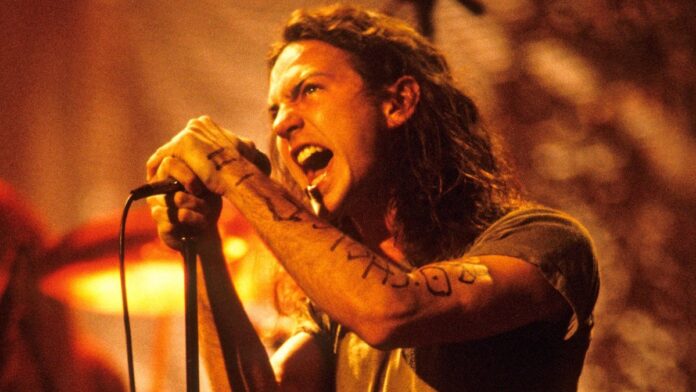
Before Eddie Vedder became one of the defining voices of 1990s grunge, he was working night shifts as a security guard in San Diego, spending his mornings surfing the Pacific coast when time allowed. It was during one of those early, fog-shrouded sessions on the water that he received a demo tape from two musicians who would soon become his bandmates: guitarist Stone Gossard and bassist Jeff Ament. What followed was a burst of songwriting rooted in personal grief, a love of classic rock, and the rhythmic pull of the ocean, producing three tracks that would eventually launch one of the most successful rock bands of the decade.
The emotional core of that writing session was Vedder’s complicated relationship with his own identity and family history. As a teenager, he had discovered that the man he believed to be his father was actually his stepfather, and that his biological father, Edward Severson, had already died before Vedder ever had the chance to know him. That revelation had unsettled his sense of self for years, and it surfaced powerfully during this particular morning on the water. Drawing also from his deep admiration for The Who’s concept album Quadrophenia, which opens with the sound of waves crashing on the track “I Am The Sea,” Vedder shaped his raw feelings into lyrics and wove three songs together into what he called a “mini-opera,” titled Mamasan. The opening track of that sequence became “Alive.”
The demo tape impressed Gossard and Ament enough that they flew Vedder up to Seattle, where the future members of Pearl Jam were already working in the studio alongside Chris Cornell and Matt Cameron of Soundgarden. The project was Temple of the Dog, a tribute album dedicated to Andrew Wood, the late singer of Mother Love Bone and a close friend to several of the musicians involved. During those sessions, Cornell invited Vedder to contribute additional vocals to “Hunger Strike,” a collaboration that would become a hit single in 1992, once the record label recognized it brought together two acts, Soundgarden and Pearl Jam, both of whom had by then achieved significant mainstream recognition.
Pearl Jam released “Alive” as their lead single on July 7, 1991, and it climbed to number 16 on the Mainstream Rock Airplay chart and number 18 on the Modern Rock Tracks chart. The two other songs from the Mamasan demo also found their place in the band’s catalogue: “Once” appeared on the debut album Ten, while “Footsteps” surfaced years later on the rarities and B-sides compilation Lost Dogs, released in 2003. The success of “Alive” built momentum for Ten, which was released on August 27, 1991, and eventually climbed to number 2 on the Billboard 200 a full year after its release, held from the top spot by Billy Ray Cyrus’ Some Gave All. Fuelled by the subsequent singles “Even Flow” in March 1992 and “Jeremy” in August 1992, the album became a landmark of the era, arriving at the same cultural moment that Nirvana’s Nevermind reached number 1 on the Billboard 200 in January 1992 and helped carry grunge into the mainstream for good.

