A Classic Reclaimed
Thirty-seven years is a long time to wait for a second look — but Dead Poets Society has earned it. Peter Weir’s 1989 coming-of-age drama, starring Robin Williams as the unforgettable English teacher John Keating, has returned in a fully restored 4K Ultra HD release, available both on digital platforms and as a two-disc Blu-ray combo pack. The reissue is not mere nostalgia packaging. It is an argument, renewed in high dynamic range, that this film belongs in the permanent canon of American cinema.
The thesis is simple but worth defending: Dead Poets Society endures not because it flatters its audience, but because it refuses to. Its portrait of institutional conformity, adolescent awakening, and the genuine cost of inspiration remains as uncomfortable — and as necessary — as it was when it first reached theatres on June 2, 1989.
What the Film Actually Does
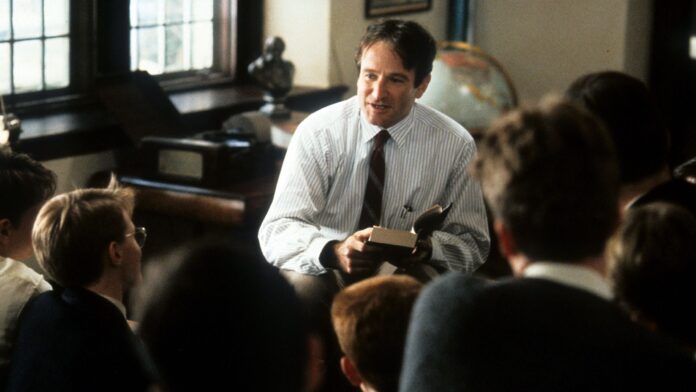
Written by Tom Schulman and directed by Weir with a restraint that is easy to underestimate, the film places Williams’ Keating inside the suffocating world of the fictional Welton Academy, an elite New England boarding school where tradition functions less as heritage than as control. Keating’s method — urging students to stand on their desks, tear prescribed pages from textbooks, and embrace the Latin mandate “carpe diem” — is not mere eccentricity. It is a structured challenge to the way authority reproduces itself through education.
The students who form the revived Dead Poets Society do not simply discover poetry; they discover that desire, ambition, and selfhood are not luxuries their institution is designed to accommodate. The consequences are real and, for one student, devastating. Schulman’s script does not flinch from that outcome, and Weir does not allow Williams to charm his way past it. The film earns its grief.
Williams received an Academy Award nomination for Best Actor for the role — a recognition that acknowledged something critics at the time were slower to grant. Roger Ebert, among others, found the drama uneven on first viewing. The film now holds an 85 percent critics’ score and a 92 percent audience score, a trajectory that says something meaningful about how its reputation was built: not through marketing cycles, but through the quiet persistence of viewers who found something true in it.
The Restoration and What It Offers
The new release was produced by scanning the original camera negatives at full 4K resolution and restoring the image in High Dynamic Range (HDR), a process that recovers detail in both shadow and highlight that standard transfers have long compressed away. Cinematographer John Seale’s work — the candlelit cave sequences, the grey New England mornings, the charged geometry of the classroom — benefits substantially from this treatment. The accompanying Dolby Atmos audio track, meanwhile, restores the spatial texture of Alan Splet’s sound design, which was always more deliberate than audiences may have noticed.
The two-disc Blu-ray package includes a set of supplementary features that extend well beyond the standard promotional fare. A featurette titled Dead Poets: A Look Back brings together director Peter Weir, actors Ethan Hawke and Robert Sean Leonard, and — notably — filmmaker David Lynch, whose presence suggests the film’s reach across creative communities. A separate featurette, Master of Sound: Alan Splet, addresses the sound designer’s contributions directly, while Cinematography Master Class includes an intensive lighting workshop. An audio commentary featuring Weir alongside Seale and screenwriter Tom Schulman rounds out a package designed for serious engagement rather than casual browsing.
Dead Poets Society arrived on 4K Ultra HD Digital and Blu-ray on September 29, 2026, alongside a simultaneous reissue of Mrs. Doubtfire — another Williams film from the same era, released in 4K for the first time. Both titles are now available for digital purchase through Amazon Prime Video, Apple TV, and Fandango at Home, each with newly commissioned key art.
Why This Release Is More Than a Remaster
Robin Williams went on to build one of the most varied filmographies in Hollywood history, moving through Hook, Aladdin, Jumanji, The Birdcage, and Good Will Hunting with an ease that obscured how much discipline each role required. Yet Dead Poets Society occupies a particular position in that body of work. It is the film in which Williams’ instinct for performance — the warmth, the verbal velocity, the sudden stillness — was placed in direct service of an idea rather than a spectacle.
The 4K restoration does not change what the film is. It simply removes the patina of age that allowed viewers to experience it as a period piece rather than a living argument. Keating’s insistence that literature is not a luxury but a necessity — that measuring the worth of a life requires more than conformity and credential — does not feel dated in the current moment. If anything, it feels pointed. That is why this release matters, and why thirty-seven years have done nothing to diminish the film’s claim on its audience.

