
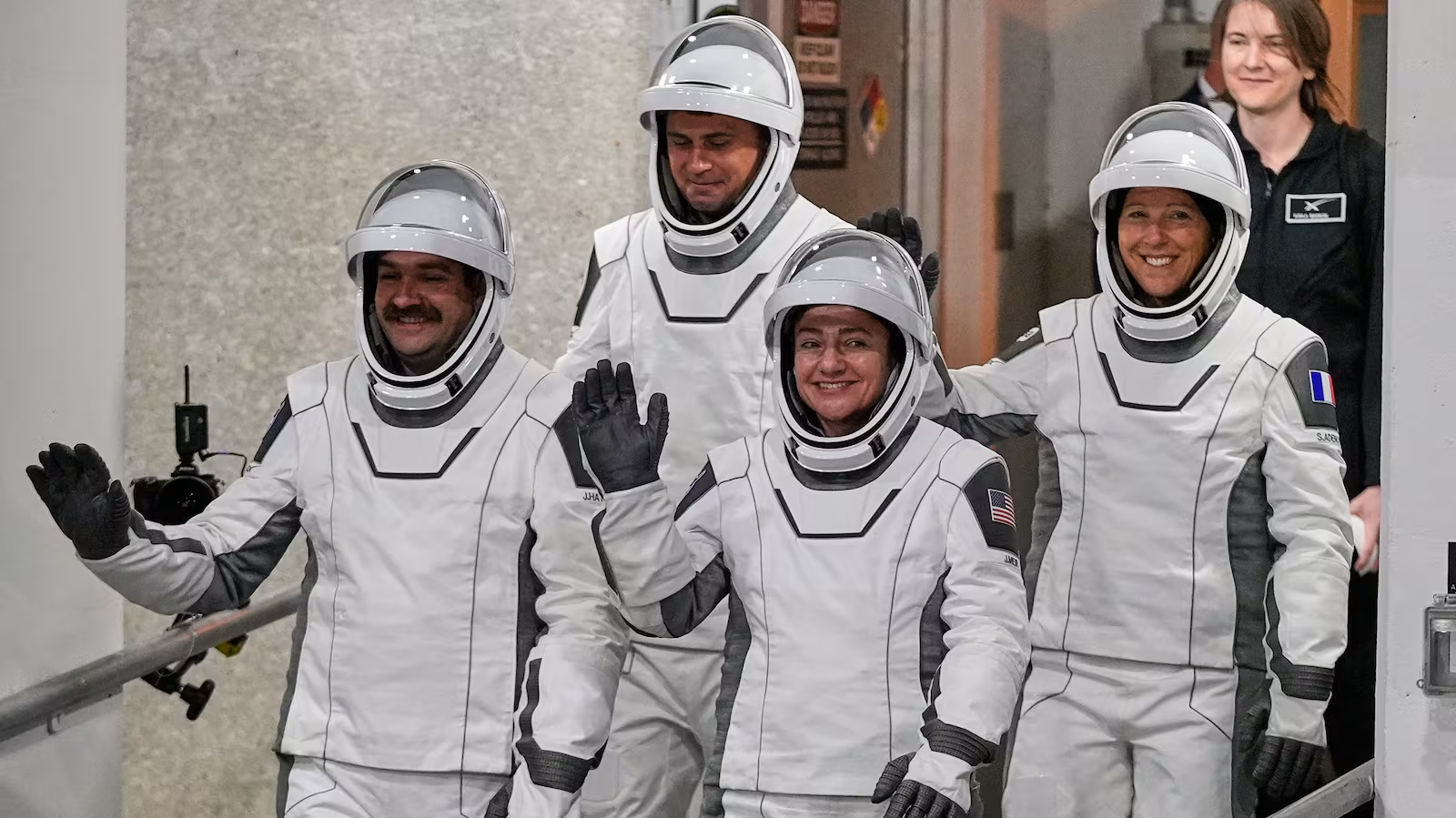
A new four-person crew blasted off from Florida on Friday to re-staff the International Space Station. The mission follows NASA’s first medical evacuation of a crew in 65 years of human spaceflight. SpaceX launched the replacements at NASA’s request, sending Americans Jessica Meir and Jack Hathaway, France’s Sophie Adenot, and Russia’s Andrei Fedyaev on an expected eight- to nine-month stay. They are due to arrive Saturday, bringing the station back to full strength after a month of reduced operations. “It turns out Friday the 13th is a very lucky day,” Mission Control told the crew after orbital insertion. “That was quite a ride,” commander Jessica Meir replied.
What changed on orbit
NASA paused spacewalks and deferred some maintenance while waiting for reinforcements. Only three astronauts—one American and two Russians—kept the orbital lab running in recent weeks. The evacuated crew splashed down in the Pacific near San Diego and went directly to hospital care. NASA has not identified the affected astronaut or disclosed the condition. An ultrasound machine already aboard for research supported on-orbit checks on January 7, allowing teams to manage the situation until a safe return. Ultrasound is a medical imaging method that uses high-frequency sound waves to view tissues and blood flow.
Launch details and the ride uphill
Liftoff came from Cape Canaveral Space Force Station. The rocket was a Falcon 9, a two-stage launcher that returns its first stage for reuse. The capsule was Crew Dragon, SpaceX’s human-rated spacecraft designed for orbital missions and ISS dockings. Ascent, staging, and orbital insertion proceeded as planned. The crew then began a standard series of maneuvers to phase with the station for docking on Saturday.
Who is on Crew-12
Meir returns for a second station mission; in 2019 she took part in the first all-female spacewalk. Hathaway is a spaceflight rookie. Adenot becomes only the second French woman to fly to space, three decades after Claudie Haigneré’s 1996 mission. Fedyaev makes his second trip to the ISS. Together, they restore the laboratory’s normal tempo of science and upkeep.
Crew-12 launch and why it matters
The rapid turnaround underscores how human spaceflight must manage medical risk. Long missions stretch systems and crews. Some equipment cannot be miniaturized or operated safely in microgravity, so timely return remains a key safety tool. A full crew also allows NASA and partners to resume spacewalks, conduct maintenance, and clear science backlogs. The station’s role as a testbed for future exploration depends on that steady cadence.
Science tasks with an exploration focus
The crew will test a filter that can turn drinking water into emergency IV fluid. They will try an ultrasound system that uses artificial intelligence and augmented reality to guide scans without real-time experts on the ground. They will also perform jugular-vein ultrasound scans for a study on blood clot risks in microgravity. These experiments target medical autonomy for trips to the Moon and Mars, where communication delays and limited supplies raise the stakes.
Training linked to Artemis
On orbit, the astronauts will run a simulated lunar landing guidance exercise. The drill draws added attention with Artemis II preparing to send four astronauts around the Moon for the first time in more than 50 years. Meir noted before launch that she did not expect to see a lunar return so soon in her career, and said overlapping missions make this a striking moment for crews on both paths.
Industry and agency context
SpaceX flew Crew-12 while also preparing its nearby Kennedy Space Center pad for Starship operations. NASA plans to use the larger vehicle as part of future lunar landings. After Friday’s launch, NASA Administrator Jared Isaacman said fueling tests continue at the Artemis pad. A recent hydrogen leak prompted seal replacements and an additional test. He emphasized that no launch date will be set until the team completes further tanking runs, with the earliest target for Artemis II now cited as March 3.
In short, Crew-12 restores full staffing on the ISS and resets the pace of science, maintenance, and training. The mission supports near-term lunar objectives while advancing the medical tools needed for longer, more distant voyages.

