
College Football Network has released the bottom tier of its 2026 preseason rankings, covering teams 101 through 138, and this stretch of the list carries more intrigue than usual heading into the fall season. Sacramento State makes its FBS debut in the MAC, Northern Illinois begins a new chapter in the Mountain West, and a cluster of Sun Belt programs enter the year with genuine conference title ambitions. Taken together, these 38 teams represent a wide range of circumstances — rebuilds, fresh starts, and programs quietly positioning themselves for a breakthrough.
At the very bottom of the rankings sits Sacramento State (No. 138), the newest FBS program, projected to finish 3-9 in its inaugural season. The Hornets bring a loyal fanbase and a home-field advantage that could turn heads, but thin offensive and defensive lines remain a serious concern. Joining them near the floor is UMass (No. 137), coming off a winless 2025 campaign and projected for just two wins, though a pair of FCS matchups on the schedule offer a narrow path to modest improvement. Charlotte (No. 132) finds itself in a similar predicament, projected for just one win after a disastrous 1-11 finish last season, with the 49ers needing to find any formula that produces consistent competitiveness before results can follow.
Several programs in this tier are navigating significant transitions. Northern Illinois (No. 123) moves to the Mountain West under an interim head coach, with a roster in the early stages of a rebuild and a travel schedule that will stretch across four time zones — a genuine logistical and competitive challenge for a program still finding its footing. UTEP (No. 129) also joins the Mountain West, entering with more optimism: a lively offence and a favourable mid-season home stretch give the Miners a realistic shot at outperforming their projected 2-10 record. Louisiana Tech (No. 103) completes its own move, departing Conference USA for the Sun Belt, where its offence is expected to rank among the division’s best.
The Sun Belt West emerges as one of the more competitive sub-stories in this portion of the rankings. Arkansas State (No. 102), Louisiana (No. 105), and Louisiana Tech (No. 103) are each projected for six or seven wins, with road-game performance in the back half of their schedules likely to determine which program claims the division title. Georgia Southern (No. 101), the highest-ranked team in this group, enters at 7-5 projected, leaning on a reliable passing game while hoping its defence takes a meaningful step forward. The Sun Belt East is projected to be equally demanding, with Old Dominion (No. 108) and App State (No. 120) both facing pressure to return to relevance after disappointing recent campaigns.
A few teams in the middle of this range stand out as potential overachievers. Kennesaw State (No. 111) enters as the defending Conference USA champion and is projected for an 8-4 record, with a controlled, disciplined style of play that makes the Owls a consistent threat. WKU (No. 107) is similarly well-regarded, projected at 8-4 despite a punishing early schedule that includes trips to Georgia and Indiana. Central Michigan (No. 119) is identified as one of the MAC’s genuine wildcard teams, with a strong offensive backfield and coaching staff capable of competing for a conference title. CFN also flags Jacksonville State (No. 112) with a note of self-correction, acknowledging it significantly underestimated the Gamecocks in 2025, when the program went 9-5 — a caution worth keeping in mind as the season approaches.
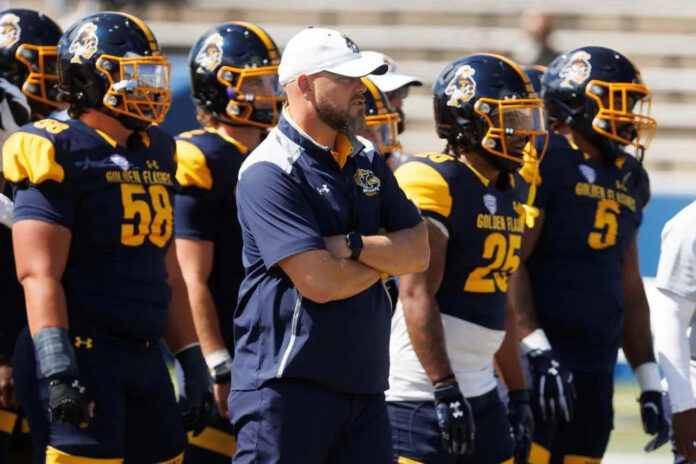
At the MAC level, Bowling Green (No. 122) under Eddie George is projected to struggle early before the schedule softens, while Eastern Michigan (No. 127) is seen as a bounce-back candidate after slipping to 4-8 last year, buoyed by an improved passing attack and a more reliable offensive line. Kent State (No. 125) draws praise for head coach Mark Carney, described as a rising star in the profession, even as the Golden Flashes are projected to fall short of a winning record due to ongoing roster limitations. Further down, Ball State (No. 124) faces the structural difficulty of five road games in its first seven weeks, making any late-season bowl push an uphill climb from the opening whistle.
Rounding out the rankings, FIU (No. 109) is positioned as a potential Conference USA breakthrough team under Willie Simmons, with a capable passing game and defensive secondary that could push for a title. Temple (No. 110) draws an enthusiastic note about head coach KC Keeler, whose track record suggests the Owls could punch above their weight in the American Athletic Conference. Across the board, this tier of college football reflects the sport’s structural realities — limited recruiting budgets, brutal scheduling, and the constant churn of the transfer portal — but also the genuine unpredictability that makes the bottom half of the rankings worth watching every fall Saturday.

