
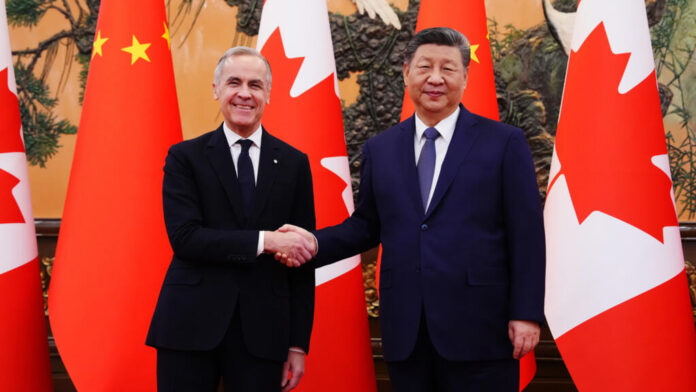
OTTAWA — Canada and China have reached a preliminary agreement-in-principle that would roll back punitive tariffs on Chinese electric vehicles and Canadian canola products, a significant thaw in a relationship that has been strained by trade retaliation and broader geopolitical tension. The tariff changes are expected to take effect by March 1, 2026, with Ottawa framing the deal as a managed reopening of trade that protects domestic industries while restoring market access for key Canadian exports.
Canada China tariffs deal: what changes on March 1
Under the agreement, Canada will allow an initial annual quota of 49,000 China-made electric vehicles to enter the Canadian market at the most-favoured-nation tariff rate of 6.1%, replacing the additional 100% tariff Canada imposed in 2024. Ottawa says the quota reflects import volumes before recent trade frictions and would represent less than 3% of Canada’s new-vehicle market.
On the agriculture side, Canada expects China to cut tariffs on Canadian canola seed to a combined rate of about 15% by March 1, down from a combined rate Ottawa puts at 84%. The federal government says the change would improve access for roughly $4 billion in annual Canadian canola seed exports to China.
Canada also expects that canola meal, lobsters, peas and crabs will not be subject to China’s “anti-discrimination” tariffs from March 1 until at least the end of 2026, a package Ottawa values at about $2.6 billion in market access for agricultural goods.
Electric vehicles: quota, pricing targets and certification
Ottawa says the EV quota is designed as “managed market entry,” with an affordability target built into the plan: the share of the quota reserved for vehicles priced at C$35,000 or less at import is expected to reach 50% by 2030. The government says it will also work with Chinese manufacturers on vehicle certification to ensure models sold in Canada meet federal motor vehicle safety standards.
China’s commerce ministry has publicly described the arrangement as ending Canada’s additional 100% tariff within the quota while keeping the 6.1% most-favoured-nation rate in place.
Canola: relief promised, but investigations still hang over trade
Canada is positioning the canola tariff rollback as one of the deal’s central commercial wins, given China’s importance to Prairie farmers and the wider oilseed supply chain. However, industry groups have noted that canola seed exports have also been affected by China’s provisional duties tied to an ongoing anti-dumping process, adding uncertainty around how quickly trade normalizes in practice.
The federal backgrounder describing the agreement says Canada expects China to accelerate the resumption of exports of Canadian beef, pet food, animal genetics and other products to China, signalling that further sector-specific discussions are still underway.
Political and industry reaction in Canada
The EV concession is expected to draw close scrutiny from automakers and unions in Ontario and across North America, where the sector is tightly integrated and competing governments have used tariffs to slow the inflow of low-cost Chinese-made EVs. General Motors CEO Mary Barra, speaking to The Wall Street Journal, criticized Canada’s decision to admit a capped number of Chinese EVs at a lower tariff, warning it could undermine regional manufacturing and supply chains.
Ottawa has argued the quota system is intended to provide predictability for Canadian manufacturers while increasing consumer choice and accelerating EV adoption, and it has linked the arrangement to an expectation of new joint-venture investment in Canada with “trusted partners.”
What comes next: review clause and broader trade agenda
Canada’s Global Affairs backgrounder describes the deal as an agreement-in-principle with a planned review of implementation and progress in three years to assess whether expected Canadian benefits have materialized. It also says the two countries agreed to continue work in coming months on additional “trade irritants” and areas of economic importance.
For Canada, the immediate test will be whether the promised agricultural relief translates into predictable access for farmers and exporters by March 1, and whether the EV quota can be implemented without triggering a new round of political friction with domestic manufacturers or Canada’s key trading partners.

