
OTTAWA — Canada’s carbon pricing debate has returned to the political forefront as the federal government prepares changes to industrial carbon-pricing rules while opposition parties and some provincial leaders argue that climate policy must not worsen affordability pressures.
The renewed arguments come after Ottawa ended the consumer-facing federal fuel charge effective April 1, 2025, shifting the centre of gravity to pricing systems that apply to large industrial emitters and to provincial policies that determine how those costs are managed and passed through the economy.
Carbon Pricing Debate Shifts From Households to Heavy Industry
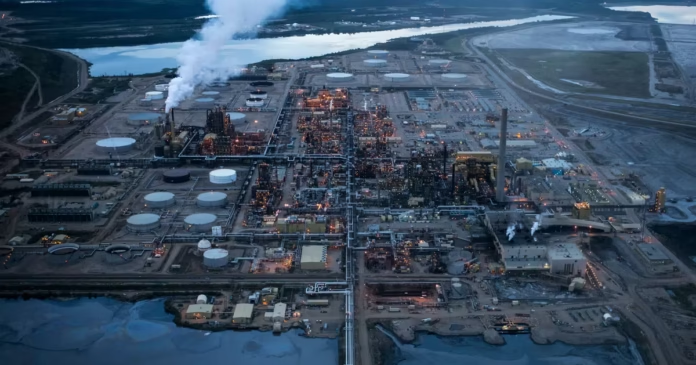
With the fuel charge set to zero, federal carbon policy is now primarily contested around industrial systems that cover major emitters in sectors such as power generation, oil and gas, and heavy manufacturing. Ottawa has said the intent is to keep a carbon price signal on a broad range of industrial emissions while allowing provinces flexibility in designing their own systems, provided they meet federal minimum standards.
Critics argue that even without a direct charge at the pump, carbon costs can still be reflected in electricity, home heating, transportation and the price of goods. Supporters counter that industrial pricing is designed to steer investment toward lower-emitting production and reduce longer-term economic risks tied to climate change and shifting global trade rules.
Federal Benchmark Review Reopens Provincial Friction
Environment and Climate Change Canada launched a formal engagement process in December 2025 to strengthen and update the federal benchmark for industrial carbon pricing. The benchmark sets the minimum stringency provincial and territorial systems must achieve to be considered equivalent to the federal standard.
Provincial governments that have resisted federal climate measures say tighter requirements can raise operating costs and weaken competitiveness, particularly in trade-exposed industries. Ottawa’s position is that predictable industrial carbon pricing is central to driving decarbonization investment while limiting the risk that emissions-intensive activity relocates to jurisdictions with weaker rules.
Climate Targets Raise the Stakes for Policy Choices
Canada’s federal climate framework includes a 2030 target of cutting emissions 40% to 45% below 2005 levels, and a legal commitment to reach net-zero emissions by 2050. Canada has also submitted a 2035 target range of 45% to 50% below 2005 levels.
Independent reviews and audit reports have repeatedly cautioned that meeting those targets depends on durable policy implementation across high-emitting sectors, including those governed by industrial carbon-pricing systems.
Cost-of-Living Politics and the Fight Over “Hidden” Impacts
The debate is also shaped by competing interpretations of how carbon pricing affects households. Past analysis by the Parliamentary Budget Officer of the former federal fuel charge found that direct costs and rebates could produce different outcomes across provinces and income groups, while broader economic effects and indirect price impacts remain politically contentious.
For the federal government, the challenge is to defend industrial carbon pricing as a climate and investment policy while responding to public concern about prices and to calls from opponents to dismantle carbon pricing entirely.
What Comes Next
Ottawa’s benchmark update is expected to influence industrial carbon pricing rules through the rest of the decade, including how provinces structure compliance options, set performance standards for large facilities, and recycle revenues back into households, businesses or clean investment.
As the federal consultation moves toward decisions, the carbon pricing debate is likely to remain a defining fault line in Canadian politics—testing whether governments can sustain climate policy ambition while addressing cost-of-living pressures that continue to dominate public attention.

