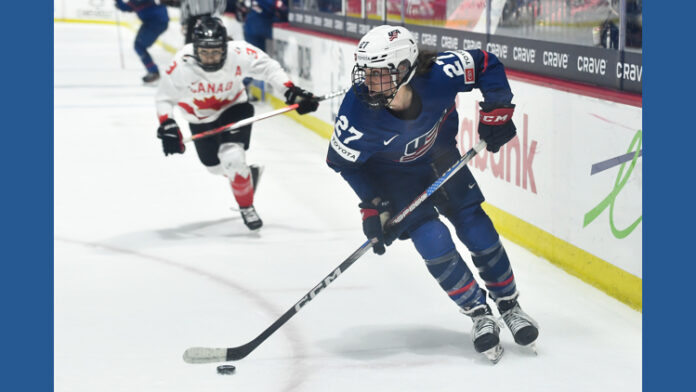
Next week, the best women’s hockey players in Canada and the United States will lace up their skates in Denmark for the women’s world championship. What they will wear on their backs, however, remains an open question — and the answer depends on the outcome of a legal dispute that cuts to the heart of who controls the identity of national hockey teams.
The conflict pits Hockey Canada and USA Hockey against the International Ice Hockey Federation over a deceptively simple question: who owns the commercial rights to national team jerseys? The answer, it turns out, is anything but simple, and the consequences could be deeply symbolic for players and fans alike.
A year ago, the IIHF announced an agreement with True Hockey, designating the company as the exclusive supplier of team uniforms and apparel for all IIHF member national associations at international events, effective beginning in the 2026-27 season. Whether that agreement was ever fully completed remains unclear. What is clear is that Hockey Canada already has a jersey deal with Bauer, and USA Hockey has one with CCM — and neither organization is prepared to quietly set those agreements aside.
Both Hockey Canada and USA Hockey have challenged the IIHF’s position before a court in Switzerland, where the federation is headquartered. They argue that commercial rights over their national team jerseys belong to them, not to the international body. The IIHF’s own bylaws appear to give some weight to that argument: the governing documents state that member national associations retain all rights related to their national team logo, emblem and uniform design, and that the IIHF shall not use those jerseys for commercial purposes without approval from the respective association.
And yet the court has not sided cleanly with the national federations. A Swiss court found that IIHF rules grant the federation commercial rights connected to its own competitions — including the supply of jerseys. That ruling opened the door for the IIHF to sell True Hockey jerseys bearing national team identities, while effectively blocking Hockey Canada and USA Hockey from selling their own branded sweaters at IIHF events.
The legal back-and-forth has been turbulent. At an Extraordinary Congress held in May, the IIHF moved to amend its bylaws to explicitly grant itself control over commercial jersey rights, which would have required all competing contracts — including those with Bauer and CCM — to be terminated. Hockey Canada and USA Hockey both filed for injunctions ahead of that congress. Those injunctions were initially granted, then revoked in September. Both organizations have since filed appeals, and the matter remains unresolved.
The stakes are not merely commercial. They are cultural.
Hockey Canada captured the emotional weight of the dispute plainly. In a public statement, the organization said that “wearing our Maple Leaf is incredibly important to our national team athletes.” It added that it remains hopeful a positive resolution can be reached with the IIHF’s new administration — one that would allow Canadian players to wear their country’s emblem when they take the ice in Denmark.
That hope has not yet translated into certainty. As things stand, both Canada and the United States could be forced to compete in generic jerseys — stripped of the logos, colours and markings that players and supporters have long associated with their national teams. True Hockey, caught in the middle of the dispute, cannot use either federation’s designs or markings without resolution.
Canada opens the tournament against Sweden on November 6. For the players who have spent careers chasing the chance to wear the Maple Leaf at a world championship, the uncertainty is more than a legal footnote — it is a question about what it means to represent a country on the international stage, and who has the right to define that representation.
The dispute reflects a broader tension in international sport between governing bodies seeking to consolidate commercial power and national federations defending their autonomy and identity. In Canada especially, where hockey occupies a singular place in national life, the idea that an international body might determine what a Canadian team looks like — or profit from it — touches something that goes well beyond contract law. The women’s championship begins in days. The jerseys remain undecided.

