Israel’s Ministry of Foreign Affairs has sharply condemned the Green Party of England and Wales after delegates at the party’s annual conference in Brighton voted on Sunday to define Zionism as a form of racism, calling the resolution a “stain on the history of the United Kingdom” and demanding that every British political party, beginning with the governing Labour Party, “unequivocally reject this twisted resolution.”
The motion, passed by 1,022 votes to 813, defines Zionism as an ideology supporting “an ethnonationalist Jewish state” and commits the party to backing “a single democratic Palestinian state in all of historic Palestine.” It further states that “the real, material, manifestation of Zionism has been the historic and ongoing dehumanisation, displacement, dispossession, disenfranchisement and destruction of Palestinians,” and asserts that “anti-Zionism should not be equated with anti-Semitism.” The relatively narrow margin of the vote reflects genuine and deep division within the party’s membership over where to draw the line on these contested questions.
The Israeli foreign ministry’s response was unsparing. In a statement posted on X, it accused the Green Party of having “ceased to act as a political party and become a body that gives legitimacy to terrorism,” alleging that the resolution “legitimises armed struggle” and amounts to a call for the destruction of the State of Israel. Israeli Foreign Minister Gideon Sa’ar went further on Sunday evening, announcing a ban on Green Party leader Zack Polanski from entering Israel, arguing that the motion “constitutes a clear anti-Semitic text according to the IHRA definition, as it denies the Jewish people’s right to self-determination.”
The Green Party rejected that characterisation without hesitation. In a statement issued to multiple media outlets, the party said it “would not be bullied into silence by the Israeli government,” adding: “We are proud that Zack and our party are standing up for Palestinian rights and demanding an end to British complicity in genocide and apartheid.”
A Party Divided, and a By-Election Looming
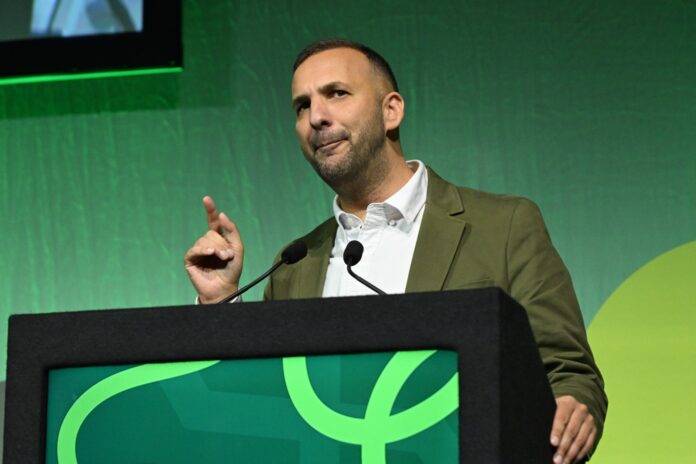
The vote exposed a visible fault line within the party’s own leadership. Deputy leader Mothin Ali supported the motion as written, while Polanski himself and the party’s other deputy leader, Rachel Millward, called for amendments to certain provisions, including the commitment to a one-state solution. That the party’s leader sought to soften a motion his party ultimately passed in full underscores the difficulty of managing a rapidly expanding and ideologically diverse membership.
The timing of the conference vote is not incidental. The resolution passed just days before the Holborn and St Pancras parliamentary by-election scheduled for October 8 — a seat vacated by former Prime Minister Keir Starmer — in which Polanski is a candidate. The Gaza issue has proven to be one of the most potent drivers of voter movement away from Labour and toward the Greens, with YouGov research from July finding that 23 percent of Labour defectors who switched to the Greens cited the party’s stance on Gaza as a factor, while 44 percent said Labour had moved too far to the right. A more recent September poll placed overall Green Party support at 11 percent nationally, and the party has emerged as the leading choice among voters aged 18 to 24, commanding 37 percent in that cohort.
The episode also deepens an already strained relationship between the British government and Israel. Earlier this month, London joined European allies in reiterating support for a two-state solution while simultaneously announcing sanctions against illegal Israeli settlements in the West Bank, accusing the Israeli government of “undermining the possibility of a two-State solution.” Israel responded by closing the United Kingdom’s consulate in East Jerusalem, with Foreign Minister Sa’ar accusing the Labour government of acting “consistently against the State of Israel.” The Green Party remains the only major British political force to have formally abandoned the two-state framework altogether — a position that, as the party’s electoral footprint grows, carries increasing weight in the broader political conversation.

