
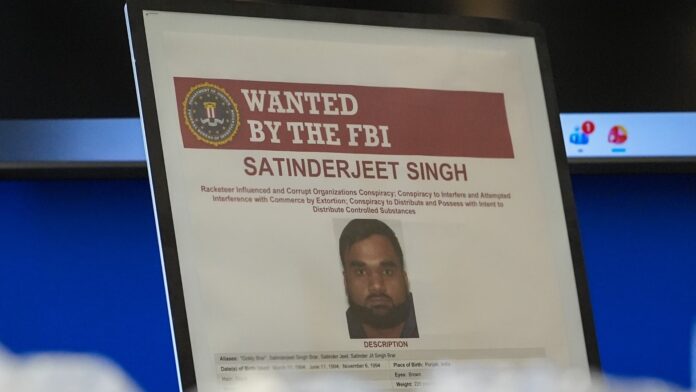
The FBI announced Monday it is offering a reward of US$1 million for information leading to the arrest of Satinderjeet Singh, also known as Goldy Brar, in connection with the 2023 assassination of Sikh activist Hardeep Singh Nijjar in Surrey, British Columbia. Patrick Grandy, assistant director in charge with the FBI’s Los Angeles field office, described Singh as “armed and dangerous” at a joint press conference held alongside the RCMP, and confirmed that Singh has been added to the FBI’s list of ten most wanted fugitives. Authorities believe Singh may currently be in the Los Angeles area, though he has also been known to reside in other parts of California and in Canada over the years. “We do not know his exact location as we stand here right now,” Grandy said. “That is part of the reason why we have offered this reward for information leading to his capture.”
Singh was first charged in July as part of Operation Hard Ball, a joint FBI-RCMP crackdown targeting India-based organized crime networks operating across North America. That operation resulted in charges against 37 individuals and the arrest of 24 others. Singh was charged alongside Lawrence Bishnoi, leader of the Bishnoi gang, who is also accused of ordering Nijjar’s killing and remains imprisoned in India. RCMP Deputy Commissioner Lisa Moreland, speaking at Monday’s press conference, offered a pointed characterization of the fugitive: Singh, she said, “holds no loyalty, nor should others feel any loyalty towards him.”
A Killing That Reshaped Canada-India Relations
The assassination of Hardeep Singh Nijjar on June 18, 2023, outside a Sikh cultural centre in Surrey sent shockwaves through Canadian politics and fundamentally disrupted the country’s relationship with India. Then-prime minister Justin Trudeau stood in the House of Commons that September and stated there were “credible allegations” that agents of the Indian government had been involved in the killing — a claim India swiftly and categorically denied. The diplomatic fallout was swift and severe: Canada expelled six Indian diplomats, and India retaliated in kind. For months, the two governments engaged in a tense standoff, with Canadian officials stating publicly that India had refused to co-operate with any investigation into the matter.
The following year brought further escalation when the RCMP and the federal government publicly accused Indian diplomats and consular officials based in Canada of engaging in clandestine activities linked to serious criminal conduct, including homicides and extortion. The allegations placed Canada in the uncomfortable position of confronting one of the world’s largest democracies over conduct on Canadian soil — a challenge that tested the limits of both Canadian institutions and diplomatic norms. Canadian Sikh communities, many of whom had long raised concerns about transnational repression originating from India, found their fears given official weight, even as the full picture of state involvement remained contested.
A Recalibrated Relationship Under Carney
Since Prime Minister Mark Carney took office, the tone of Canada’s relationship with India has shifted considerably. In September 2025, the Canadian government formally designated the Bishnoi enterprise as a terrorist entity under the Criminal Code — a significant legal step that reinforced Canada’s stated commitment to accountability. Yet Carney has simultaneously moved to rebuild economic and diplomatic ties, describing India last November as “a reliable trading partner.” Last week, he confirmed that Indian Prime Minister Narendra Modi will visit Canada in December, a development that would have been difficult to imagine at the height of the diplomatic crisis. Both countries are now working toward a bilateral trade agreement with the ambition of doubling two-way trade to $70 billion annually by 2030.
The RCMP’s own public posture has also evolved in ways that have drawn scrutiny. Commissioner Mike Duheme stated in March that active investigations no longer showed “any connection right now with any foreign entity” in files related to transnational repression in Canada. The force later clarified those remarks, acknowledging awareness of complaints of intimidation and harassment against certain communities and conceding that foreign states are engaged in such activities on Canadian soil — while stopping short of establishing current criminal links. The clarification did little to resolve the ambiguity, and advocacy groups representing Canadian Sikh communities have continued to press the government for greater transparency and protection.
Public Safety Minister Gary Anandasangaree’s office said Monday it “welcomes” the FBI’s reward announcement, with press secretary Simon Lafortune stating that the move “demonstrates the strength of Canada’s close cooperation with the United States and our shared determination to ensure that those accused of serious violence and intimidation have nowhere to hide.” Anandasangaree’s office added that transnational repression remains a “top priority” for the government. Anyone with information about Singh’s whereabouts is asked to contact the FBI’s toll-free tip line at 1-800-CALL-FBI (1-800-225-5324).

