Something shifted on Wednesday — not quietly, and not without consequence. In the chamber of the European Parliament, European Commission President Ursula von der Leyen stood before her assembled lawmakers, with Canadian Prime Minister Mark Carney seated to her left, and extended an invitation that no country has ever received before: she asked Canada to become the European Union’s first associate member. The room rose. Carney walked to her podium and shook her hand. And within hours, the reverberations were felt from Washington to Penticton.
Von der Leyen framed the invitation in the language of shared values and urgent geopolitical necessity. “We share one ocean, one set of values, one way of seeing the world,” she told the Parliament. “And we will now build our shared future as well.” She had spoken at length about the challenges confronting Europe and her conviction that the bloc must “urgently reimagine our partnerships” — and she named Canada as the country with which she most wanted to do that reimagining.
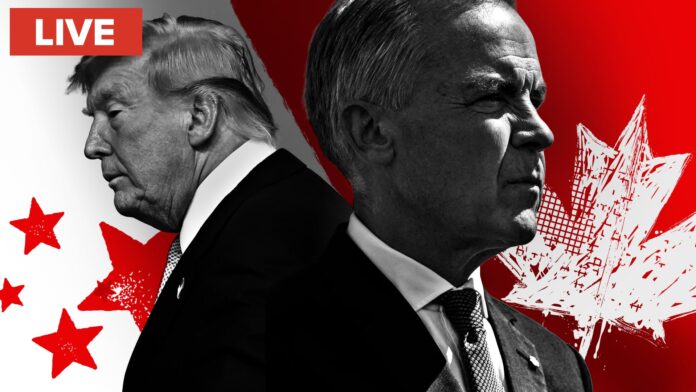
The response from Washington was swift and characteristically blunt. U.S. President Donald Trump told reporters Wednesday evening that Canada becoming an associate member of the EU could constitute a “hostile act,” and threatened to impose heavy tariffs on Europe or curtail trade across a broad range of goods. “If it’s a good intention, that’s fine. If it’s a bad intention, we’ll put very heavy tariffs on Europe,” Trump said. He called Canada a “terrible trade partner” and dismissed the prospect of associate membership as “laughable.” The threat arrived on the same day Trump signed a presidential memorandum directing federal agencies to identify and remove Canadian-origin goods from U.S. government procurement schedules — a measure he had telegraphed the previous week on Truth Social, claiming Canadian products in those schedules amounted to more than fifty billion dollars annually.
Trump also renewed his accusations that Canada was failing to stop the flow of fentanyl southward, alleging that clandestine Canadian labs were producing the drug and that Chinese criminal networks were operating near the border. He did not, however, include Canada on the official list of major drug-producing countries submitted to Congress — a list that named Afghanistan, China, Colombia, Mexico and several others. U.S. government data consistently shows that the volume of drugs seized at the northern border is a fraction of what is intercepted at the boundary with Mexico, a context that tends to get lost in the noise of Trump’s proclamations.
Back in Canada, the diplomatic excitement collided with domestic political friction. Conservative Leader Pierre Poilievre, speaking to his caucus gathered for a retreat in Penticton, British Columbia, accused Carney of “secretly negotiating” with the EU and insisted that Canada already has the frameworks it needs — CETA for trade, NATO for defence — without venturing into uncharted constitutional territory. “Conservatives say no EU taxes, no EU laws, and no EU open-border immigration rules in Canada,” Poilievre said. “Canada must be independent and sovereign. Period.” He also took aim at Carney’s apparent inconsistency in terminology, noting that the prime minister had referred to a “unique alliance” while von der Leyen spoke of “associate membership” — a distinction that Canada’s ambassador designate to the EU, Jonathan Wilkinson, acknowledged openly, saying the two sides are “much more focused on getting concrete results” before settling on a label.
Wilkinson’s candour was itself revealing. He told reporters that the details of any new Canada-EU relationship remain fluid, that sovereignty concerns are real and unresolved, and that Ottawa is simply “not there” yet when it comes to the associate membership framing. “I think we’ve actually got to get to the point where we know what we’re describing,” he said — a measured, lawyerly formulation that reflects the genuine complexity of what is being negotiated. Associate membership has no established template in EU law; it has been discussed in the past for post-Brexit Britain and for Ukraine, but no concrete mechanism exists, and any formal steps toward membership would require unanimous approval from all twenty-seven member states.
Tobias Cremer, a German Social Democrat in the European Parliament, captured the moment’s ambition and impatience in equal measure. “Now is the time to stop sending each other love letters and put meat on the bone,” he said, arguing that whatever emerges should be more holistic than another trade or defence agreement — a genuine strategic alliance. The readout from Carney’s meeting with von der Leyen spoke of moving “beyond” their existing trade deal toward something “far stronger, more ambitious,” with expanded co-operation in critical minerals, defence, artificial intelligence, energy, space, and financial services.
Carney then travelled to Liverpool, where he attended an Everton FC match alongside new British Prime Minister Andy Burnham — both men are supporters of the club — before announcing that Canada has formally applied for full membership in the U.K.-led Joint Expeditionary Force, a ten-nation NATO rapid-response coalition established in 2014. London is supporting the bid. Canada’s military has participated in multinational exercises with the force but has not held permanent membership. The move signals a broader reorientation of Canadian defence and diplomatic ties toward European partners, one that carries its own strategic logic in a moment when the reliability of the United States as an ally is genuinely in question.
At home, the NDP’s Avi Lewis offered a sharper domestic critique, pressing Carney on the government’s investment summit in Toronto and its openness to privatizing four major Canadian airports — Pearson, Montréal-Trudeau, Calgary, and Vancouver. “Where is the money for the people?” Lewis asked during an interview on CTV Power Play. He warned that airport privatization, drawing on the cautionary examples of Australia and the United Kingdom, tends to raise costs for travellers and burden the public purse over time. He invoked the Highway 407 in Ontario — sold under Mike Harris and now among the most expensive toll roads on the continent — as a local illustration of where that logic leads. Ontario Premier Doug Ford, by contrast, called Carney’s privatization plan “fabulous” and suggested it “should have been done years ago.”
Elsewhere in Ontario, the small town of Meaford voted five to one to remove the American flag that had flown in its Market Square beside Town Hall. Mayor Ross Kentner cited the “pressures against our sovereignty” as the animating force behind the decision. The lone dissenting councillor had suggested lowering the flag to half-mast instead — a symbol, he said, of grieving a relationship rather than severing it. Both impulses feel true to the moment.
In Alberta, meanwhile, voters are preparing for an October referendum that includes, among ten questions, one asking whether the province should remain part of Canada or begin the legal process toward a binding separation referendum. Elections Alberta has acknowledged that staff at voting locations will not be able to explain what the questions mean or what the government intended by them — a striking admission that has prompted academics to urge Albertans to read the questions carefully in advance. The referendum is a reminder that the strains on Canadian federalism are not only external, and that the country Carney is trying to reposition on the world stage remains a work in progress at home.
What Wednesday ultimately revealed is the scale of the reconfiguration underway — and the genuine uncertainty surrounding it. Canada is reaching toward Europe with one hand while fending off Washington with the other, navigating a constitutional relationship with Indigenous peoples that remains unresolved, managing regional tensions that run from separatist sentiment in Alberta to fiscal grievances across the country, and doing all of this without a clear domestic consensus on where the journey leads. Von der Leyen’s invitation was historic. Whether Canada can accept it, and on what terms, is a question that will take far longer than a parliamentary handshake to answer.

