A Country at a Crossroads
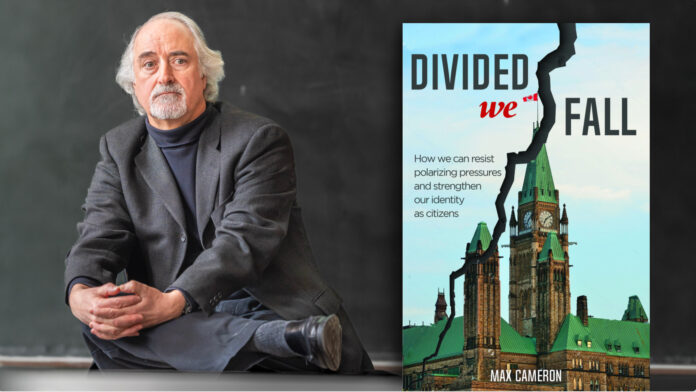
It started with a seminar on uncivil discourse and an election south of the border that nobody quite expected. For Dr. Max Cameron, professor of political science at UBC’s School of Public Policy and Global Affairs, those two moments crystallized into something larger: a question about what Canada is, what it could become, and whether its citizens are prepared to defend it.
His new book, Divided We Fall, arrives at a moment when that question feels urgent. Across the democratic world, polarization is accelerating. Institutions are under strain. And yet, Cameron argues, Canada is not simply a smaller version of the United States — it has its own political traditions, its own fractures, and its own reasons for cautious optimism.
The book is, in his words, written by a political scientist as a citizen for fellow citizens.
The Spark Behind the Book
Cameron traces the project’s origins to a Lind seminar he co-taught with Kathryn Gretsinger, associate professor of teaching at UBC’s School of Journalism, Writing and Media. The seminar examined polarization and uncivil discourse in the American context, and it left Cameron convinced that Canada needed its own version of that reckoning.
Then Donald Trump won a second term and began speaking openly about Canada as a prospective 51st state. Something shifted. Rather than fracturing along familiar regional and partisan lines, Canadians pushed back together — elbows up, as the phrase went — with a renewed sense of shared identity that Cameron found striking enough to build an entire argument around.
“Rather than becoming more polarized, Canadians suddenly became more united,” he notes. That collective reflex, however fleeting, became the book’s animating example.
What Polarization Actually Means
Cameron is careful not to treat all political division as pathological. Some degree of polarization, he argues, is not only normal but necessary in a pluralistic democracy — people enter political life precisely because they hold different visions of how society should be organized. He cites Governor General Louise Arbour’s observation that extreme consensus is as dangerous as extreme division, since genuine disagreement fuels critical thinking and democratic creativity.
The line Cameron draws is between productive conflict and what researchers call pernicious polarization — the kind where differences become so entrenched that citizens begin tolerating, or even welcoming, anti-democratic behaviour from leaders they perceive as allies. That, the historical record suggests, is almost always the precursor to democratic breakdown.
Navigating that distinction demands something specific: compassion and genuine listening, yes, but also the willingness to name and resist polarization when it is being deployed as a tool of domination rather than a natural expression of political difference.
Canada’s Position — and Its Vulnerabilities
Cameron does not offer Canada a clean bill of health. The country carries its own deep tensions — between federal and provincial authorities, between Quebec’s distinct political culture and the rest of the federation, between Indigenous nations asserting sovereignty and a constitutional order still working through what that means in practice. Regional grievances, from Atlantic fisheries policy to Prairie energy politics, are real and deserve serious attention rather than dismissal.
What Cameron suggests is that Canada’s institutional architecture — its parliamentary system, its federal structure, its tradition of negotiated accommodation — gives it tools that other democracies lack. Those tools are not self-executing. They require citizens who know how to use them.
The Responsibilities of Citizenship
This is where the book shifts from diagnosis to something closer to a civic argument. Cameron’s central claim is that sovereignty — real, meaningful sovereignty — depends on citizens who are genuinely capable of self-governance: engaged, informed, willing to enter the discomfort of political conflict rather than retreat from it.
Many Canadians, he observes, are conflict-avoidant by disposition. Politics feels negative, so people withdraw into private life. But a community that collectively disengages from its own governance is no longer, in any meaningful sense, self-governing.
The habits Cameron calls for go beyond voting, though voting matters. He points to joining civic associations, voicing opinions in public, telling stories that build social cohesion across difference, developing the skills to engage in conflict constructively, and finding ways to serve community life directly. These are not abstract virtues — they are, he argues, the practical character traits that democratic self-governance actually requires.
And despite everything, Cameron says he remains optimistic. Not naively so, but with the measured confidence of someone who watched Canadians, briefly and imperfectly, choose solidarity over division when it mattered.
About the Author
Max Cameron holds a PhD from the University of California, Berkeley (1989) and is a professor in the Department of Political Science and the School of Public Policy and Global Affairs at the University of British Columbia. Divided We Fall is available now.

