The announcement came without warning, and it landed squarely in the middle of a politically charged moment.
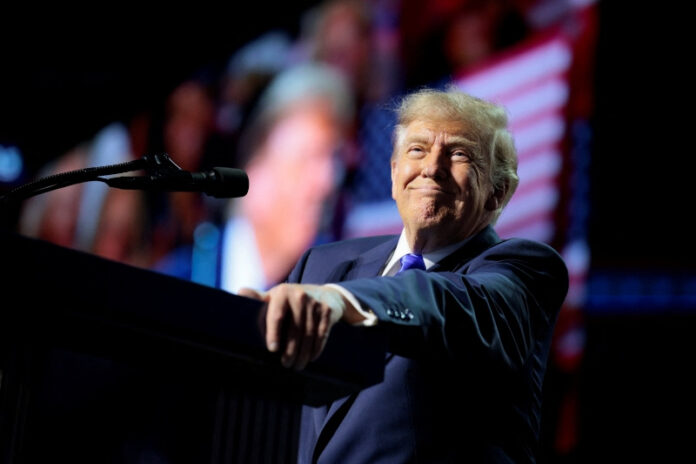
Speaking from Doonbeg, Ireland — where he was attending a golf tournament at his own club — President Donald Trump declared on Sunday that the United States should carry the world’s lowest interest rate. The statement arrived just days before the U.S. Federal Reserve was scheduled to meet, renewing long-standing tensions between the White House and the central bank over monetary policy independence.
A Promise Floated at the Convention
The interest rate remarks were not the only economic pledge Trump made that weekend. Days earlier, during a speech at the Republican Party convention, Trump had unveiled a proposal to send $5,000 payments to every American adult — a sweeping promise he repeated to reporters in Ireland on Sunday. “I don’t know but it’s easy if the Republicans win,” Trump said when asked whether Congress would need to authorize the payments. “We’re taking in so much money,” he added, suggesting trillions of dollars were flowing into the country.
The proposal drew immediate scrutiny. House Speaker Mike Johnson, a Louisiana Republican, acknowledged the same day that any such payment would require congressional approval. “Of course, the devil’s in the details. We have to figure all that out,” Johnson told CNN’s State of the Union, offering support for the idea in principle while stopping well short of a firm commitment.
Not every Republican was as accommodating. Representative Mike Lawler of New York — running in a closely contested race — declined to specifically endorse the $5,000 dividend when pressed on ABC’s This Week. “I support putting money back in the pockets of hardworking Americans,” he said, pointing instead to the tax cuts contained in the One Big Beautiful Bill passed the previous year. “But whether you call it a stimulus check or a dividend, the question is, how do you pay for it? We have a $4 trillion debt, and we have to be serious about tackling that.”
Democratic Skepticism and Pointed Comparisons
Democratic politicians wasted little time pushing back. House Minority Leader Hakeem Jeffries told ABC’s This Week that the proposal was not a “serious” one. Senator Mallory McMorrow of Michigan drew a sharper comparison, reminding viewers that an earlier promise of Affordable Care Act subsidy payments — worth roughly $1,000 per household — had never materialized after Republican legislation cancelled the underlying subsidies. “If you believe that you’re going to get $5,000, I’ve got a bridge to sell you,” McMorrow said on CNN.
Lisa Gilbert, co-president of the consumer advocacy organization Public Citizen, went further still, framing the proposal in explicitly electoral terms. “This explicit and desperate attempt to buy votes in the November election is a new low,” Gilbert said. “Trump knows he can’t do this, and yet he’s attempting to bribe voters with the false promise of cash to help his party win an election, which is antithetical to every principle of American democracy.”
The Broader Economic Backdrop
The $5,000 proposal and the interest rate comments together sketched a picture of a president eager to place his economic stamp on the coming election cycle. By calling for the lowest interest rates in the world just before a scheduled Federal Reserve meeting, Trump was openly pressuring an institution designed by statute to operate independently of political direction — a pattern that has defined much of his relationship with the central bank across both of his terms in office.
Whether Congress would ever advance a $5,000 payment scheme remains deeply uncertain. Republicans hold a narrow majority, and, as Lawler’s cautious response illustrated, fiscal concerns within the caucus have not disappeared. The Federal Reserve, for its part, has historically declined to respond publicly to presidential pressure on rate decisions, leaving the ultimate shape of both proposals — the payments and the rates — unresolved as the election season accelerates.

