
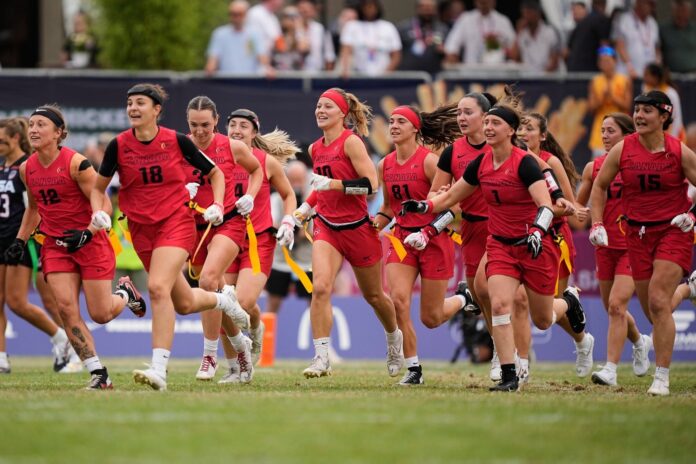
Canada has established itself as a genuine world power in flag football, and the results from the Flag Football World Championships in Düsseldorf, Germany, make the case impossible to ignore. Both the Canadian men’s and women’s national teams secured Olympic qualification for the sport’s debut at the 2028 Summer Games in Los Angeles — an outcome that reflects not a sudden surge of fortune, but the patient, deliberate construction of elite programs over many years.
The thesis here is straightforward: Canada’s double qualification is not an accident of circumstance but the logical consequence of deep football culture, sustained development infrastructure, and a pipeline of elite quarterbacks that gives the national program a structural advantage heading into the Olympics.
The women’s team made the most emphatic statement of all, defeating the United States 27-20 in the gold medal final to claim the world championship outright. That victory, against the country that invented the sport and dominates its professional ranks, signals something meaningful about where Canadian women’s football has arrived. The men’s program delivered its own dramatic proof of concept, erasing a deficit against Mexico before closing out a 34-26 overtime win to secure the bronze medal and, with it, an Olympic berth. Two teams, two paths, one shared destination: Los Angeles 2028.
What underpins this success is a quarterback tradition that Canada has quietly cultivated at both the university and professional levels. Michael O’Connor, who led the UBC Thunderbirds to a Vanier Cup championship in 2015 and subsequently played for the BC Lions, is among the central figures steering the men’s program toward the Olympic stage. “It just means the world to us to represent our country on a global stage and make Canada proud,” O’Connor said after qualifying. His presence on the roster is not incidental — it reflects how the Canadian football ecosystem, from university programs to the CFL, has become a genuine feeder for international competition at the highest level.
The possibility that BC Lions quarterback Nathan Rourke could join the men’s roster adds another dimension to the conversation. Rourke has previously expressed interest in representing Canada in flag football, and TSN analyst Marshall Ferguson has argued the format suits him almost by design. “It’s all about pre-snap reading, diagnosing and then accurate delivery,” Ferguson noted. “Well, that’s Nathan Rourke.” Whether or not Rourke ultimately joins the squad, the fact that Canada can credibly discuss adding a quarterback of his calibre speaks to the depth the program now commands.
Flag football’s growth across North America has been rapid, with participation expanding at youth and recreational levels in ways that are beginning to feed measurable elite talent into national programs. Ferguson, who has tracked Canadian football for years, frames the country’s international standing in blunt terms: “Actually, it’s something we might be the best at in the world.” That claim, which might have sounded extravagant a decade ago, now has a world championship trophy and an Olympic qualification to support it.
The implication for Los Angeles is significant. Canada’s women will arrive as reigning world champions, carrying the weight and the confidence of that title into the first Olympic flag football competition in history. The men will arrive as bronze medallists with a roster that could yet grow stronger. For a sport about to receive its largest global audience, Canada has not merely earned a seat at the table — it has arrived as one of the teams everyone else will need to plan around.

